

Pharmacists are warning a new Tennessee bill could shut down more than 100 CVS stores, including those in rural areas throughout the Volunteer State. Lawmakers say that is not the purpose of the legislation, but it is a business decision.
Senate Bill 2040 was introduced in Nashville at the beginning of the year. It passed the Senate Health and Welfare Committee 8 to 1 on February 25. It is now referred to the Senate Finance, Ways, and Means Committee. The bill would limit how pharmacy benefit managers, PBMs, operate in Tennessee. It reads in part:
“The General Assembly finds that protecting the health and welfare of Tennesseans requires access to affordable and safely dispensed prescription medications through a fair and transparent pharmacy system; and WHEREAS, increasing consolidation of pharmacy benefits managers (PBMs) with pharmacies has created conflicts of interest that can restrict patient choice, increase costs, and jeopardize continuity of care… WHEREAS, eliminating the conflict of interest inherent when a pharmacy benefits manager both sets and receives reimbursement, commonly described as the “fox guarding the henhouse,” is necessary to ensure transparent pricing, maintain trust in the pharmacy system, and promote better health outcomes for Tennessee patients…”
Senator Bo Watson in Hamilton County is one of the co-sponsors of SB 2040. Watson sits on the Health and Welfare Committee and voted in favor of the legislation on Wednesday.
“For several years now, we have been trying to figure out how best to deal with pharmacy benefit managers. It’s a really complex process. You will hear terms like vertical integration and all of that kind of stuff… About three or four years ago, we started on this process and this year this legislation, it’s a little bit more all encompassing. It has more of a direct effect on how PBM’s operate in some areas. Not in every area. This isn’t an indictment against pharmacy benefit managers. We understand the role they play in providing prescription medications. It is the business model around some of them. Not all of them,” said Tennessee Senator Bo Watson during a one-on-one interview with Local 3 News.
Pharmacy benefits managers are essentially the middlemen between patients, insurance companies, and pharmacies. According to the American Medical Association, PBMs were created in the 1960s to help insurance companies control drug spending and manage benefits.
Jacob Standefer is a local pharmacist in Chattanooga. He owns Access Family Pharmacy. He told Local 3 News that he wants the industry to be more transparent.
“I’m sure every independent pharmacist supports this bill. What it is, is it aims to divert ownership where pharmacies cannot own PBMs, because that basically is a vertical integrated monopoly. They can drive healthcare costs up through the roof and line their own pockets. There is so much cost that is being lost in the middle. The patients get to pay for it too,” said Standefer.
However, not all pharmacists support the bill. Adam Brandon is a CVS Pharmacy Manager in Jasper, Tennessee. He said it is a rural town with not a lot of pharmacy options for residents.
“I think for a lot for us CVS employees, looking at SB 2040, it’s just like the impact that it could have on us personally. Whether or not we will still be able to have jobs working for CVS… It is a big concern especially just looking across the state. I know there is 134 CVS locations that are brick and mortar buildings like this that would close. Looking at the amount of patients, which I mean last year in the State of Tennessee, CVS worked with over 1.5 million patients. I’ve had patients come in today, saying that they have concerns about what they’re seeing on the news or this bill that is going through,” said Brandon.
A spokesperson for CVS shared this statement about SB 2040 with Local 3 News:
“Senate Bill 2040 would devastate pharmacy care access and affordability in Tennessee. It endangers Tennesseans by eliminating access to 134 vital community pharmacies and the essential health and wellness products they provide. People with chronic, complex conditions will have fewer home delivery options and less access to high-touch, expert specialty pharmacies. Even our more than 25 MinuteClinic locations would close, meaning patients will have to find convenient access to acute care – for things like ear infections, strep throat, and flu – elsewhere, and more than 500 patients will need to find a new primary care provider. The bill will cost thousands of jobs for people who live and work in Tennessee. Supporting SB 2040 is supporting health care chaos for working families, seniors, and people with disabilities.”

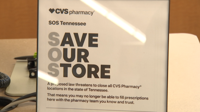
In CVS stores across the Volunteer state, there are flyers posted saying, “Save our Store”. They read, “A proposed law threatens to close all CVS Pharmacy locations in the state of Tennessee. That means you may no longer be able to fill prescriptions here with the pharmacy team you know and trust.”
CVS’s practices are just one of several companies being called into question in SB 2040. At the beginning of February of this year, the state of Tennessee’s Department of Commerce and Insurance released a 20 page report. The report looked at Caremark’s operations, a pharmacy benefits manager and subsidiary of CVS Health. Some of it’s key findings include:
Caremark reimbursing its own CVS pharmacies higher rates for some medication sometimes a 16,000% higher rates
Caremark charged plan sponsors more than it paid pharmacies
Caremark failed to pay required fees to low volume rural pharmacies
Senator Watson responded to CVS’s comments of having close stores should SB 2040 pass.
“This bill does not shut down retail pharmacies. Now, because this bill prohibits or may prohibit certain business activities, around retail pharmacy, a business may choose to shut down because they don’t like the fact that they can’t continue with this business model. But, this bill does not shut down pharmacies. That is a decision that CVS or anyone else would have to make for themselves,” said Senator Watson.
A similar bill was signed into in Arkansas last year. However, a federal judge temporarily blocked it citing it may violate the U.S. Constitution’s Commerce Clause.