
Welcome to Prefab Profiles, an ongoing series of interviews with people transforming how we build houses. From prefab tiny houses and modular cabin kits to entire homes ready to ship, their projects represent some of the best ideas in the industry. Do you know a prefab brand that should be on our radar? Get in touch!
About a decade ago, architect Samuel Gonçalves was asked to lend his expertise to an idea for a prefab product. A smattering of other experts within fields like automation, HVAC systems, and carpentry built on what Gonçalves created, but there was one problem: the idea never got off the ground. “Nevertheless, that was the moment I was confronted with prefabrication,” Gonçalves says. “That very same year, I quit my job and founded Summary.“
Since then, with his new prefab home-design business, Gonçalves has prioritized speed, ingenuity, and style with his homes, most of which are in Portugal. In his latest project, a single-family home, Gonçalves and his team crafted an exterior envelope from composite panels made of recycled rice husks, which act as insulation and cladding. Here’s why the architect is experimenting with the biomaterial.
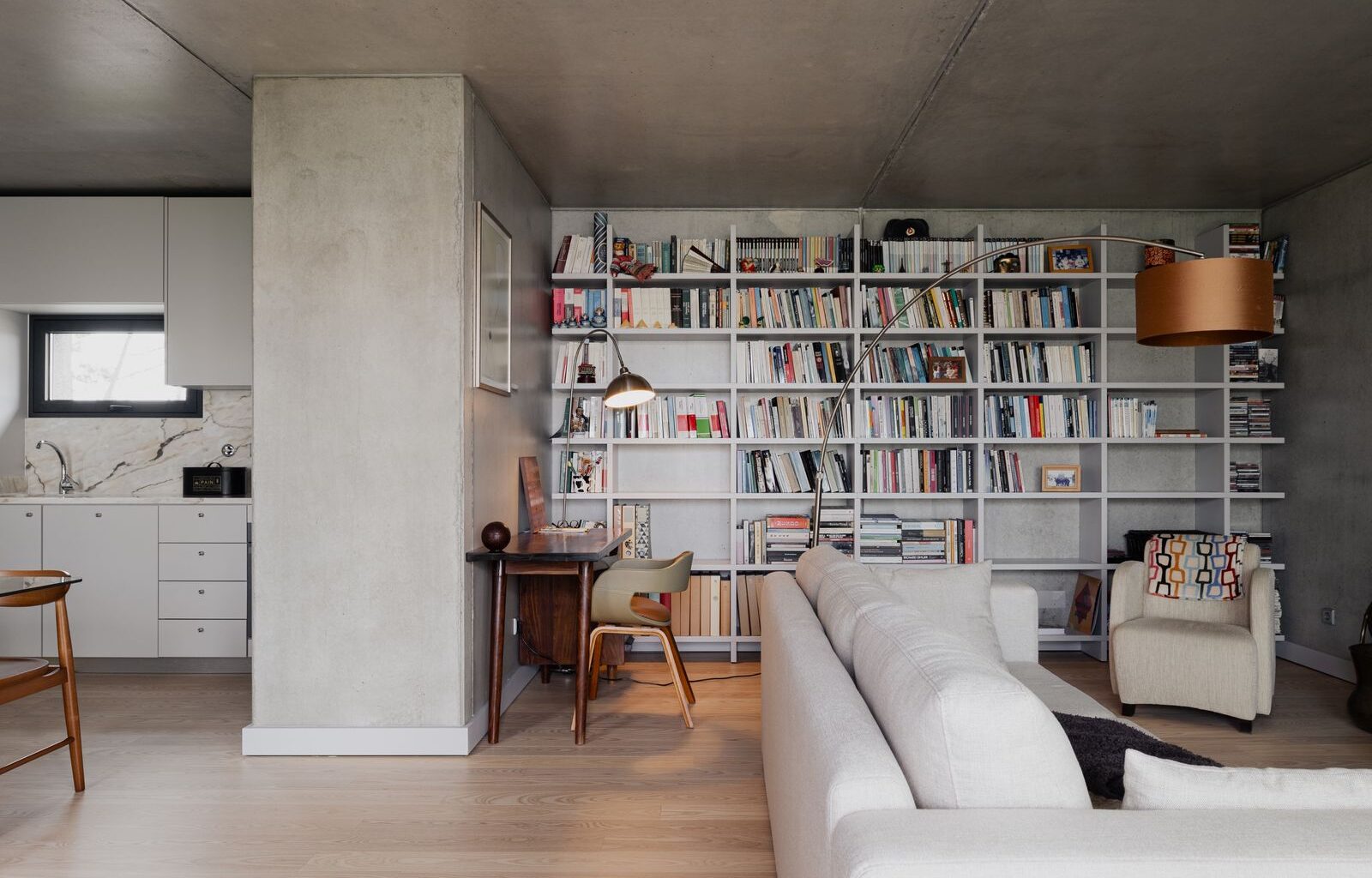
Architecture studio Summary created a residence in Esmoriz, Portugal, using a modular system that’s finished with composite panels made from rice husks.
Tell us about this home. Why rice husks?
It is a single-family home that’s a prototype exploring the potential of combining industrialized construction methods with the use of biobased materials. We generally prefer to work on collective housing projects, but there is a degree of openness to experimentation that you can only find in small, bespoke projects like this.
Each module leaves the factory containing structural reinforced concrete and an outer layer of cement-based composite incorporating rice husk. This material—an agro-industrial byproduct typically discarded or burned—is locally sourced from the rice fields of the Lower Mondego region and transformed into a biobased construction material.This 23 cm-thick rice husk layer serves as both exterior cladding and insulation.
The team at Summary hopes that the home can serve as a model for further experimentation with biomaterials.
What do your homes cost? Can you provide some context around pricing?
So far, the different projects we’ve built range from about €95 to €185 per square foot. The building systems represent only a part of the overall construction cost, however. Variables such as the finishes, the location, the distance from the factory, the soil conditions, the level of repeatability, or the size of the project play a crucial role in the determination of the price.
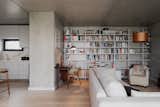
The interior’s open floor plan features cozy details like floor-to-ceiling shelving.
How do your prefab designs stand apart from others?
They don’t. We see prefabrication as an ecosystem of ideas. This means that similar ideas are developed by different architects and manufacturers, some of which are realized more effectively than others. For example, some of our designs result from the direct influence of existing projects, such as the Airoh House, the St. Andrews Student Residence (by J. Stirling), or the IBM Building (by Miguel Fisac).
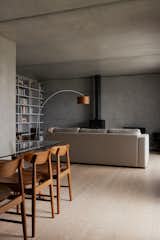
The rice-husk composite panels have a cementlike texture that lend itself to Summary’s minimalist style.
How long can a client expect the process to take after they put down a deposit?
It depends on the scale and specifications of each project. For example, 14 emergency houses we’re currently working on are planned to be assembled on-site in four months. In cases like that, speed is the main advantage, rather than price, which is typically equivalent to traditional construction.
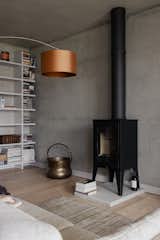
This home has an L-shaped layout that separates the private and public spaces of the home.
What aspects of an install do you manage?
We manage design and permitting. The site work and manufacturing are conducted by other companies, some of which we already consider our partners. Focusing on design and distancing ourselves from the manufacturer allows us to achieve a certain independence, which we think benefits the architecture.
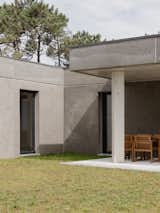
This home’s exterior is made from recycled rick husks, which also act as insulation.
What aspects of the design can a client customize?
All of them, depending on the specifics of each project.
More Prefab Profiles: