
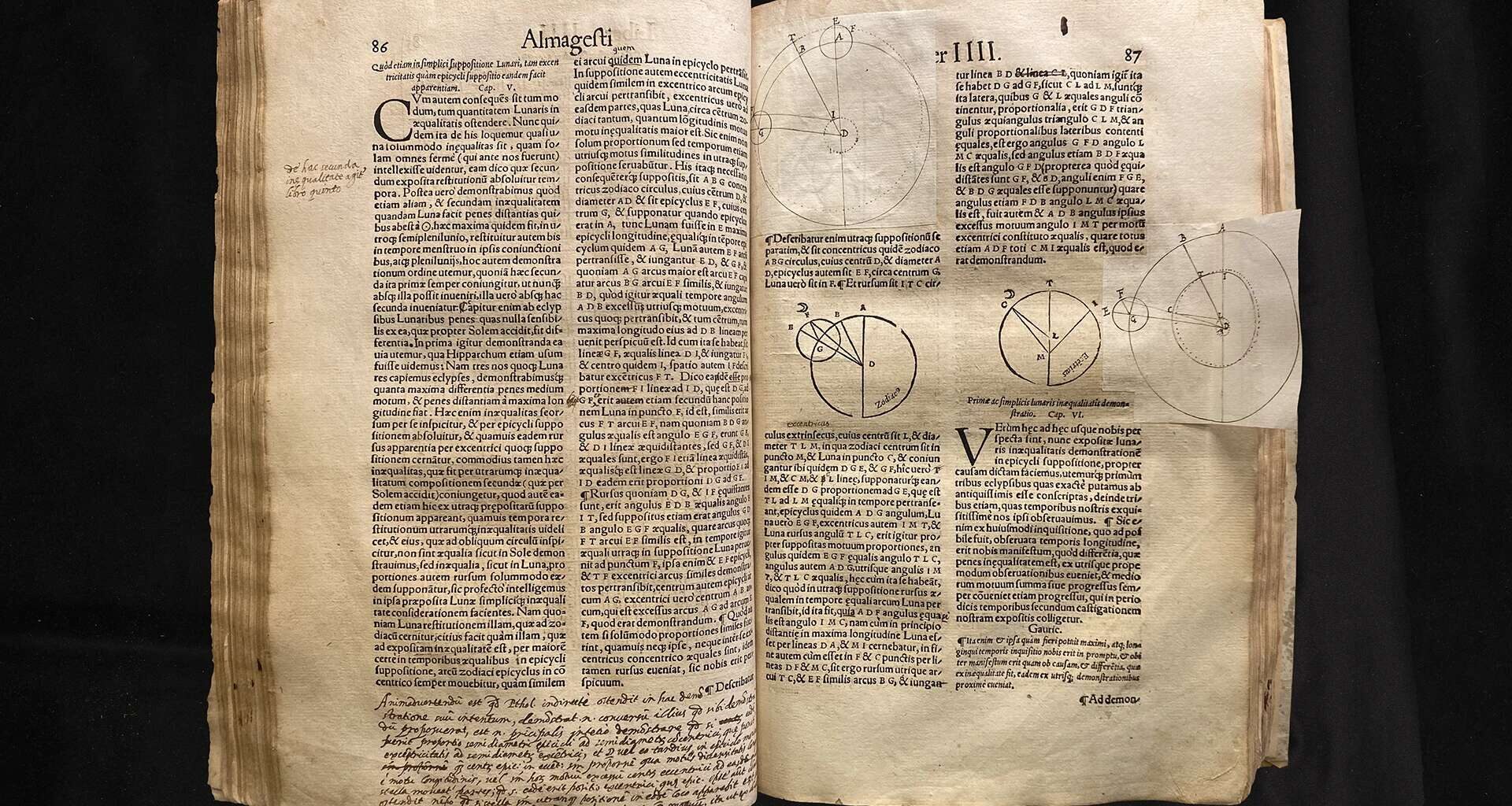
A historian examining a rare Renaissance-era astronomy book has uncovered handwritten notes believed to belong to Galileo Galilei, offering a rare look into how the famed scientist studied earlier ideas about the universe.
The discovery of Galileo’s handwritten notes was made by historian Ivan Malara while reviewing a 1551 Latin edition of The Almagest at the National Central Library of Florence in January.
The influential text was originally written in the second century by the Greek-Egyptian astronomer Claudius Ptolemy. For more than 1,400 years, the book shaped Western understanding of the cosmos with its geocentric model, which placed Earth at the center of the universe.
While studying the volume, Malara noticed an unusual feature on a blank page: a handwritten copy of Psalm 145. The writing style immediately drew his attention because it appeared similar to Galileo’s handwriting. A closer inspection of the book revealed numerous detailed notes written along the margins of several pages.
These annotations, written in tight script beside the printed text, seemed consistent with Galileo’s style and methods of studying scientific works.
Scholars verify the handwritten notes
After documenting the discovery, Malara consulted several experts on Galileo’s writings to verify the findings. Among them was Michele Camerota, a historian at the University of Cagliari who specializes in Galileo’s life and research. Camerota reviewed the handwriting and concluded that the notes strongly appear to be authentic.
Experts connected with the Galileo Museum and the Florentine library also compared the writing with known manuscripts produced by Galileo. They examined handwriting patterns, abbreviations, and annotation techniques. According to the researchers, these features closely match Galileo’s documented writing habits.
Malara believes the notes were written around 1590, when Galileo was still a young scholar. This period came years before his groundbreaking telescope observations of the Moon’s surface and the moons of Jupiter, discoveries that later helped challenge traditional ideas about the universe.
The notes suggest that Galileo carefully studied Ptolemy’s mathematical explanations before eventually questioning the geocentric model that dominated scientific thinking for centuries.
Discovery reveals the early stage of Galileo’s scientific thinking
Some of the marginal comments resemble arguments that Galileo later used in his own scientific works from the same period. The biblical passage written inside the book also gained historical meaning through other records.
Malara found that another 16th-century copy of The Almagest includes a note stating that Galileo prayed before studying the text. A letter written in 1673 by mathematician Alessandro Marchetti also mentioned that Galileo prayed before reading the book.
Historians say the newly identified annotations show that Galileo deeply examined earlier astronomical theories before supporting the heliocentric model proposed by Nicolaus Copernicus. That theory argued that Earth and other planets orbit the sun, a view that later brought Galileo into conflict with the Catholic Church and led to his house arrest in 1633.
Malara plans to publish a detailed academic study of the notes in the Journal for the History of Astronomy, where researchers will further analyze how these early annotations shaped Galileo’s scientific development.