
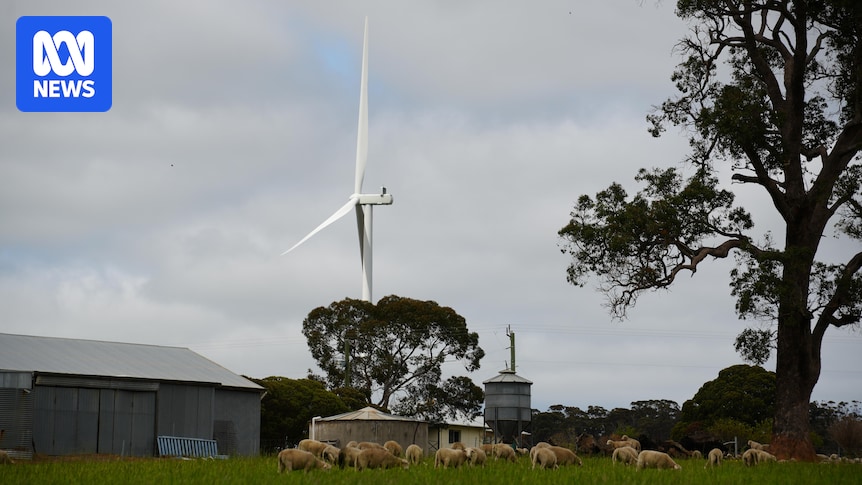
The West Australian government wants to make new wind and solar farms pay into community funds, but host towns say more work needs to be done to make sure the payments actually happen.
Shires in regional WA have cautiously welcomed new guidelines outlining what renewable energy developers should pay to the communities where the projects are being built.
The plan will apply to wind, solar and standalone battery energy storage system projects that connect to the South West Interconnected System.
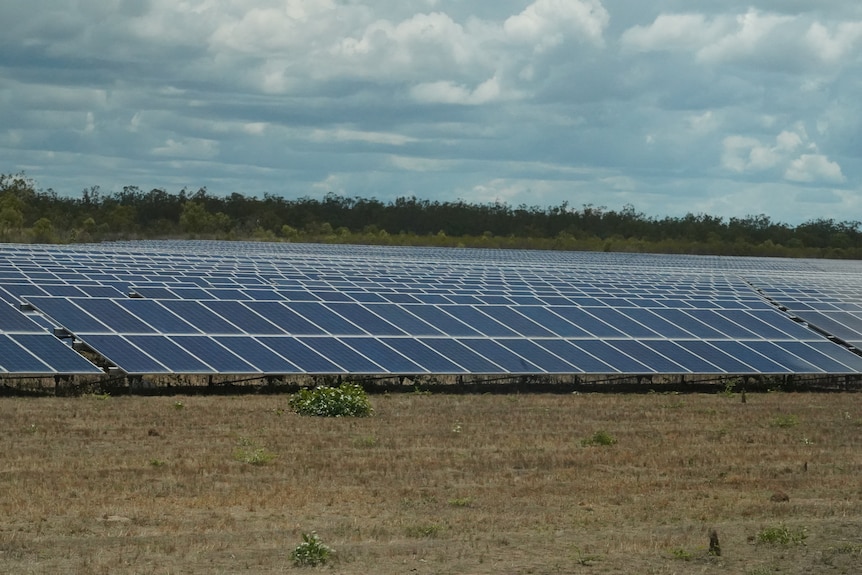
The draft guidelines were released for consultation in August last year. (ABC News: Emily Dobson)
Renewable projects worth billions of dollars are proposed throughout the state and the WA Local Government Association has put forward a submission on the draft guidelines on behalf of 40 local governments.
The Shire of Gnowangerup in the south is one of the regional areas earmarked for wind farms.
Shire chief executive David Nicholson said the guidelines were a good start, but pointed out that they were not mandatory.
“It’s not legislation, it’s not law — no-one has to comply with it,” he said.
“We’ll provide them with feedback and, whilst the guideline is in place, I will certainly have conversations with appropriate decision-makers.”

David Nicholson says it is important a strong governance structure is put in place. (ABC Great Southern: Andrew Chounding)
Under the guidelines companies will pay a set price to communities based on the annual maximum energy generation capacity of an operation.
For wind power, that would range from $15,000 for a 10-megawatt project to $1.75 million for a 2-gigawatt project.
For solar, payments will be calculated at $750 per megawatt.
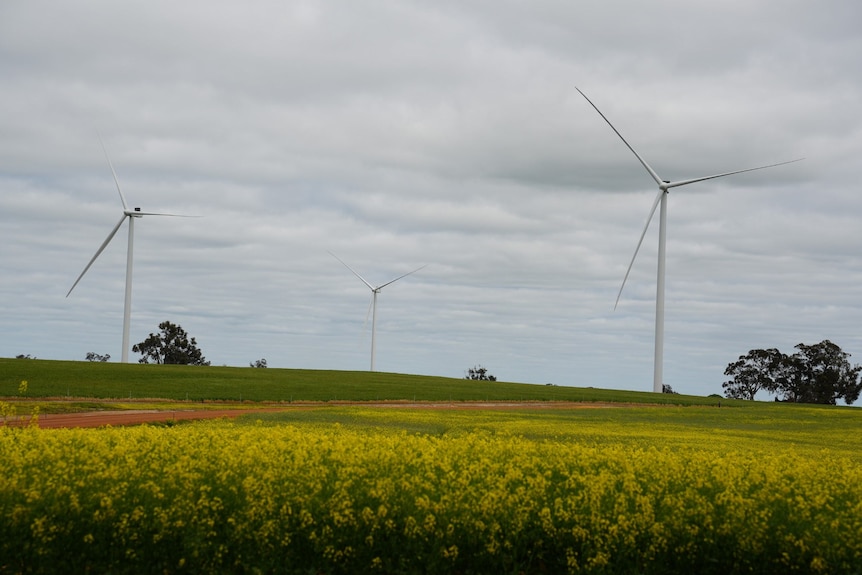
Flat Rocks Wind Farm in Kojonup is one of the state’s newest renewable energy projects. (ABC Great Southern: Andrew Chounding)
“Compliance will be encouraged through existing mechanisms such as eligibility for the Commonwealth government’s Capacity Investment Scheme,” the guidelines state.
“The state government may consider mandating the standards outlined in this guideline in the future if required.”
WA Shadow Energy Minister Steve Thomas said recommending payments was not enough.
“The question is whether the government can enforce its ‘recommended’ community payment,” he said.
Managing the money
Further north, the Shire of Victoria Plains is one of the local governments selected to participate in a pilot program to help work through how the guidelines will be implemented.
Shire President Pauline Bantock said directing the funds to local priorities was key.
“This isn’t going to happen overnight, and it’s not necessarily funds that are directed straight into local government,” she said.
“That’s what’s going to come out of the pilot projects and working with the state government and the advisory committees on what’s best for local communities.”
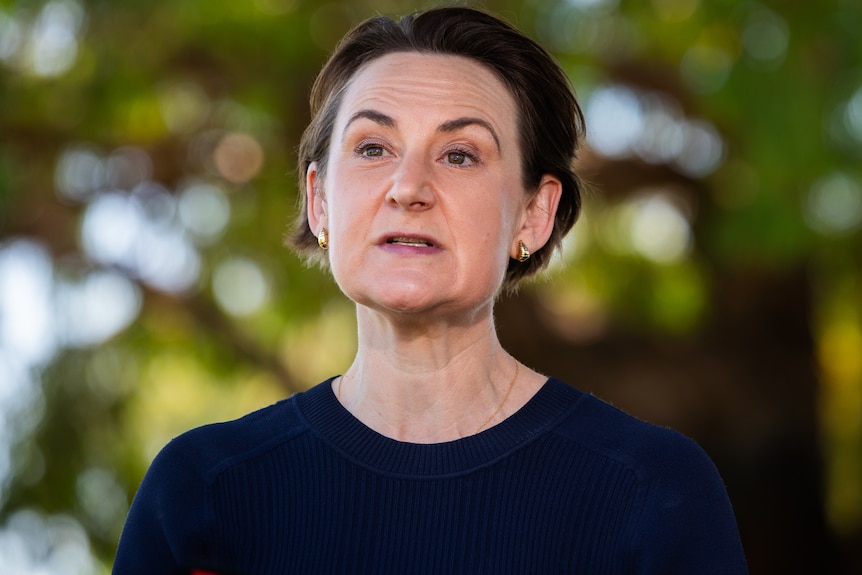
Amber-Jade Sanderson says the guidelines have been informed by extensive community consultation. (ABC News: Keane Bourke)
Mr Nicholson said a strong governance structure was necessary to distribute the funds.
“We’re talking, in some cases, a lot of money, and if that money is going to communities, which obviously is the intention, how is that going to be managed?” he said.
“The other part was making sure that it’s equitable, that everybody in the community that’s impacted, in fact, the broader community, get some remuneration or some benefits through this.”
WA Energy Minister Amber-Jade Sanderson said the guidelines would help to ensure long-term benefits in regional areas.
“This guideline ensures that, as WA builds the infrastructure we need to deliver our sustainable energy future, we are also supporting the communities that host new renewable energy projects,” she said.