
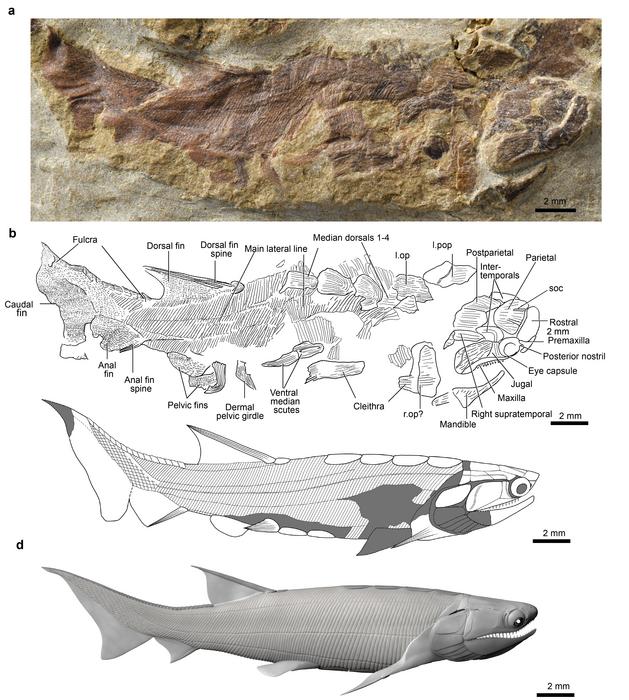
 Fossil and reconstruction of Eosteus. Image Credit
Image by IVPP, CAS
Chinese paleontologists have discovered the world’s oldest complete bony fish fossils, dating back 436 million years. These specimens, including the tiny Eosteus and the predatory Megamastax, reveal the early evolution of jaws and teeth that define nearly all modern vertebrates.
A landmark pair of cover stories published in Nature on March 4, 2026, has settled long-standing questions about the origins of bony fishes—the ancestors of 98% of all living vertebrates, including humans.
A research team from the Chinese Academy of Sciences has unearthed the oldest known complete fossils of bony fishes in southern China. These findings fill a critical gap in the “from fish to human” evolutionary timeline, showing that the core features of modern vertebrates evolved millions of years earlier than previously believed.
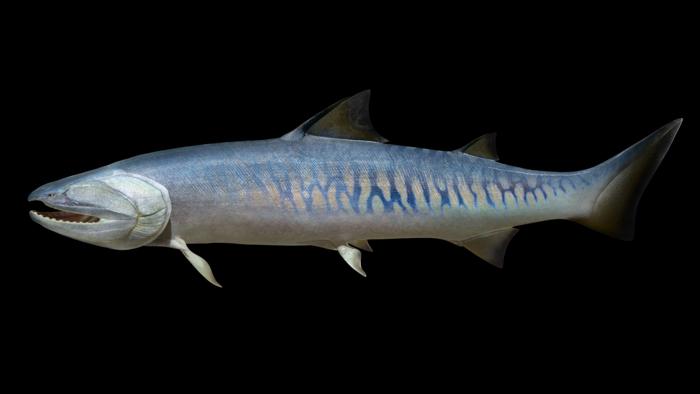 Life reconstruction of the biggest Silurian vertebrate Megamastax amblyodus.
Credit Image by NICE PaleoVislab, IVPP
Discovery of the global “oldest” fish
The team identified a new species, Eosteus chongqingensis, in 436-million-year-old deposits in Chongqing. Measuring just three centimeters long, this tiny specimen is the oldest complete bony fish fossil ever discovered. Despite its small size, it provides a “mosaic” of features that link early jawed vertebrates to modern fish.
While Eosteus has the streamlined body and scales of a modern fish, it also possesses anatomical traits previously seen only in extinct cartilaginous fishes and armored placoderms. This combination suggests it sits at the very base of the bony fish family tree, existing just before the major evolutionary split into ray-finned fishes (which make up most modern species) and lobe-finned fishes (the group that eventually walked onto land).
The “Big Mouth” of the Silurian
In a second study, researchers used high-resolution CT scanning to reconstruct the skull of Megamastax amblyodus, a giant of its time found in Yunnan. At over one meter long, Megamastax was the largest vertebrate of the Silurian period (roughly 423 million years ago).
By creating a 3D digital model, the team revealed an intricate set of “tooth cushions”—blunt, grinding structures—inside its jaw. This discovery resolves a 50-year-old debate about isolated fossil teeth found in Europe, confirming they belonged to primitive bony fish. The large size of Megamastax also challenges the idea that early vertebrates were exclusively small, suggesting instead that a complex predator-prey ecosystem existed long before the “Age of Fishes.”
South China as the cradle of life
The back-to-back studies reinforce the theory that southern China was a primary center for early vertebrate evolution. These fossils provide a rare look at the ancestral anatomy shared by all modern bony creatures.
By identifying these “stem” species, scientists can now map how complex jaws and teeth first formed. These discoveries do more than just add new names to the fossil record; they clarify the trajectory of the lineage that ultimately led to the human body plan.