
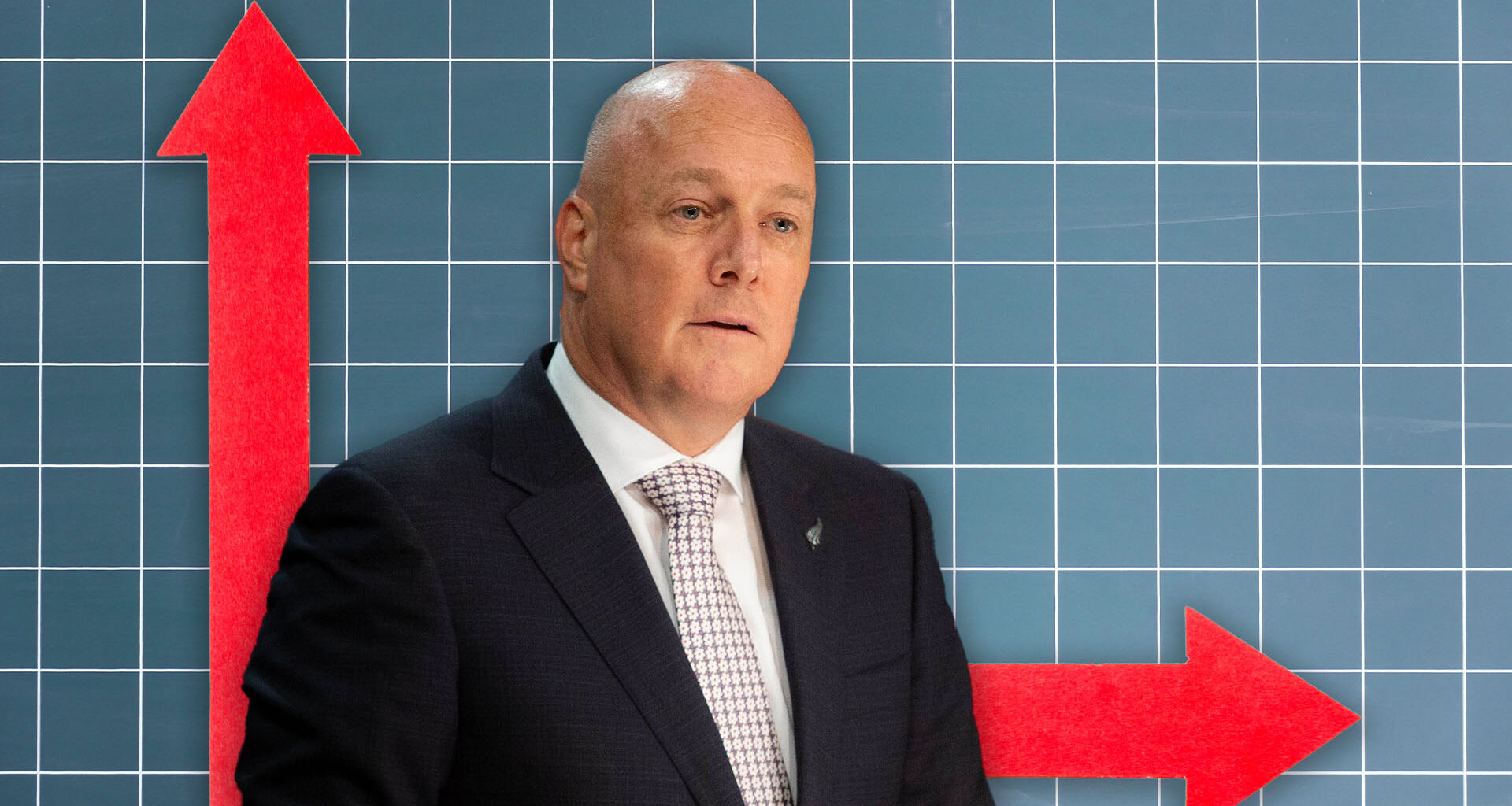
Prime Minister Christopher Luxon is rejecting widespread talk about his leadership future as pressure mounts on the National Party following a damaging new poll.
Speaking on Newstalk ZB, Luxon said all of his ministers back him and none were telling him to consider his future. A rumour circulating widely was that Luxon would consider his options over the weekend.
“The only thing I’m considering is the future of our kids and our grandkids and that’s why I came to politics,” he told ZB, saying he thought the media had got “carried away”.
It follows his party’s disastrous 28.4% poll result released on Friday in the latest Taxpayers’ Union-Curia Poll taken earlier this week.
Earlier on Friday, political commentator Ben Thomas, who previously worked for the National Party, described the result as – “not great”.
“That mark under 30, it’s obviously a psychological inflection point, but more importantly it changes the complexion of National’s outlook for the election.”
“So on 30%, 32% say, as they’ve [been] on a number of polls – historically a very low result for National but at the same time, the continuation of a National-led coalition government. [But] when National gets down to 28% without a corresponding increase in its coalition partners, then you’re looking at a historically low result and being turfed out of Parliament after one term,” Thomas said.
“That obviously puts a very, very different lens on it.”
One Plus One director of government relations Esther Robinson, who previously worked for the Labour Party, said it was a poll that National couldn’t afford to ignore.
“As the backbenchers head back to their electorates this weekend, many will know that based on these numbers their jobs are at stake on Saturday, 7 November,” Robinson said.
“With support in the high-20s, a turnaround strategy is still possible for National, but intervention is needed.”
“While smaller parties will play a decisive role in determining who forms the next government, the group of undecided voters remains significant this far out from an election. It suggests neither of the major parties has yet done enough to capture the attention of the voters who will ultimately decide the outcome,” said Robinson.
Thomas said while the tangible effect of National heading into the election on a poll number “that is so much lower than they got in 2023 is obviously first of all, MPs in marginal seats are very much at risk”.
“And MPs on the list, which, because of the low number of MPs they got on the list in the last election, are very generally senior ministers, Nicola Willis, Paul Goldsmith, the speaker [Gerry Brownlee] … they’re the members of caucus who are most likely to be spooked by low polling numbers.”