
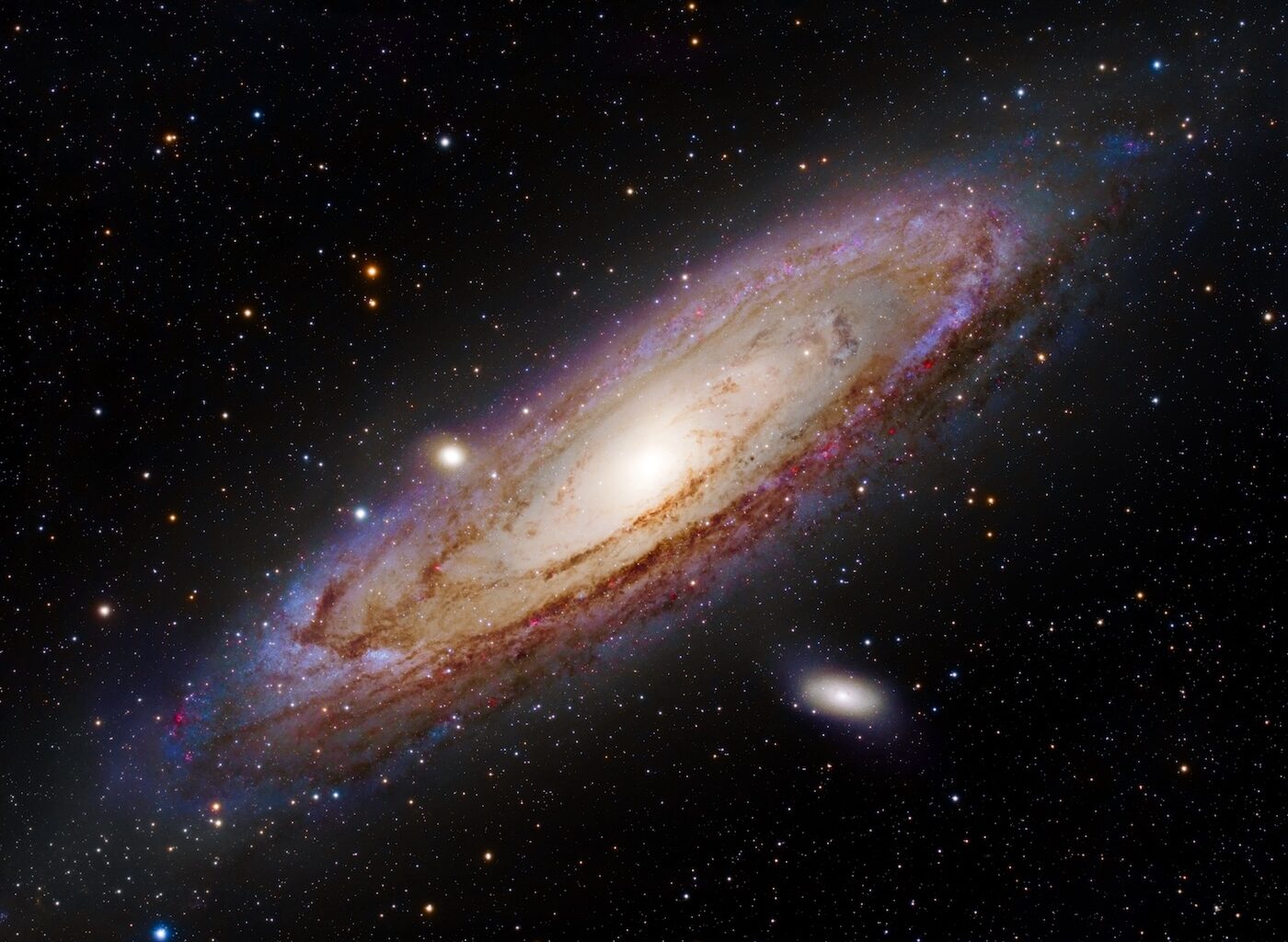
FLORA LICHTMAN: Hey, it’s Flora Lichtman, and you’re listening to Science Friday. As you know, we live in the Milky Way Galaxy, one of an estimated 200 billion galaxies out there. You know the pictures. You’ve seen them, the cloudy, beautiful spirals. Well now, a new book takes these images to a higher dimension. Islands in Infinity– Galaxies 3-D brings space to stereoscopic life, turning those flat, galactic postcards into three-dimensional spacescapes.
I’ve got the authors with me. Dr. Derek Ward-Thompson is an astrophysicist at the University of Lancashire in England, and astronomer Dr. Brian May, he’s had a circuitous career in astronomy because he was busy for 30 years, you know, doing this.
[QUEEN, “WE WILL ROCK YOU”]
– We will we will
Rock you
We will we will
Rock you
FLORA LICHTMAN: Yes, Brian May, as in the guitarist of Queen, that Brian may. Welcome to Science Friday. Thank you so much for being here.
DEREK WARD-THOMPSON: Thank you for inviting us.
BRIAN MAY: Thank you, Flora.
FLORA LICHTMAN: OK Brian, I don’t know if this is charming or embarrassing, but I think, on this show, your astronomer credentials may hold as much weight as being in one of the most iconic bands of all time. So thank you for coming to nerd out with us today.
BRIAN MAY: Thank you, Flora. It’s my pleasure, absolutely. And I’m very proud of the book, and I’m glad you like it. I had a great time creating it with Derek here, and with J-P Metsavainio, our Finnish genius friend, who converted these, as you say, flat pictures, normally, of galaxies into wonderful, three-dimensional representations, which really are very true to life. And yeah, it’s a first.
FLORA LICHTMAN: It’s a first. Is that true?
BRIAN MAY: There has never been a stereoscopic book on galaxies before, no, never ever. And the reason is clear– it’s very hard to do. You can’t go out with a stereoscopic camera, with a 3D camera, and take pictures of galaxies. You have to do it another way. And it’s a magic process that J-P has pioneered using the available data on the spatial setup in each of these galaxies.
FLORA LICHTMAN: I mean, Derek, you’re an astrophysicist. You focus on star and planet formation. What interests you about these images?
DEREK WARD-THOMPSON: Oh, it’s just amazing. I mean, I’ve been looking at stars and galaxies since my PhD, over 40 years ago. And this is the first time I felt as if they’re literally jumping out of the page at me. And actually, OK, you might be able to guess what their structure is from looking at a picture. But it’s only when you see them in these stereoscopic images that you really, really get a feel for how they genuinely look, how they feel. It’s almost like holding them in your hand. It’s quite remarkable, it really is. J-P is a wizard.
FLORA LICHTMAN: I mean, they are. They’re mesmerizing to look at. And it’s funny, because I’ve looked at space imagery for decades in this job. And then to realize that the shapes are actually quite different from what I had pictured in my mind– I always imagined them as flat, because that’s how they looked.
BRIAN MAY: Yeah.
DEREK WARD-THOMPSON: Yep.
BRIAN MAY: Yeah, even the most familiar ones, it’s a shock, isn’t it? When you see M31– we’ve all seen countless pictures of M31. But the same for me, until you actually see it in 3D, you don’t have the right image in your head. You don’t have the right understanding of the way it ticks.
FLORA LICHTMAN: Derek, can you learn something new by seeing these images in 3D? I mean, is it telling us anything scientifically?
DEREK WARD-THOMPSON: Oh, yes. In the book, we try to demonstrate the full range of what galaxies look like. And in particular, there’s one chapter in the book where we talk about so-called interacting galaxies. These are galaxies in the process of colliding with each other. And you look at those two-dimensional pictures, and it’s sort of difficult to figure what’s going on. You see it in three dimensions, and suddenly you see the whole train wreck of these galaxies that are literally tearing each other apart. And there was one in particular where we’ve contributed to the debate about how the collision is taking place.
FLORA LICHTMAN: Wow, that’s cool. Brian, I know you have a long relationship with stereoscopy. How did this come into your life?
BRIAN MAY: Well, it goes back a long way, to when I was a kid eating my breakfast cereal. And in those days, you used to get toys with your breakfast. It doesn’t happen anymore now. It’s rather sad. But with Weetabix, you used to get little cards, at one point, which had two little images on them. And I remember taking this one picture out of the packet, and it was of a hippopotamus. But there’s two images of it. And each of the images is flat.
And it says on the back, send away a packet top and one and sixpence, and we will send you a stereo viewer. So then you can look at these things as they’re meant to be seen. This is what I did. In the post comes the viewer. I pop in the hippopotamus. And suddenly, the thing isn’t two to flat pictures anymore, it’s one picture. And it’s so three-dimensional, I feel like I could fall into the mouth of this hippo. It’s incredible. I could almost smell the breath of this animal.
So I think to myself, if this is what can be done in three dimensions, why does anybody bother with two-dimensional pictures? Why isn’t everything in 3D? So it’s a really life-changing moment for me. And truly, I’ve never lost that excitement. It always seems to me, if you can see it well in 2D, you can see it a whole lot better in 3D. And that’s the inspiration for where I am now with Derek.
Now, I don’t have any genius about this. My only genius is bringing Derek and J-P together, which is a masterstroke. Because it’s not just a picture book. You have this genius who can make pictures in 3D, coupled with one of the world’s greatest experts on galactic evolution, which is Derek. And I thought I knew about galaxies. I didn’t, until I started writing this book with Derek. And every time we ventured into a new page, I learned something more.
So to me, this has been a wonderful voyage of discovery. And marrying these pictures with this incredible knowledge, very up to date knowledge in galaxies, has been completely eye-opening for me. And that’s what I hope will happen to you, and anyone who opens this book. I hope your eyes will be opened to the universe in three dimensions.
FLORA LICHTMAN: Derek, I watched a video of you showing people pictures in 3D. And you can hear people responding. There were literal oohs and aahs in the audience.
DEREK WARD-THOMPSON: Yeah.
FLORA LICHTMAN: I mean, beyond the science, is this about pleasure, the pleasure of seeing space in a different way?
DEREK WARD-THOMPSON: It’s the pleasure of scientific discovery that I’m sure all your listeners can relate to, learning something new. I learn something new every day. Brian’s being far too modest, by the way. He basically translated it from Nerdese into English so that the idea is that everybody can understand it. It’s not just a book for the scientific expert. It’s a book for everyone. And what we hope is people will pick it up and go, ooh and aah, as you said, and then pause to read some of the words, and actually learn along the way as well.
BRIAN MAY: I’m so glad we did this. I’m so glad we did this interview. I’m going to cherish that quote forever. Thank you.
FLORA LICHTMAN: Nerdese– translating Nerdese.
DEREK WARD-THOMPSON: That’s true.
BRIAN MAY: That’s my job. That’s my job. That’s my job specification.
DEREK WARD-THOMPSON: We had lots of fun writing the book together. We had lots of fun in our little team. It was great.
FLORA LICHTMAN: You can tell. You can tell you all were having fun. This is the perfect segue. Because after the break, I want to talk about the collision of art and astronomy. Stick around.
Brian, let’s go back to your salad days. You said, growing up, that you were told that you couldn’t do both art and science. What did you hear, exactly?
BRIAN MAY: Yeah, that’s exactly what I was told. There were points in my school days where they said, you have to choose now, between this and this. There were always choices between art and science. And I always felt that I did not want to be abandoning one for the other. And that’s kind of been my whole life. Because I think the complete person, the complete human being, has to understand both art and science. They have to understand the beauty of the universe, and they also have to understand the way it works.
They have to understand people. People are part of the universe. People are artistic creatures, as well as scientific creations, if you like. So it all intermingles. And people that I’ve met, more and more, are understanding this. A lot of the greatest scientists throughout history were actually great musicians, or in some cases, other kind of artists, including my great friend Patrick Moore, who’s an inspiration to all of us. He was a great scientist, but also a fantastic musician and composer.
But you look at Sir Isaac Newton, he was a musician. So it’s not a new idea, but it’s an idea which I think got lost when I was growing up. The previous generation somehow got separated into art and science, and I think it was damaging. I think human beings need to be able to do both, and to be able to enjoy both sides of their nature.
FLORA LICHTMAN: I agree completely. Derek, where do you fall on this?
DEREK WARD-THOMPSON: Oh, absolutely. And Brian gave the example of music. And music is, in fact, highly mathematical, follows very strict mathematical rules. And actually, to understand music, you have to understand the mathematics of the rhythm, and of the frequencies, the overtones. It’s all pure maths and applied physics.
BRIAN MAY: Yeah.
FLORA LICHTMAN: I mean, Brian, let’s go– I want to go to this moment in your life where your musical career is blasting off, and you’re trying to do a PhD, which seems just very difficult to me. What was that like?
BRIAN MAY: Yeah, it’s difficult. It was. Yeah, I’m trying to do the two things at the same time. I’m also trying to teach because I have no money. And the money from my PhD has run out, so I’m teaching at a comprehensive school in Brixton. So I’m doing this. I’m trying to get the group going. And the group is looking hopeful, but at the same time, we don’t have any contacts. We don’t know how to break into the world of music.
And I’m trying to finish off my PhD, which is increasingly hard because my supervisor doesn’t really think I’ve got it in me. I think I can sum it up that way. I’d written up most of my work. And he kept coming back and saying, well, you could just do a bit more on this and a bit more on this. And I’m thinking, OK, that’s another three years’ work he’s suggesting there. So I’m feeling more and more that this is never going to happen.
And I have to make the choice of where my life’s going to go at this minute. And I made the choice to jump into playing guitar around the world. And I think it was a good decision. I remember saying, at the time, this is going to be a good decision for science because I’m obviously not good enough. But hopefully, it’s a good decision for music as well.
FLORA LICHTMAN: I think many, many millions, if not billions, of people thank you for that decision that you made.
BRIAN MAY: Bless you.
FLORA LICHTMAN: Derek, do you think scientists could learn something from musicians?
DEREK WARD-THOMPSON: Oh, definitely. Definitely, and from our artists generally. And that is how to communicate. Scientists are very good at inventing our own language and behaving like a sort of high priesthood. And you have to be initiated into the secrets of our science before you’re allowed to participate. I mean, that’s been changing in the last couple of decades, but it certainly used to be more like that.
But we still need even more– I spent quite a lot of time trying to pass on the excitement that we feel about science. Because the other aspect about schools is they can make science seem very fusty, and boring, and hard work, when it should be fun.
FLORA LICHTMAN: Yeah.
DEREK WARD-THOMPSON: And I think that’s something that artists do very, very well.
FLORA LICHTMAN: Did you have a perspective on that, Brian, the idea that could can musicians learn from scientists, or scientists learn from musicians?
BRIAN MAY: I think it’s part of a bigger picture. I feel that we live in very dangerous times because it’s hard to find the truth. And it’s much easier to propagate mistruths on the internet than it is to– for some reason, it’s more exciting to propagate misinformation than the truth. And it concerns me greatly because we’re seeing science being submerged in a welter of superstition. And we seem to be going backwards in many ways. I think you get more views for saying the Earth is flat, or people didn’t go on the moon, and all this sort of stuff.
And that’s a whole mass of nonsense to make your way through if you’re a kid now. So it’s our responsibility to give kids an inquiring mind so that they find out, for themselves, what the truth really is. So music is a help in that. Music is part of that. Music opens people’s minds and brings people together. And we have to get away from this kind of polarization culture that we seem to have at the moment.
It’s good to discuss. It’s good to have alternative points of view. But out of those discussions should come an awareness of truth, not just scientific truth, but universal truths, human truths. And the ideas of compassion, and mercy, and decency, justice are embodied in those discussions. And I would like to see more of that. And I think it’s our responsibility as a generation to try to bring that back.
FLORA LICHTMAN: As we’re talking about music opening people’s minds and bringing people together, we have to talk a little bit about one of my favorite songs, Don’t Stop Me Now–
[QUEEN, “DON’T STOP ME NOW”]
– Don’t stop me now
FLORA LICHTMAN: –which uses space as a metaphor for pleasure.
– Having a good time
I’m a shooting star
Leaping through the sky like a tiger
Defying the laws of gravity
FLORA LICHTMAN: Did you have anything to do with those lyrics?
BRIAN MAY: No. In fact, I kind of berated– I remember berating Freddie for saying that he was traveling at the speed of light. I go, Freddie, you cannot travel at the speed of light, I’m sorry. And he says, I don’t [BLEEP] care.
– I’m traveling at the speed of light
I want to make a supersonic man outta you
BRIAN MAY: Sorry for my French, but you can’t really quote Freddie without using those words. But it’s all about fun and joy, yeah. And I stayed out of it. I always worried, actually. Because being such a hedonistic thing, there were dangers to living a hedonistic lifestyle at that time. And I remember being a bit of a schoolmaster, a bit of a geek myself. I felt worried for Freddie at that time, which is part of my reservations about the song.
Now, I look back and see the song, and I think it is a work of genius. Because it takes you away from– it takes you above those questions. And it becamse– it’s funny, it didn’t immediately become a huge hit. It had a slow burn. And now it’s become one of Queen’s best known songs around the world. And it’s universally played at hen nights, and stag nights, and God knows what, funerals, births, weddings. So it’s got to be a great song, and I appreciate that. And I’m happy that I was at least something to do with it.
FLORA LICHTMAN: Yeah, I mean, it strikes me that space provides a place for our imagination to go when we feel, perhaps, imprisoned or constrained by our life on Earth. And that’s what I love about it.
BRIAN MAY: Hmm. I’ve found it very helpful at certain times. Particularly when I was deep in depression, I found that looking at the stars– there’s a particular time when winter is coming on, and you start to see the winter stars. I used to call them the brave stars– Orion, and Sirius, and Gemini, Aldebaran, the Pleiades. I find great comfort in seeing these beauties in the sky and thinking, they will be there long after I’ve gone away. They will still be strong. They will still be beautiful. And my descendants will be seeing them and getting the same strength as I do from them. So it’s a spiritual thing, I think, connecting with those fantastic beacons in the sky.
FLORA LICHTMAN: That’s really beautifully put.
DEREK WARD-THOMPSON: Can I tell you, Flora, which one’s my favorite Queen track?
FLORA LICHTMAN: Yes, please.
DEREK WARD-THOMPSON: This one might. might make Brian blush because it was written by him. It’s called the Year Of ’39. And it’s actually a very, very sad, tragic love song that uses a thing that some of your listeners will have heard of called the Twin Paradox, which is an effect of relativity that, if you go away from the Earth in a rocket ship fast enough, and you turn around and come back again after about a year, you will have experienced a year in your time. But time, as we know, is relative. And so there are these two lovers. And he goes off on the spaceship and comes back, and 100 years have passed. And his beloved is dead and buried, and he’s still got his life ahead of him.
FLORA LICHTMAN: Oh.
BRIAN MAY: Thank you for bringing that up, Derek.
DEREK WARD-THOMPSON: It’s a beautiful song. It’s a beautiful song.
BRIAN MAY: Thank you, Derek. Yeah, it’s a long time ago now. I mean, I’m old enough to be that time traveler now. In fact, when I was recently playing my acoustic guitar on tour quite recently, I felt like I had been away and come back. Because I’m playing to a new generation, in fact, two generations apart from me, so yeah. And I think everyone will appreciate there’s a scientific backbone to that song. There’s a reason for that, as Derek has told you. But I was concerned with the emotional side really, with the human side. That’s what the song is about.
[QUEEN, “’39”]
– In the year of ’39
Assembled here the volunteers
In the days when lands were few
Here the ships sailed out
Into the blue and sunny morn
Sweetest I’d ever seen
FLORA LICHTMAN: Dr. Derrick Ward-Thompson is an astrophysicist at the University of Lancashire in England, and Dr. Brian May is an astronomer, and yes, the guitarist in the band Queen. Thank you both for joining me today. This has been really such a pleasure.
DEREK WARD-THOMPSON: Thank you, Flora.
BRIAN MAY: Thank you, Flora. Great pleasure.
– Don’t you hear my call
Though you’re many years away
Don’t you hear me calling you
Write your letters
FLORA LICHTMAN: This episode was produced by Rasha Aridi, with help from D. Peter Schmidt. I don’t want to put you under pressure, but if you like what you heard, why not tell a friend about our show? It really does help us if you get the word out. And if you have a great review you’ve been meaning to write for the podcast, don’t let it bite the dust. Go to your favorite platform, and leave us a review. Catch you next time. I’m Flora Lichtman.
[MUSIC PLAYING]
Copyright © 2026 Science Friday Initiative. All rights reserved. Science Friday transcripts are produced on a tight deadline by 3Play Media. Fidelity to the original aired/published audio or video file might vary, and text might be updated or amended in the future. For the authoritative record of Science Friday’s programming, please visit the original aired/published recording. For terms of use and more information, visit our policies pages at http://www.sciencefriday.com/about/policies/