
Unlock the Editor’s Digest for free
Roula Khalaf, Editor of the FT, selects her favourite stories in this weekly newsletter.
Like the silent movie goddess Norma Desmond in the classic Hollywood noir Sunset Boulevard, Tracey Emin has been out of the spotlight for a while but she can still claim: “I am big! It’s the pictures that got small!”
There hasn’t been the same buzz around art in the UK since Emin and the Young British Artists including Damien Hirst were making headlines — and millions — in the days of Tony Blair and “Cool Britannia” in the late 1990s. At 62, and after serious health problems, Emin is back with a book about painting — and much else — as well as a retrospective at Tate Modern.
We encounter this star not in LA but in Margate, where the gull-strafed promenade is a sunset boulevard in its own right. The light on the Kentish riviera has drawn artists since Turner’s day. A Norma Desmond needs her amanuensis, and here that part is played by the critic Martin Gayford instead of William Holden’s washed-up screenwriter.
The book pulls no punches about the artist’s cancer diagnosis. The first page is an unsparing inventory of the body parts she’s lost
Gayford is an established confidant of painters, the artist-whisperer of Lucian Freud and David Hockney. He elicits a remarkable trove of information and opinion from Emin, who has sometimes proved a prickly interviewee in the past. The author shepherds their conversation through chapters about subjects including the artist’s early life and career, her influences, and why painting matters above everything else. My Heart Is This is the story of how a dark stretch in her life led Emin to a new love and appreciation of paint and greater facility at the canvas. It will appeal to her many fans as well as the gallery crowd, though it is refreshingly free of art guff.
The book pulls no punches about the artist’s diagnosis of squamous cell bladder cancer, in 2020, and the extent of the surgery that followed. The first page is an unsparing inventory of the body parts she’s lost: “uterus, ovaries, lymph nodes, urethra, part of her colon, urinary tract and her entire bladder. She thought she might have six months to live.”
Not surprisingly, Emin is often tired and spends three days a week in bed, where she attends to her correspondence and receives visitors. We may imagine Gayford at the foot of her “luxuriant divan” which has “mega-expensive thread sheets”, according to Emin.
It’s a far cry from “My Bed”, the scandalisingly lived-in piece of furniture that is her best-known work. Since this book is supposed to be about the art of paint, Gayford makes a stout attempt to claim “My Bed” as a kind of painting, but he’s on surer ground when he calls it a self-portrait. Emin herself says, “We die in bed, fuck in bed, we give birth in bed.” Her once notorious work claims a place among the most celebrated sleeping quarters in art history, made by such giants as Titian, Delacroix and Manet.
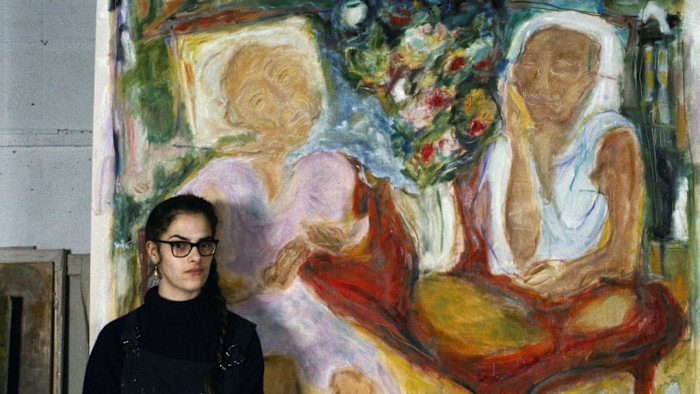
 Tracey Emin photographed in her Margate studio with ‘The Crucifixion’, 2025 © Juergen Teller
When Emin was a child, her Turkish father and English mother ran a hotel in Margate but, as she recalls in these pages, for much of her life the town was a place she was in flight from: where she was abused and raped as a youngster, where she threw herself off the harbour wall in a suicide attempt aged 20. Now, says Gayford, “Emin has come back to Margate and sizeable parts of it are quite literally hers.”
From the bedroom at the heart of her property portfolio, Emin commands a home and atelier and a teaching space for budding artists, as well as an old pavilion on the front which she plans to develop as a studio-cum-saltwater spa. Emin’s conceptual pieces seem to be a thing of the past. These days, her practice is just her and her paints, though she has a faithful retainer, her creative director Harry Weller.
Emin and Margate have helped each other come back to life. Madonna has been to stay and enthused about the revitalised resort. Despite Emin’s frailty, she swims in the “cold green water of the North Sea”, she tells Gayford.
When she was young and poor with nowhere to keep her canvases, she destroyed them instead. As a student at the Royal College of Art, she was required to donate a painting to her alma mater. But the one her teachers chose, a portrait of her two nans, was her favourite, so she switched it in secret for a much poorer work and had to endure sitting in front of it at a gala dinner where the men next to her derided it and even changed seats to escape it.

Now she has produced “a bumper harvest of extraordinary paintings . . . fraught, tender, powerful, harrowing, beautiful”, says Gayford. It’s a curious thing to say of a successful artist but Emin has always been winningly artless.
The bombshell she drops this time is: “cancer . . . was brilliant for me”. It made her value everything she had and make the most of every day. In this intimate and unexpectedly cheering book, she says, “I just got happier and happier . . . and I’ve got this amazing career I didn’t have before.” Tracey Emin is back, and like Norma Desmond, she’s ready for her close-up.
My Heart Is This: Tracey Emin on Painting by Martin Gayford Thames & Hudson £25, 256 pages
Join our online book group on Facebook at FT Books Café and follow FT Weekend on Instagram, Bluesky and X