
The crew wrongly believed it could do both jobs at once, failing to realise the degree of risk they were exposing the ship’s systems to.
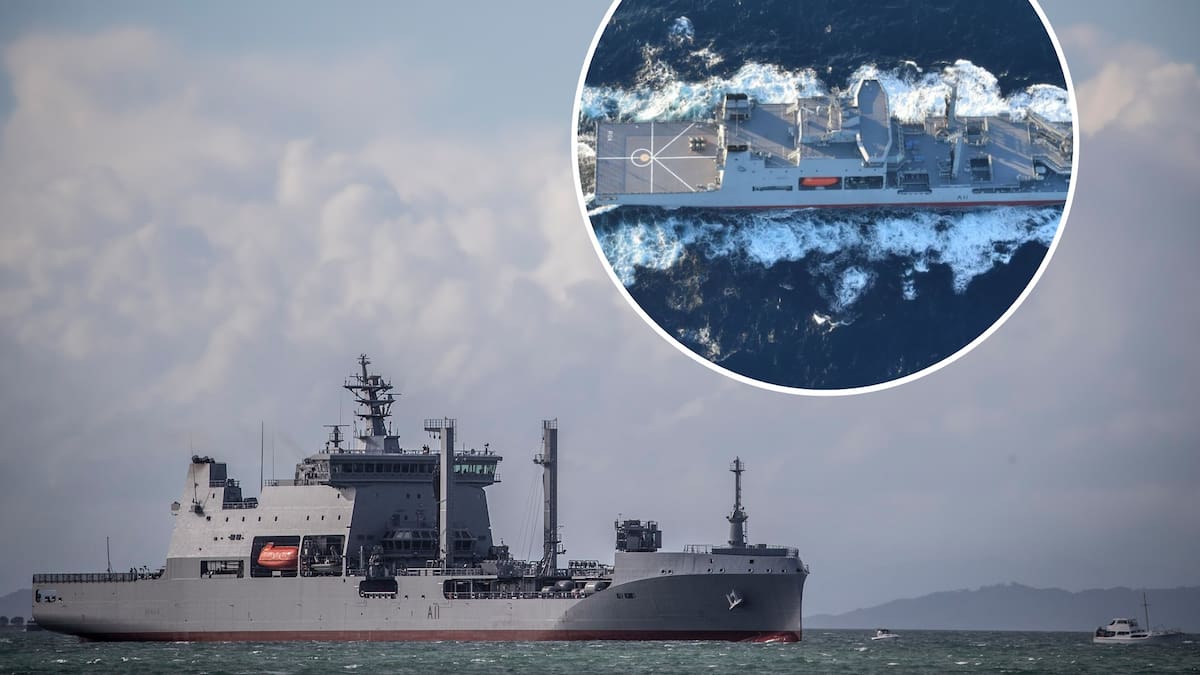
The Royal NZ Navy’s new ship, Aotearoa, was brought into service in 2020. Photo / Royal NZ Navy
The report found the formal technical training introduced when the ship came into service in 2020 was considered unsuitable, but did not specify who in the command chain believed this.
It became supplanted by “on-the-job training” where crew taught their replacements. But over time that led to degraded knowledge and patchy understanding among personnel of the ship’s fuel systems, the report said.
The inquiry found the less formal training had been approved as an interim measure – but the stop-gap became the default while a computer-based training package was developed.
Without the technical training they needed, and under time pressure, the crew then tried to do tank-washing and refuelling operations at the same time – without realising that both couldn’t be done safely on that particular ship.
It led to water getting into the Aotearoa’s cargo fuel, leading to contamination and then biological growth inside the tanks.
The ship then had to be stood down for five months for significant maintenance.
The incident happened when time was short and there was high pressure during the exercise known as RIMPAC – short for Rim of the Pacific.
The US-hosted multinational naval exercise run from Hawaii is regarded as the world’s largest international maritime drill.
Aotearoa sailed from New Zealand on June 13, 2022 for RIMPAC 2022, which ran from June 29 to August 4.
During the exercise, Aotearoa refuelled the vessels of other militaries taking part at sea before leaving Hawaii for Singapore for scheduled maintenance.
It was while en route to Singapore, when cleaning its cargo fuel tanks ahead of docking, that the Navy effectively scuppered its own ship.
Facing a tight timeframe, tank-washing was carried out at sea with most waste kept in a slops tank “to ensure the ship was ready to dock on arrival”. Water entered the diesel system – a disaster for the ship.
RNZN Aotearoa’s 2022 trip to Antarctica for resupply and equipment delivery.
The inquiry report later described the crew’s understanding as “deficient”.
Once water was inside the diesel fuel system, the conditions were created for microbiological contamination.
Later testing showed widespread contamination in the ship’s diesel cargo fuel. Onboard aviation fuel — carried to support helicopters and aircraft operating from other vessels — was also found to have “unacceptable levels” of contamination.
The two activities – washing out and refuelling – are supposed to be done separately to protect the ship’s internal systems.
While the fuel contamination kept the ship from duties, the inquiry into the issue identified important wider issues with oversight, policy and training.
It described the training provided to the crew as “insufficient at best”.
The inquiry found the training package that came with the ship was set aside and a computer-based training model was being developed but took 18 months to arrive.
In the interim, “on-the-job training” – approved by the Seaworthiness Authority – became the default process in which the commissioning crew trained new arrivals.
The inquiry found the decision to do this introduced significant risk.
The inquiry report said the practice ”invariably degraded the knowledge imparted from one crew to the next”.
It found crew churn exacerbated the issue. The entire marine engineering department departed after a two-month Antarctic deployment in early 2022.
The Royal New Zealand Navy’s largest ever ship, HMNZS Aotearoa, arriving into Devonport Naval Base. Photo / Michael Craig
The Herald has reported that by mid-2022, attrition in the Navy was around 12% with a growing number of shortages in critical trades.
While training had been reviewed, the higher level assessment to establish whether people were being taught the correct information hadn’t been done.
The inquiry also found gaps in fuel policy and documentation. The limited reference to cargo fuel in the Navy’s technical instructions around fuels was “a significant gap”.
The Navy also lacked strategic policy around contingency reserve stock levels, day-to-day stock holdings and other mission-critical elements.
It meant there was “no clear direction of responsibility or delegation of authority for determining the quantity of cargo fuel” to be loaded on Aotearoa, it said.
“The quantity of fuel loaded was effectively determined by the ship’s staff.”
The court found the volume of fuel onboard made the problem harder to fix. With so much diesel in the tanks, there was limited ability to move, isolate or treat contaminated fuel, prolonging the clean-up.
The cost of the incident was the loss of Aotearoa’s “primary operational capability of logistics support at sea” for 139 days, the inquiry said.
The report found the cost to fix the fuel issue was $5.6m excluding GST, and the cost associated with premature wear and replacement of fuel injectors was not quantified.
NZDF’s 2023 annual report had set aside $9.2m to fix the mistake.
The inquiry – which ran from September 2023 to July 2024 – came up with 27 recommendations for change.
Commodore Shane Arndell, the current Maritime Component Commander whose role was to assemble the inquiry, endorsed the report in April 2025.
Of the 27 recommendations made, NZDF told the Herald five had been completed by the end of 2025.
They included setting up a fuel management team, reviewing crewing in the marine engineering department, including fuel quality management as a criterion for seaworthiness and buying extra fuel sampling kit.
The steps yet to be taken included reforms of training, a prohibition on simultaneous tank washing and refuelling unless proven safe, revision of technical publications and a review of assurance processes.
The release of the Aotearoa Court of Inquiry report followed the publication of the final Court of Inquiry into the grounding and sinking of Manawanui in Samoa in October 2024.
The Manawanui report found that “the risk management culture within the organisation was deficient” and that in some areas “the focus is weighted heavily on achieving the mission without sufficient focus on safety”.
David Fisher is based in Northland and has worked as a journalist for more than 30 years, winning multiple journalism awards including being twice named Reporter of the Year and being selected as one of a small number of Wolfson Press Fellows to Wolfson College, Cambridge. He joined the Herald in 2004.
Sign up to The Daily H, a free newsletter curated by our editors and delivered straight to your inbox every weekday.