
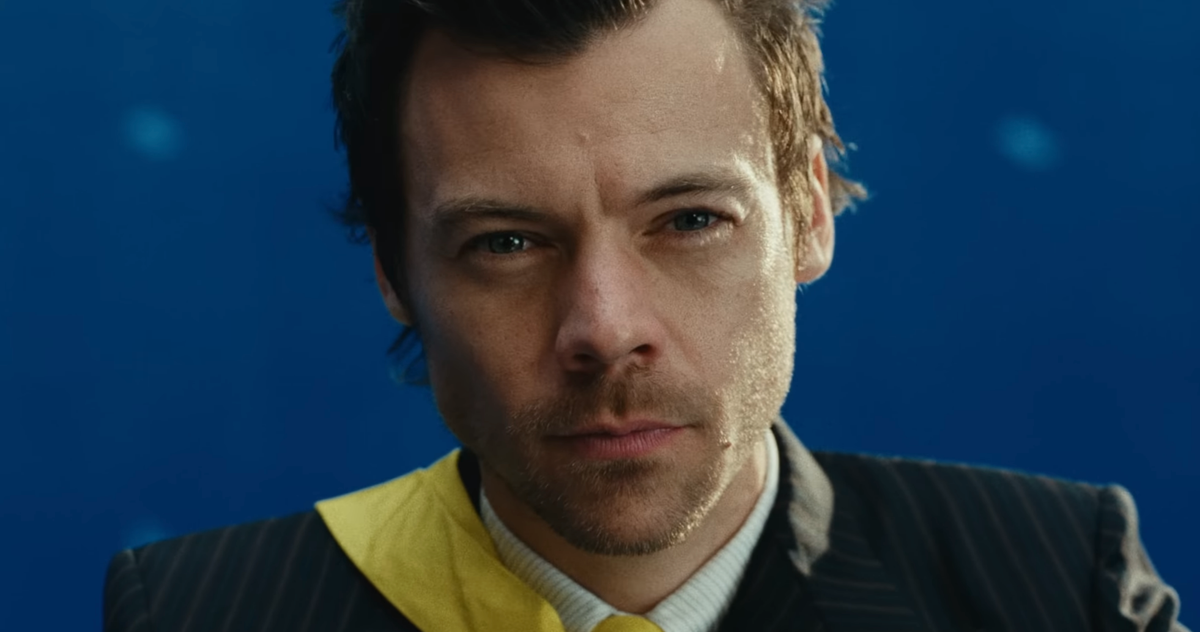
His new album, Kiss All the Time. Disco, Occasionally, threatens to be a genre reinvention it does not necessarily fully commit to.
Photo: Harry Styles via YouTube
Harry Styles auditioned for The X Factor in 2010 when he was 16 and has rarely been out of the spotlight ever since. His time in One Direction and his trio of successful solo albums (and films with diverging critical responses) must’ve been exhausting, because he now speaks of finally escaping the hamster-wheel grind in 2023, after a long world tour for 2022’s Grammy-winning Harry’s House, like his own Rumspringa. While on hiatus, Styles rediscovered himself both alone and in crowds, fixating on long-distance running, family, and electronic music. He trained for marathons after reading Japanese novelist Haruki Murakami’s memoir What I Talk About When I Talk About Running; he had a blast watching LCD Soundsystem in Madrid and Brixton and Radiohead on their 2025 reunion tour; he did what David Bowie also did around 30 and decamped to Berlin to obsess over synthesizers. Now 32, Styles has reemerged with his fourth album, Kiss All the Time. Disco, Occasionally, which threatens to be a genre reinvention it does not necessarily fully commit to. His latest work treasures motion in both its study of dance music that straddles the 20th and 21st centuries and its gentle tug away from pure pop. The result is a zanier and livelier ride than the cloistered and predictable Harry’s House.
Harry’s House was fashionably late to a wave of artists attempting to revitalize adult-contemporary music. Styles’s lanes — the sleek male pop vocalist, the possible rock icon — are now brimming with contenders. If you ache to hear a sensitive man rummaging through a book of potent past personas and/or auditory aesthetics, or just a rock crooner with pop instincts (or vice versa), you may consult Alex Warren, Yungblud, Sombr, Benson Boone, mk.gee, Role Model, and others. Sometimes Styles seems eager to leave House’s lite-radio fare and Fine Line’s “Moves Like Jagger” clones to his subordinates. But Disco’s expedition into new subgenres is anchored by a sense of structure that he gleaned from a long stadium-headliner résumé; Beyoncé’s Renaissance, which lost Album of the Year to House, made it all but custom for 2020s pop stars to make a foray into thumping four-on-the-floor rhythm. In that sense, Disco is playing catch-up with contemporary pop.
On the surface, Disco is a 2000s festivalcore period piece that test-drives the sounds of bands Styles was once too committed to folk and pop to pursue. It imagines him taking the stage at 2012’s iTunes Festival with not One Direction but London alt-dance vets Hot Chip, who also performed. The album’s volley of astute re-creations of this idea sometimes gets in the way of Styles’s attempt to relay sadness or dour self-reflection. The root of Disco is tension — between Styles and an ex, between an artist and himself, between a pop star and a fandom’s gaze, and between serious intentions and sometimes silly lyricism. Lead single “Aperture” takes after the slow build of LCD Soundsystem’s 2010 epic “Dance Yrself Clean,” its verses and choruses selling tersely anthemic notes of togetherness. At just over five minutes, it’s the longest song on the album. But, unlike James Murphy, Styles would never wait three minutes to drop drums for just two full choruses. Producer Kid Harpoon uses Disco’s busy drums (often from Tom Skinner of Thom Yorke and Jonny Greenwood’s the Smile) to meet pinging bass and melodic elements that systematically stack underneath Styles’s vocals. The dance-punk-revival revivalism of the stomping “Ready, Steady, Go!” and “American Girls” — callbacks to the breakthrough of the Killers, the Rapture, and a parade of stylish, NME-approved rockers laser-focused on getting it on — and closer “Carla’s Song” sticks for roughly half the album. But this isn’t the only historical hot spot Styles is focused on.
Elsewhere, Disco sets the catchy but sometimes retrograde post-post-punk aside and arrives at a few of its most exciting and annoying songs. “Dance No More” rides the kind of walking bass line indebted to Sugarhill Gang’s “Rapper’s Delight” that Bruno Mars has given up on. Styles’s scatting funk delivery and the Nile Rodgers–influenced guitar are a welcome detour from songs like “Taste Back,” where Styles seems to want to burrow into the mix and disappear completely, though some of that distance and distortion, like a shrill “But you call Leon!” in “Ready,” is alluring. The bustle subsides in the string-draped, forlorn Disney-prince ballad “Coming Up Roses” and the mature, acoustic “Paint by Numbers,” Styles’s crack at the big-picture perspective of a “Let It Be.” The message is clearer in these moments, since it isn’t under siege by jittery, interlocking rhythms: “It’s a little bit complicated / When they put an image in your head, and now you’re stuck with it / You’re the luckiest, oh, the irony / Holdin’ the weight of the American children whose hearts you break.”
Entertaining crowds is now half of Styles’s life story, and he’s sticking to it. But he’s just as likely to garble a verse that interrogates an internal struggle. “Are You Listening Yet?” tiptoes into the sardonic metacommentary of Zooropa-era Bono, revealing itself as self-critical if you can get past the absurdism: “It’s like you’re taking up arms, but the message is wet / It sounds inviting, but you don’t believe in it yet.” (“Carla’s Song” briefly descends into cringe — “You’ve been a baby sleeping upon a candy bar” — as it recalls the joy of introducing someone to Simon & Garfunkel’s Bridge Over Troubled Water.) Meanwhile, the glum “The Waiting Game” and “Season 2 Weight Loss” almost feel like they’re pushing a downcast singer toward a gorgeously gutting chorus. These cuts resemble the music of rock vets when they were questioning the very idea of themselves. But Disco’s enormous Radiohead influence is, like the auditory fingerprints of bands signed to James Murphy’s DFA Records, ultimately set dressing for pop instincts. Styles is rarely interested in the satirical snarl of actual Murphy verses or the once-lacerating political clarity of Yorke; it’s their clattering, evolving accompaniment that gets him going. When he isn’t pantomiming his predecessors too closely, his delicate reinvention feels refreshing; when he is barking very obviously up someone else’s tree, he falls back on hooks that, cloying or not, leave a phrase or two lodged in your head.
Disco’s tales of arguments and makeout sessions are a gentleman’s rejoinder to the cartoon-character cutesiness of modern Y2K-inspired pop. Styles admits to being a torqued-up tube of conflicting desires — alternating between dreading and enjoying the single life — while steeped in the swashbuckling new-millennium electro-cock-rock that soundtracked dive-bar meet-cutes 20 years ago. He’s haunted by the specter of aging — apparent in Styles’s fixating on wellness in interviews and roasting his own hairline on Brittany Broski’s Royal Court — and has hinted at private anguish over the death of One Direction’s Liam Payne. These are intriguing threads Disco almost fights. A track will only sometimes clue us in on what makes a person embark on a soul-searching sabbatical seeking “some sense of structure” that “wasn’t work,” as the singer explained of his enthusiasm for long-distance running in a recent interview. Styles lets himself have it at the top of “Waiting Game”: “You can romanticize your shortcomings, ignore your agency to stop / Write a ballad with the details, while skimming off the top.”
But there are sing-alongs to inspire. “American Girls” is a tune about watching friends get married that you could easily mistake on paper for Styles’s answer to a David Lee Roth jam: “I’ve seen it in stages all over the world / My friends are in love with American girls.” Other songwriters might opt to wring notes of sadness from the whole squad getting hitched, but this one is winking at the listener, signifying the end of his seclusion in Europe and the embrace of fans who haven’t had an audience with him in a long time. Disco is most at ease with the vague sloganeering that “Aperture” stakes a chorus on: “We belong togethеr / It finally appears, it’s only love.” The entendres of “Pop,” whose title can be read as action verb or genre-affirming noun, are representative of the general tone throughout. Aspirational fitness lore and new sounds (for Styles) notwithstanding, Disco feels deliberately designed to make sure that his six months of Together, Together residencies this year feel light and bouncy. Styles doesn’t steer clear of self-effacing reflection, but neither will he stew in it. He’s carefully uncorking the rocker impulses we’ve always known to be there, but he won’t crowd an album with enough loud guitars to escape contention for another Best Vocal Pop Album nomination.
Sign up for The Critics
A weekly dispatch on the cultural discourse, for subscribers only.
Vox Media, LLC Terms and Privacy Notice
Related