
Australia is 12,000 kilometres away, but the ripples of the conflict in the Middle East could reverberate all the way into our power bills.
The human toll of the war dwarfs any impact felt here, but new pressure on energy costs could still intensify Australia’s cost-of-living issues.
Paradoxically, being an “energy superpower” and the third-largest gas exporter across the globe won’t insulate Australians from energy price spikes, much the same as during Russia’s war in Ukraine.
Iran war live updates: For the latest news on the Middle East crisis read our blog.
The Strait of Hormuz
Long lines at the petrol station prove Australians are aware of the Middle East’s oil dominance, but the region also produces a lot of the world’s gas.
Qatar provides about 20 per cent of the world’s liquefied natural gas (LNG), putting it second in the world for gas exports, behind the US and ahead of third-placed Australia.
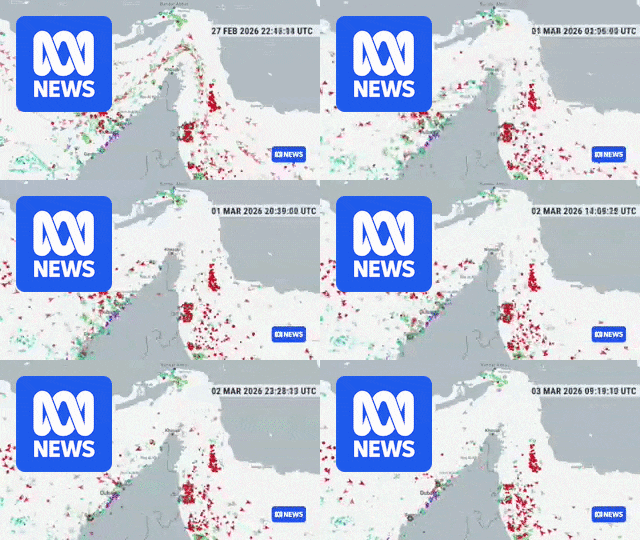
Just like the oil, it needs to pass through the Strait of Hormuz, the thin stretch of water flanked by Iran to the north and the Arab states to the south.
It’s a critical and vulnerable choke point in the world’s energy flows, as the only entrance for ships to the resource-rich Persian Gulf.
Iranian media reported on Monday that the Strait was closed and Iranian officials had threatened to attack any ship trying to pass through the narrow passage. A number of tankers have already been hit since the war broke out.
The fighting has led to Qatar announcing that it is halting LNG production, with industry insiders telling Reuters the shutdown would last at least two weeks and it would take another two weeks to ramp back up to normal production once the situation was resolved.
Read more about the Iran war:
While LNG doesn’t account for all of the world’s gas consumption, as many supply chains rely on pipelines across borders and even continents, it is highly critical for certain markets, especially in Asia.
Some 83 per cent of the gas shipped through the Strait in 2024 went to Asian markets according to estimates from the US Energy Information Administration (EIA), with China, India, Japan and Korea taking the majority.
Australia remains exposed to market shocks
The global gas price matters because it flows through to what Australians pay for gas.
Australia’s east coast gas fields were opened up to the export market from 2015, but structural policy flaws meant that Australia, one of the world’s largest gas exporters, was left facing warnings of a gas shortage and high prices.
This latest conflict in the Middle East highlights the fact that international price spikes can drive up costs here in Australia.

Josh Runciman says domestic gas prices have effectively tripled since 2015. (ABC News)
Lead gas analyst at the Institute for Energy Economics and Financial Analysis (IEEFA) Josh Runciman said, for many years, gas companies were under no obligation to give Australians a special deal on gas.
Since 2023, the federal government intervened with a policy getting gas companies to offer gas at a “reasonable” price to the domestic market, still at much higher prices than a decade ago.
“Since [2015], we’ve seen domestic gas prices effectively triple. That’s not just due to exports. Low-cost gas that we have in eastern Australia is becoming depleted, and so now we’re developing more expensive gas fields,” he said.
Unthinkable? Australia on cusp of importing gas
“But it is very clear that LNG prices have played a very big role in the increase in domestic gas prices.”
Now, about 70 per cent of Australia’s gas is exported, making the current energy crisis in the making a boon for the country’s gas producers but a potential nightmare for everyone else forced to pay more on bills and at the local checkout.
Gas fuels the price of everything
The main damage to Australians’ hip pockets is because of its role in electricity generation. Currently, gas plays a crucial part in the grid because it can be switched on at short notice, unlike a coal plant. Despite this, gas only makes up 6 per cent of the overall electricity mix in the National Electricity Market (NEM), which covers the eastern states.
“Even though gas isn’t used that much, it actually tends to set the price quite a lot. And the reason is that it’s often the last fuel that is used to meet electricity demand,” Runciman said.
“So energy bills are probably the first place households will notice.”
How such a small fraction of our power mix can make a big difference lies in the workings of the electricity market.
Throughout the day, the wholesale cost of electricity changes depending on how much power is being used and what’s used to generate that power.
During the day, renewable sources compete, driving down prices so much that they sometimes have to pay retailers to take them off their hands. Gas usually comes in when solar falls away as the sun sets.
Every energy provider sells their power in the market at different prices to cover their costs, but all providers get paid the most expensive offer. It’s called “setting the price”. The most expensive bid is often gas, which comes online for a short time and has to cover the cost of the gas it’s burning to create energy.
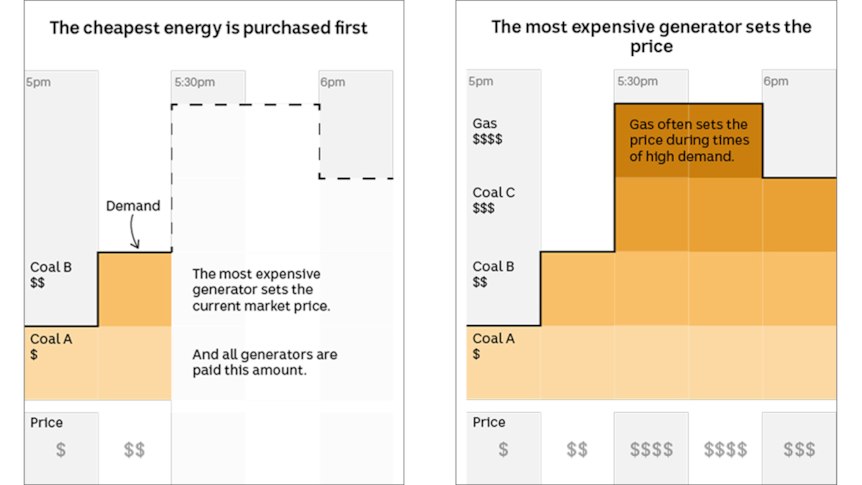
Gas is a small part to the mix but because it often sets the price it has an outsized effect on our electricity bills. (ABC News: Alex Lim)
That’s why a lasting increase in international gas prices will hit Australian electricity bills, but there are also other ways it will flow through to households.
Gas is also used across heavy industry and manufacturers; it’s a key ingredient in fertiliser production and, therefore, farming and food costs.
It is also used directly in households for cooking, hot water and heating, with some 3 million Australian households connected to gas — in Victoria, it’s 90 per cent of homes. All of these uses factor into household costs and contribute to inflation.
Are we heading for another Russia/Ukraine moment?
The latest war in the Middle East bears similarities to the fallout from Russia’s invasion of Ukraine and its subsequent energy disruptions. However, it’s too soon to predict if the current energy shocks will be as lasting.
In 2022, Europe and much of the world responded to Russia’s attacks by cutting off its gas and oil, creating a major shortfall and sending prices rocketing, said IEEFA’s Runciman. In Australia, the gas price spike that followed soon hit household bills.
“What we saw then was effectively the entire European bloc trying to replace Russian gas with LNG. Here [with Qatar], it’s a supply-driven issue and for that reason, it could actually resolve a lot sooner than the situation we saw post the Ukraine war.”
The repercussions of this current conflict on global energy prices will depend on how long the oil and gas supply is choked.
“If it is short-lived, what we would see is that prices will likely fall fairly quickly and the disruption would be short-lived. If we see ongoing issues, prices will potentially go to where they were during Russia’s invasion of Ukraine, perhaps even higher for oil,” Runciman said.
LoadingWould keeping some Australian gas back change the situation?
The spike in energy prices from 2022 created a political storm around whether the Australian gas industry is ripping off Australians and what can be done to protect households and industry from high prices.
Deakin University law professor Samantha Hepburn has noticed this conversation has heated up in recent years, especially as fossil fuel companies make soaring profits off these crises.

Samantha Hepburn says the distribution of gas resources has become political. (ABC News: Kyle Harley)
“They’re making a fortune and they have made a fortune for many years,” she said.
“For the public and the general consumer, that discussion has really opened up as prices have tripled in their energy bill. I think they’re wondering what is going on and I think there’s been a greater discussion about: ‘Why are we paying so much when we have so much already here?'”
She said the realisation that a resource-rich country such as Australia was not distributing those resources effectively had created a political issue.
“These are public resources that are not being properly managed because they’re just being exploited without that income providing any sort of real benefit to the community,” she said.
In 2023, the federal government imposed a mandatory gas code to make gas companies offer their product at a “reasonable” price domestically, and rolled out electricity bill rebates to help households with spiking bills post-Ukraine. However, the cap on prices does not apply to the spot market, where power companies tend to buy gas to produce electricity.
Then late last year, the government announced it would be implementing a gas reservation scheme for the east coast gas market, similar to one already in operation in Western Australia. It will require gas companies to reserve between 15 and 25 per cent of gas production for the domestic market.
Government confirms gas reservation plans
Federal Resources Minister Madeline King said this week the energy system was “much more resilient” than four years ago.
“There’s no doubt when we see global shocks like this … I guess it says to me we made the right decision to go down this path [of a reservation scheme]. There are a few things that are different from four years ago,” she said.
However, Professor Hepburn pointed out it wouldn’t be in place until next year.
“In my opinion, we should have had it a lot earlier, and I have argued for it for many years. Obviously, there has to be negotiation with the industry, and it is only going to take effect in 2027 to new contracts,” she said.
Expert analysis on the Middle East:Renewables, batteries for national security
While a gas reservation policy is expected to keep a lid on gas prices, another way to shield Australians from international energy price shocks is to reduce reliance on fossil fuels altogether.
“Households can reduce their exposure, just by putting solar panels on rooftops, batteries, and getting gas out of their homes, ” IEEFA’s Runciman said.
“More broadly, Australia can reduce its energy insecurity by reducing how much gas we use in our electricity system.”
Batteries — both large and small — are expected to eat into the evening role of gas in the electricity system and lessen the impact of those price spikes in the coming years.
China turns into the world’s first electrostate
There is a growing awareness across the globe that renewable technologies mean security.
Energy independence is one of the driving motivations behind China’s electrification rush. A 2025 report from the International Energy Agency found that countries that relied on energy imports were investing heavily in clean technologies.
“Some 70 per cent of the increased spending came from net fossil fuel importers,” the IEA report stated.
“This was led by China’s drive to reduce reliance on oil and gas imports and exert leadership in new technology areas.”
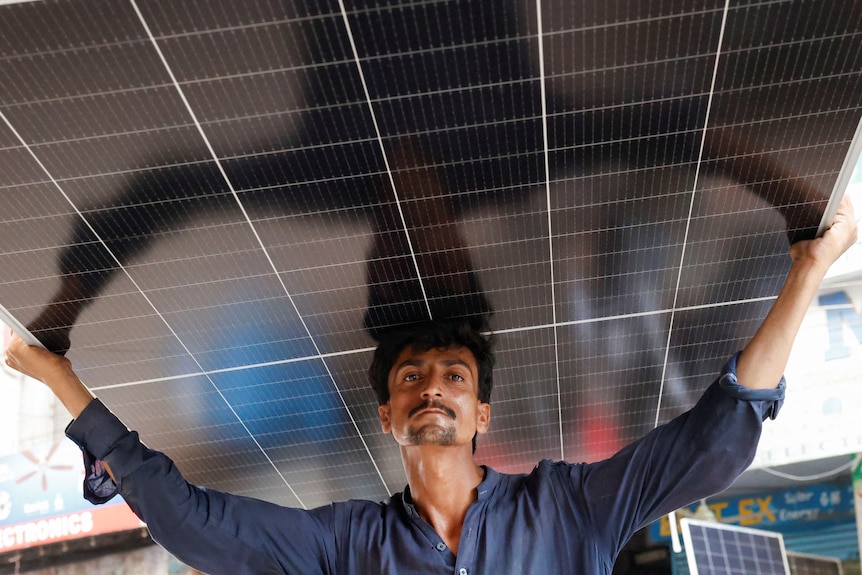
A worker carries a solar panel sheet on his head to load it on a vehicle, outside a shop in Karachi, Pakistan. (Reutrs: Akhtar Soomro)
Since 2022, Europe has worked to reduce its gas and oil use, cutting demand for gas by 19 per cent between 2021 and 2024.
IEEFA’s gas analyst Josh Runciman believes that a sustained energy crisis only four years after the last could weaken long-term demand for gas.
“The key takeaway is, if you rely on LNG, you’re exposed to those energy security risks. So I suspect that if this current situation is prolonged, and it really has that impact on LNG supply over the longer-term and therefore LNG prices, what we’re likely to see is countries across the region potentially scale back some of their LNG plans in their energy systems.”
Deakin University’s Samantha Hepburn agrees that renewable energy and electric transport will only become more appealing.
“We’re looking broadly at energy security in terms of pricing, sustainability in a warming climate, [and] in terms of geopolitical tensions. All of those factors have facilitated a shift towards renewables.”Loading…