
First off. I am not a professional physicist. You should assume anything I write here will be wrong, at least the stuff I came up with myself. Why am I sharing? Because I don’t have time to work on this anymore and I need to let go of these ideas. I have been teaching myself Special and General Relativity from graduate level MIT courses on YouTube. But I simply don’t have the spare time to get my knowledge to the place for me to prove these theories. And I’m not going to have that time anytime soon, so I am letting them go into the wild so my head can focus on the things I need to focus on. And should there be anything to them, hopefully someone who does know what they are doing could use them.
I am seriously proposing these two ideas and have spent time trying to make sure they are consistent with well established physics. My last article on physics was entirely a brain dump with many incorrect ideas. This time I am trying to actually solve something, but being a complete amateur I don’t pretend that I will succeed. But perhaps I can get close enough that it sparks a useful idea in a real physicist.
The topic of galactic rotation I will present first as it is simpler and more fully baked. The second topic on the nature of space-time itself is half-baked. I’m not insulting myself here, just acknowledging that the exploration of the idea is not finished. I will try to indicate when we get into my own ideas so you know when to ignore me. 🙂
Part I: Solving Galactic Rotation or What is Dark Matter?
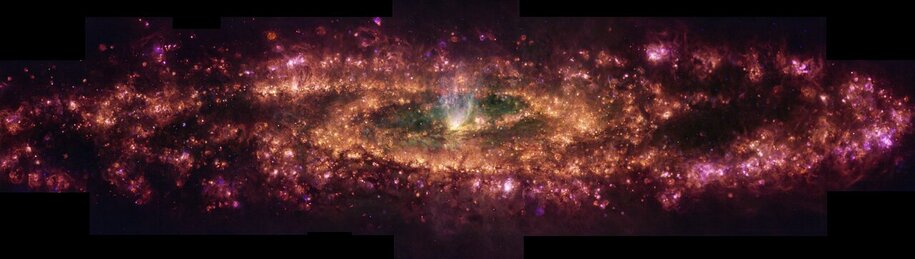
In the 1900s physicists made observations of different galaxies and discovered something odd. They were all spinning faster than they should. When astronomers looked at the speed of rotation and added up all the visible mass of a galaxy, the galaxy being observed did not have enough mass to keep the stars from flying off away from the galaxy. To explain this they eventually came up with two theories. The first theory became known as dark matter.
Dark matter is a catch all term for a group of theories that explain galactic rotation by somehow adding more mass to the galaxy in ways which are not visible. If you add a bunch of mass to the galaxy in a diffuse cloud and stipulate this mass only interacts with other matter via gravity, you can generate reasonable models of galactic rotation. The problem is, after decades of trying really, really, hard we have no conclusive proof of dark matter other than through observations of this additional gravity we can see. Something is causing that gravity, but we have not yet identified the particle or objects producing that gravity. We still have possible theories, just no proof.
The second explanation for galactic rotation are various versions of “modified gravity”. This is basically a theory that says gravity works normally (General Relativity) at short distances but at galactic distances it behaves differently. So this explanation says there is no missing matter, we just don’t fully understand gravity. This seems to be the less popular theory, but plenty of credible scientists are exploring it.
So what is my theory?
My theory of galactic rotation is that curvature caused by the expansion of one area of space while a different area of space doesn’t expand is effectively the same type of spacetime curvature as “normal” gravity. For this to work, the area which is not expanding is inside the galaxy. Somewhere outside of the galaxy, space is expanding.
That space is expanding somewhere in the universe is quite well established. But I could not track down research on the boundary between non-expanding space and expanding space. My theory requires that boundary to be somewhere on the edge of each galaxy. I could be very wrong on this part. But to explain the rest of the theory I will assume this to be true.
So what happens to spacetime if the galaxy doesn’t expand while space around it expands? To visualize this, draw a grid of 3×3 squares. If you expand all nine squares at once, there is no warpage of the lines. However, if you keep the central square the same size while expanding the squares around it you will notice the 8 outer squares pull away from the central square leaving a void between the central square and the outer squares. If we assume that space is not created to fill this void, but that space curves to keep the lines connected, we see the lines bend towards the center of the central square. They bend in the same exact way that space curves in the presence of gravity. So galactic rotation can be explained by both the normal gravity caused by mass along with the curvature created at the expansion boundary.
The expansion rate is not large when you think about the difference over only a second or even a year. But Galaxies move at a speed where it takes many millions of years for the galaxy to move one galaxy length. This means a small yearly effect caused by this process can add up over many millions of years to produce the observable effect. This also creates a great opportunity to test the theory.
By which I mean people other than myself with access to telescopes and advanced math could observe the apparent curvature of space around a galaxy and there should be a noticeable difference between the curvature on the leading edge of the galaxy and the trailing edge. There should also be differences in the amount of observed “extra gravity” based on the orientation of the galaxy and how fast it is moving with faster galaxies appearing to have less mass than slower galaxies. Finally, every galaxy should leave a trail behind it of curved space. Eventually the Hubble flow (normal expansion) will dilute the trail to be imperceptible but it should be there.
I had hoped to learn enough of the mathematics of Relativity to be able to model this. Alas, I do not have that time. Someone way more adept than me could produce a model which could show if the effect would be large enough to account for observed galactic rotation prior to investing research time into it.
Dark Matter as a solution to physics problems appears in more than just galactic rotation. This theory could possibly work with the other problems but I have explored those much less. One of those problems is modeling expansion of the early universe. There are shock waves present in the CMB (cosmic microwave background). This theory could provide a way for those shock waves to form. In this case it would be the opposite of the galaxy. The expanding space would be inside surrounded by non-expanding space. The curvature would result in an outward force creating a wave of sorts. I have not explored this very far.
Part II: The nature of spacetime.
While both relativity and quantum mechanics are very successful theories there are points at which the theories disagree and one or the other (or both) break down. So physicists are eagerly searching for a unified theory which bridges both theories. The most popular way to combine them both is essentially trying to make Gravity work like the other three forces which are well described by quantum theory. This is usually called the quantum theory of gravity. The challenge is, there is no generally accepted theory of gravity in quantum mechanics. It’s simply so tiny at the distances involved in quantum mechanics that it is very difficult to detect its effects at all.
Meanwhile Relativity has places where it breaks down which physicists usually call singularities. This is where the mathematics breaks down usually due to division by zero creating infinities. It also doesn’t work all that well at quantum distances either.
There are some models which attempt to describe a unified theory, the most commonly known one being the many versions of string theory. String theory gets its name from the mathematics which effectively describe physics as a bunch of vibrating strings. They don’t really spend a lot of time on what the strings are. The good part of String Theory is that it unifies relativity and quantum mechanics. The bad part is that it has never produced a prediction which can be tested with means currently available to us. As such, some scientists consider it a pseudoscience as it can’t (currently) be proven.
My Take: Spring Theory
Okay, so I’m being a tad cute here with the name but you’ll hopefully see why. My unifying theory is to start with the premise that energy consists of waves in the fabric of spacetime. This is not such a stretch as light is a wave in the electromagnetic field. But in my theory, this wave pulls ever so slightly on the space time around it.
Think of it like a string of yarn. You can hold a string of yarn straight and tight. But in order to create a wave in the string by moving one end up and down, the two ends need to come closer together. In this case you are loosening up on the string to create enough slack to make a wave. In my theory, the energy wave itself pulls ever so slightly on the space around it. Two points come ever so slightly closer together. The more energy in the wave, the closer the two points need to move. Now obviously this is all happening in multiple dimensions with complications beyond my ability to describe and predict.
So to put this in quantum mechanic terms, this would be a version of pilot wave theory but instead of a point particle in a predictive field, particles would be actual waves and the results we interpret as proof of the point nature of matter are simply the exact point where one wave intersects the other. The more energetic the particle the more space it pulls in from surrounding it. The amount of space pulled is still tiny enough to be nearly impossible to detect but when multiplied by all the particles making up an object, it translates into the gravity curvature that we know in relativity.
However, this ability of energy to bend space into a wave has limits. And this is where the spring comes in. Space itself resists this compression and acts like a spring pushing outwards. In order to compress space to higher and higher levels we start to accrue diminishing returns. Eventually, somewhere around the Plank length (a really tiny distance) we reach a point the spring tension pushes back in a nonlinear manner. Up to the Plank length the compression is fairly linear with the energy put in giving us standard gravity. But at that length, to compress space further requires far more energy.
If I could do the math better I see this eventual resistance to compression as similar to the Lorentz transformation. But in this case we’re not limiting spacetime on the maximum side, but limiting the practical amount of curvature. Maximum possible curvature remains infinite and preserves the relativity part of Relativity, but at the Plank length additional curvature requires so much extra energy that a pressure forms. This outward pressure results in the ratio between Black Hole mass and surface area.
This outward pressure prevents collapse to the singularity. In fact a singularity becomes impossible as it would take infinite energy to compress to a singularity. But because it operates similarly to the Lorentz transformation, it preserves relativity.
As the Black Hole doesn’t collapse to infinity, it is possible to preserve information inside the Black Hole. While it may be impossible for the information to exit, the information still exists allowing quantum mechanics to function.
What is this magical math? Please let me know if you figure it out. I never got there. That’s basically it. Although it would have the added bonus of explaining expansion of the Universe. In deep space, conditions would exist for space to expand as the energy going through space flattens out. WHY does that happen? No clue.
Anyway, rip to shreds at your hearts content. I got it out of my head. Should anything ever come of these ideas please let me know.