
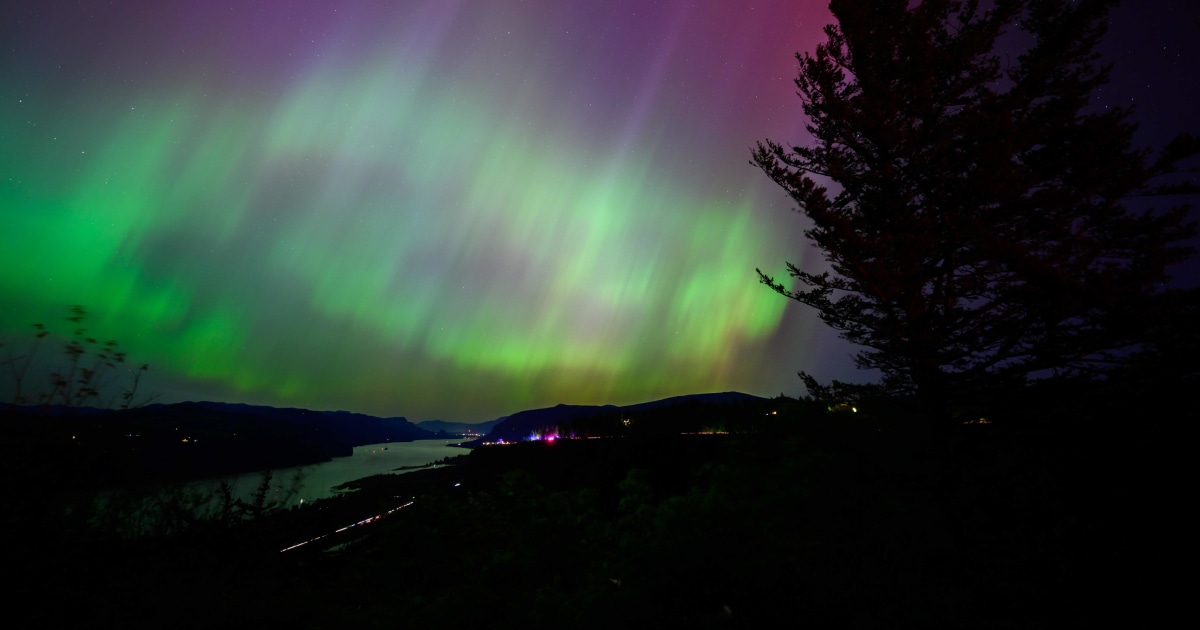
A week filled with dazzling sights for skywatchers has one more in store.
The northern lights are expected to be visible from 10 states on the night of March 6, according to the National Oceanic and Atmospheric Administration’s Space Weather Prediction Center.
The phenomenon comes three days after a reddish blood moon could be seen across the country thanks to a lunar eclipse and a week after a “parade of planets” in which six planets seemed to align.
Here’s what to know about the latest chance to see the brilliant colors of the northern lights.
What Are the Northern Lights?
Geomagnetic storms cause energized particles from the sun to collide with gases in the Earth’s atmosphere and light up the sky with various bright colors.
The phenomenon is known as the aurora borealis in the Northern Hemisphere and the aurora australis in the Southern Hemisphere.
The geomagnetic storm forecast for this week is considered a minor one G1 storm, according to the NOAA. That means auroras — the bright bands of light in the sky — will be limited to higher latitudes closer to the North Pole.
A dazzling array of color lit up the sky in November 2025 as far south as Florida, Alabama and Texas from a more powerful geomagnetic storm than the one forecast for March 6.
Strong geomagnetic storms can also cause power outages and disruptions to radios and GPS.
When Will the Northern Lights Be Visible?
The northern lights are expected to be seen on the night of March 6, according to the NOAA.
The best time to view them is usually between 10 p.m. and 2 a.m. local time because that’s when the level of geomagnetic activity increases, per the NOAA.
This also a good season for aurora viewing because it’s close to the spring equinox, which is on March 20. Larger geomagnetic storms often occur around the the fall and spring equinoxes because of the way the solar wind interacts with the Earth’s atmosphere, according to the NOAA.
In Which States Will the Northern Lights Be Visible?
Stargazers in parts of 10 states should be able to view the northern lights on March 6, according to a map shared by the NOAA.
The viewing line includes all or parts of the following states:
AlaskaIdahoMaineMichiganMinnesotaMontanaNorth DakotaSouth Dakota WashingtonWisconsin