
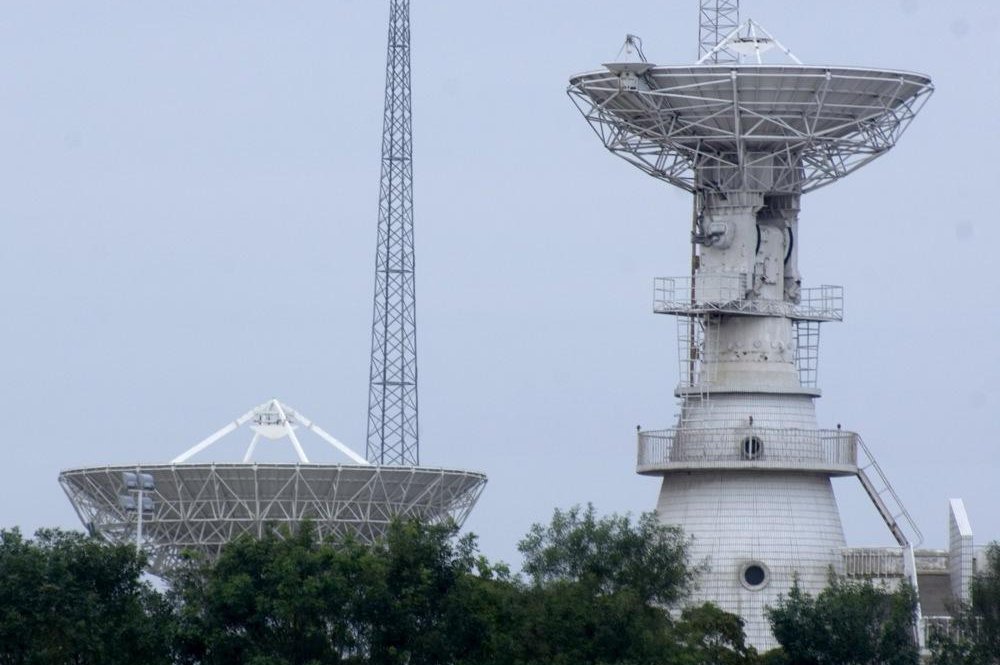
Chinag has established at least 11 space facilities in Latin America that could strengthen the surveillance and intelligence capabilities of the People’s Liberation Army, according to a new report..File Photo by Wu Hong/EPA
March 2 (UPI) — The U.S. House Select Committee on China warned that Beijing has established at least 11 space facilities in Latin America that could strengthen the surveillance and intelligence capabilities of the People’s Liberation Army.
According to the Feb. 26 report, Pulling Latin America into China’s Orbit, the second installment of a review of China’s activity in the Western Hemisphere, it details how Beijing uses infrastructure in the region to advance its space and intelligence-gathering capabilities.
The document says that China uses space cooperation agreements with countries in the region, presented as scientific in nature, but which allow it to expand its ability to monitor and track satellites and other objects in space, a key function for both civilian and military operations.
According to the committee, the facilities include ground stations, radio telescopes and satellite laser ranging sites located in Argentina, Venezuela, Bolivia, Chile and Brazil.
New @ChinaSelect report | China is using Latin America as a launchpad for military space operations. What looks like civilian cooperation is actually part of a PLA-linked global network tracking satellites and monitoring adversaries.
At least 11 Chinese-linked sites across… pic.twitter.com/koIarFiW9O— Select Committee on China (@ChinaSelect) February 26, 2026
The report notes that these centers are not isolated scientific projects, but part of an integrated network that could allow China to maintain constant contact with its satellites and improve its global monitoring capacity.
“Much of daily American life depends on the satellites above us, and that is why China’s space operations are a matter of serious concern,” committee chairman Rep. John Moolenaar, R-Mich., said in a statement.
The panel argues that the expansion reflects a Chinese policy that allows civilian and commercial infrastructure to also be used for military purposes. Under this framework, aerospace companies and state entities can be integrated into the country’s defense ecosystem.
China has launched more than 1,000 satellites and has invested in stations that allow it to control those satellites, receive data and send them instructions.
However, the report indicates that limited access to ground infrastructure outside its territory may have driven agreements with Latin American governments to ensure continuous coverage while its satellites orbit the planet.
Among the cases cited is the Deep Space Station in Argentina’s Neuquén province, operational since 2018 under a 50-year lease agreement.
The report also mentions facilities in Venezuela such as El Sombrero and Luepa; stations in Bolivia associated with the Túpac Katari satellite; projects in Chile linked to radio astronomy and data processing; and agreements in Brazil involving Chinese technology companies and local actors.
The committee said that although these infrastructures are presented as scientific or civilian cooperation projects, they have technical capabilities that could be used to intercept signals, enhance satellite tracking or support intelligence and defense systems.
In its recommendations, the report urges NASA to review any cooperation with countries that host Chinese space infrastructure to ensure compliance with the Wolf Amendment, which restricts bilateral cooperation with China in the space sector.
It also proposes updating that legislation to prevent loopholes in multilateral agreements.