
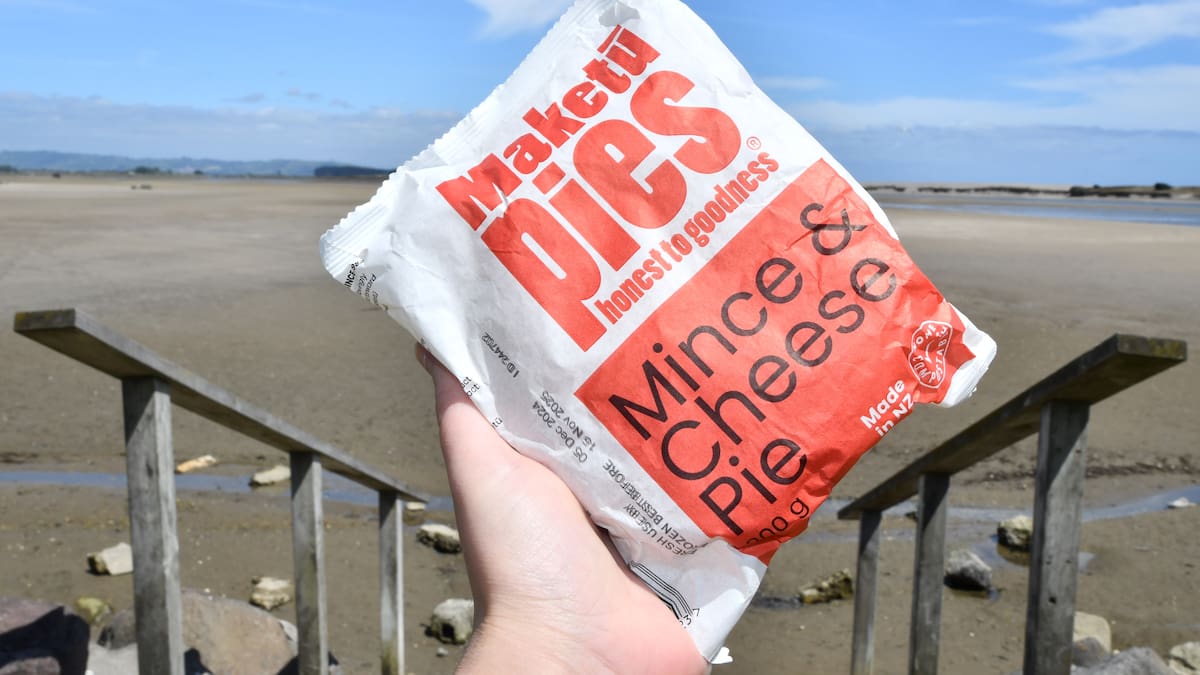
The “planets aligned”, and Williams was brought in to lead the brand’s rebuild.
Maketū Pies began in 1982 when a local grandmother began making pies in her kitchen and handing them out through her window, Williams said.
They proved so popular the next generation set up a small shop attached to the house.
The family then expanded the original home by adding new rooms, extensions and production spaces as demand grew.
That same house is still at the centre of operations, forming what Williams described as a “rabbit warren” of production rooms, chillers and ovens.
The brand soon expanded across NZ, becoming one of the country’s most recognisable pie names in the 1990s and early 2000s.
For locals, Maketū Pies became a point of pride – something from their backyard that made it big.
The Maketū Pies factory, where the iconic Bay of Plenty brand began and still operates today. Photo / George Novak.
Williams said the reduced product range of 13 pies, from its height of 40, meant fewer staff were needed.
He is no stranger to the food industry.
The 52-year-old spent most of his working life in food and hospitality, starting as a teenager at Georgie Pie before studying business and moving into senior management roles, including running high-end supermarket chain Farro Fresh.
He described pies as a core part of NZ’s food culture and something people took seriously.
Kiwis were happy to spend about $15 on a burger or sushi, but expectations were much higher when spending “five or six bucks on a pie”.
“It’s a tradie’s lunch, it’s a family meal … it’s important to people,” he said – and people go looking for a good pie.
Maketū Pies general manager Craig Williams is leading the brand’s push to get its pies back into dairy and service station warmers. Photo / Annabel Reid
Before taking on the Maketū role, Williams had been considering semi-retirement and even explored opportunities overseas, including working in Antarctica and running a business in Vanuatu.
Since taking over, Montana Group focused on fixing the foundations of the business before pushing for growth.
The company returned to the pies’ original handmade pastry recipe, which used higher-quality ingredients.
It had invested in repairing and upgrading equipment at the Maketū factory, tightening food safety systems and reducing the range to focus on consistency and quality.
“We didn’t want to go out too early and still be delivering a product that might not have been great,” Williams said.
“We wanted to get it right first.”
He saw Maketū Pies as something that belonged to the community as much as the company, and something he was meant to be a part of.
The focus was on steady growth and rebuilding relationships with New Zealanders.
“It’s about going back to the foundation of the business,” Williams said.
Crowded market, limited warmer space
Williams said the pie market could appear “pretty saturated” from the outside, but he believed there was still a gap for Maketū Pies.
Its industry data suggested about 80 million pies were sold in NZ each year, with the country ranking among the highest per-capita savoury pie consumers in the world.
He estimated Maketū Pies was operating alongside about 20 other pie brands nationally in a similar “mainstream, good-quality” segment – not budget pies, but not gourmet either.
He didn’t view those brands as rivals to “knock over”, and said Maketū Pies didn’t need to be everywhere to succeed.
“We only need to be in 10% of them to make it work.”
Pies on the production line at the Maketū Pies factory. Photo / Supplied
Williams said retailers had generally been receptive, with particularly good responses from the Bay of Plenty and Waikato.
Many in those regions had dealt with the brand before, held “good memories” of the pies and had noticed they were “missing”.
Some were open to stocking more uncommon parts of the Maketū Pies range, such as its fish or mussel pie.
Williams said he was “very confident” the brand could return to its former standing and believed people’s faith in Maketū Pies was still there.
A worker who’s seen the highs and lows
Production and scheduling manager Nina Kingham has worked at Maketū Pies for 15 years.
The Te Puke local joined the business straight out of high school in 2010, starting in the packing room.
Kingham said there were “bugger all” opposition pie brands at the time and Maketū Pies were “everywhere”, stocked in “all the supermarkets”.
“We were real busy”.
Many families had multiple generations working there.
“When I had first started there, it was locals … so many different lots of families”, Kingham said.
Kingham said Maketū Pies began “slowly going downhill” about three years into her job.
“Everything was getting smaller”, with reduced hours and declining output.
Then-owners Grant and Karen Wilson sold Maketū Pies, their business of 36 years, in 2019. The company was described as being in a “critical financial position”.
When Te Arawa Management took over, Kingham said it was ”hard for them”.
She described that period as stressful, with the “unknown” weighing heavily on staff who relied on the factory as their main source of income.
At its peak, the business employed about 40 staff, who were proud to tell people where they worked. Maketū Pies now employs about 25 people, with at least half based in the town.
Kingham said there was a “sense of hope” when the Montana Group took over. For the first time in years, she was actually “seeing change”.
Maketū Pies production and scheduling manager Nina Kingham has seen the brand’s rise, decline and rebuild over 15 years. Photo / Supplied
Kingham said Williams came into the role with fresh ideas, and he was a “go-getter” who “liked to achieve things”.
He was getting the brand “back to what it was” and was “pushing for our name”, Kingham said.
She could see the progress through “a lot more sales” and outside “compliments”.
She said Maketū Pies wasn’t back to what it was when she started yet, but it was “halfway there”.
Brand expert on rebuilding a food brand
Glenn Dougal said going through liquidation did not necessarily amount to reputational failure for an everyday food brand like Maketū Pies.
Dougal is the director at Wave Agency, a full-service marketing agency based in the Bay of Plenty, working with clients across NZ.
He said most consumers did not make purchasing decisions based on a company’s financial position, but on hunger, familiarity and whether they trusted what they would get when they ate the pie.
Strong quality was often enough for consumers to be “very forgiving”.
Reputation in food retail was rebuilt daily through taste, freshness and consistency, and could not be salvaged through rebranding alone if the product failed to deliver.
He said pies were typically a quick, instinctive purchase made in front of a dairy or service station pie warmer, where familiar and trustworthy brands tended to win.
Wave Agency director Glenn Dougal provides marketing insight on brand recovery. Photo / Supplied
A strong local heritage could help draw customers back, but Dougal said nostalgia alone was not enough.
“Pie eaters want reassurance the brand still belongs in their world now, not just in memory.”
Although he did not have specific data on the current competitive landscape, Dougal said it was reasonable to assume Maketū Pies was operating in a highly competitive retail environment, with consumers making choices based on taste, quality and price.
He said the strongest brand recoveries tended to be steady rather than dramatic, built around consistently delivering “the best pie in the warmer”.
Annabel Reid is a multimedia journalist for the Bay of Plenty Times and Rotorua Daily Post, based in Rotorua. Originally from Hawke’s Bay, she has a Bachelor of Communications from the University of Canterbury.