
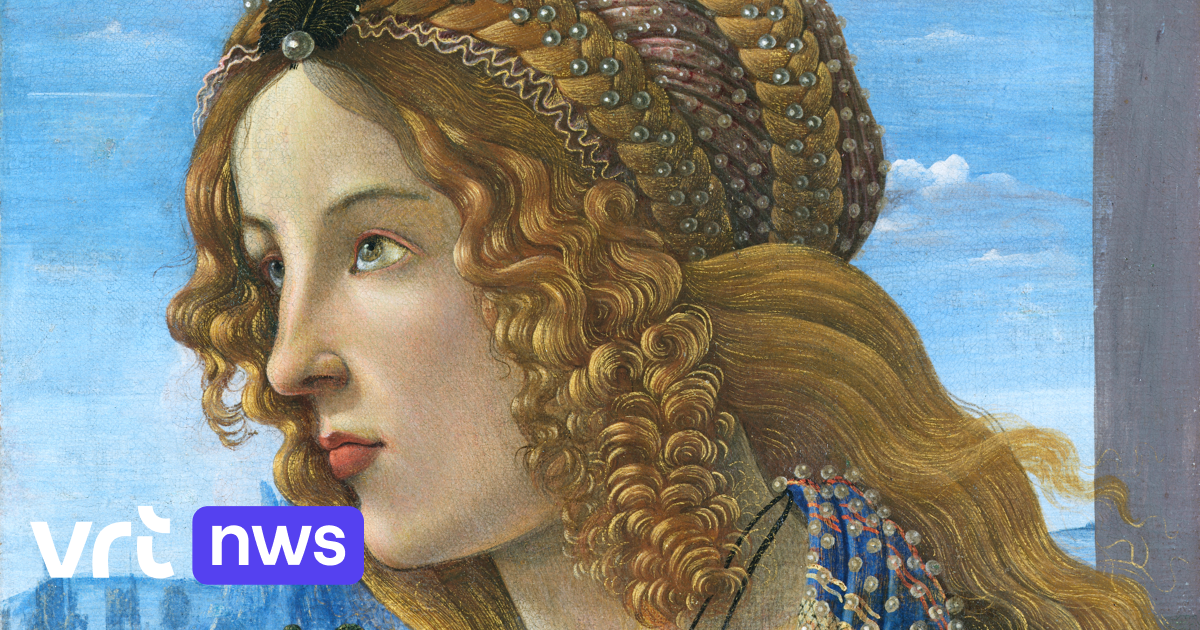
A stunning Botticelli
A major highlight of the exhibition is the Allegorical Portrait of a Woman, painted around 1490 by Sandro Botticelli. A “beautiful” woman is depicted against a bright blue sky. Pearls are stitched into her intricate braided hairstyle and onto her dress and scarf. With her fingers, she squeezes milk from her right breast, like a goddess of fertility, or a kind of Madonna, but without a child in the picture.
Botticelli most likely used Simonetta Vespucci as his model, the same woman who appears in one of his most famous paintings, “The Birth of Venus”. Simonetta died at the age of 23. The painting on display in Brussels comes from a private collection.
Even more “ideal” beauty can be found in Titian’s paintings. Like in his portrait of Giulia Gonzaga, where he clearly exaggerated her fair skin and red cheeks. In a letter she wrote that he had made her look much prettier than she really was.
In contrast to the “positive” nature of all that beauty, one could consider the artworks with “ugly” images as the “negative”. But it’s not that simple, says Zoë Gray. ‘The divine ideal and the grotesque gaze are equally important. This is not about two fixed poles, but about interaction and how one reinforces the other.’
The exhibition constantly moves the viewer back and forth between the “ideal”, the “realistic” and the “caricatural”.
Quite a few artists were fascinated by people with imperfections. The Dutch painter Willem Key painted a portrait of Magret Halseboer, also known as “The Woman with Two Beards”. Bozar also has a sketch of an old woman by none other than Michelangelo. Old faces with wrinkles or strange noses: always interesting to paint!
But this also says a lot about the relationship between artist and model, says Zoë Gray: ‘People with power are never depicted as ugly, but people on the margins are.’