
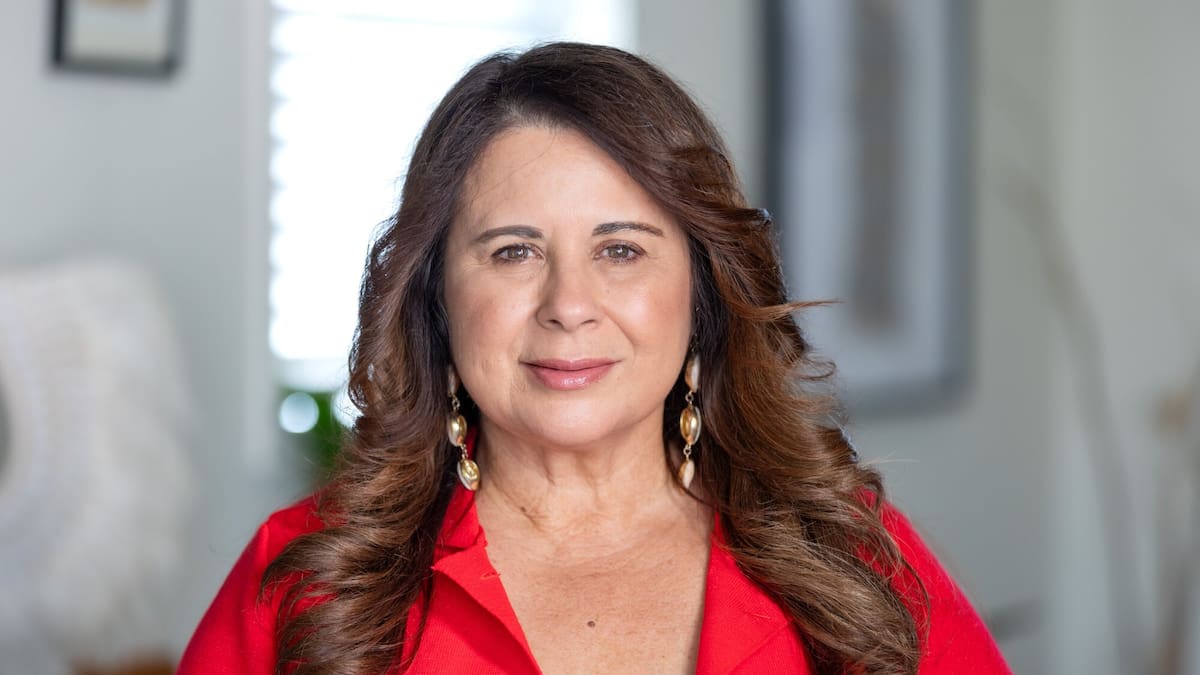
Staring down the barrel of the camera, she’s holding her ground with a focused and unflinching gaze. People have told her she looks strong and serious in the photo. In fact, she was furious.
“Honestly, I was pissed off at what had just happened,” she says, although exactly what had happened remains opaque. “The incident left more questions than answers.”
TVNZ’s Pacific correspondent Barbara Dreaver in 2018 reporting on Cyclone Gita, the most severe storm to hit Tonga since records began.
Verbal and physical threats are nothing new for the Kiribati-born journalist, who’s been based in Auckland as the Pacific correspondent for 1News since 2003.
The level of personal courage she has required as a frontline reporter will surprise many who delve into her memoir, but Dreaver has been ruffling feathers – in the islands and back home in New Zealand – since she was a rookie.
In her first job out of journalism school, she wrote a series called “Crooks in the Cooks” for the Cook Island News in Rarotonga, and a local MP called for her to be deported. In 2008, she was banned from Fiji for eight years after reporting on poverty there.
Championing coverage of Pasifika issues in the mainstream media, Dreaver has broken some of the region’s most significant stories, from political corruption and financial scandals to the impact of climate change and China’s creeping influence in the Pacific.
Along the way, she’s navigated crocodile-infested swamps and filmed among live mustard-gas shells in the Solomons, been detained by the police in Nauru, and visited communities devastated by cyclones, earthquakes and tsunami.
In the days before stricter health and safety rules kicked in, she and camera operator Raymond Moore once flew so close to an erupting volcano in Vanuatu that spewing debris left dents in the side of their charter plane.
Bill Ralston, then TVNZ’s head of news and current affairs, high-fived Dreaver when she returned with the dramatic footage.
“There were lots of things we did back then that we didn’t even question,” she says, with a hint of regret. “I do like a good adventure tale.”
Dreaver interviews former Fiji Prime Minister and 1987 coup leader Sitiveni Rabuka after his acquittal on electoral fraud. Rabuka was returned to power in the country’s 2022 general election.
It hasn’t always been easy, as a woman reporting on the Pacific, which remains a volatile region. Egos can be “very fragile” and male leaders don’t always appreciate being challenged by a female journalist.
Dreaver, who never reveals her sources, has chosen to protect the identity of certain people in her book.
“Things can change quite quickly and I’m very aware that I don’t want to put a target on anyone’s back,” she says.
“I’m not including politicians in that. They have to wear it, right? And I’ve been around for so long now they’ve kind of got used to me.”
The title of her memoir, Be Brave, is a reference to the advice Dreaver gives to young journalists, especially those working in the Pacific. (“Without fear or favour” is her other motto.)
That might mean asking difficult questions or pursuing an important story, knowing some people might be upset or offended by it.
At the height of the Covid epidemic, Dreaver took on an advocacy role, calling out the New Zealand Government for its failure to engage in good faith with Pacific health providers.
Later, she faced vitriolic abuse on social media from the other side of the fence after revealing four positive cases had been discovered in a Pasifika family, following 100 days without community spread.
Writing a script on the beach in Samoa for that evening’s 6pm news bulletin. Photo / Steve Lawton
Fears the story would trigger a racist backlash weren’t unfounded, but Dreaver still believes suppressing that information would have been irresponsible.
“There was a lot of hurt over that. It’s hard, you know, with my community because they’re targeted a lot anyway. But I had to do it because there were lives at risk,” she says.
“I defined early on that my job is not to do glowing stories about the Pacific. My job is to give Pacific people a voice and expose both the good and its flaws, because I’ve got to tell the truth.
“What’s hard is dealing with the fallout that I know is coming. And so I just have to brace myself and be brave. You have to be brave to be a journalist. And that’s something I’ve muttered to myself when I’ve been in a really bad situation.”
Dreaver found herself in one of those tight spots when she was detained in Nauru (for reasons that have never been made clear) while covering the Pacific Islands Forum in 2018. Police officers plucked her off the street, confiscating her camera and phone.
Eventually released several hours later, after being stripped of her media accreditation, she crossed live to TVNZ for the 6pm news.
Dreaver speaks to the media after being released from police detention in Nauru in 2018. Photo / Jason Oxenham
The time she felt most in danger, however, was as a much less-experienced radio reporter covering the Fiji coup in 2000. Armed rebels led by local businessman George Speight had stormed the Parliament building and taken the Government hostage.
Making her way inside the compound, Dreaver secured the first live international interview with Speight on Radio New Zealand, but tensions were high.
At night, some young rebels – “high or drunk” – tried to break into her sleeping area, and there was talk that one of the hostages would be executed, using the media as witnesses.
“I don’t know if they would have or not, but it felt like anything was possible.”
Speight was eventually arrested, and Dreaver was in court to see him sentenced to death for treason, although the penalty was commuted to life imprisonment. He was released from jail in 2024 after being granted a presidential pardon.
Understanding the Pacific and its complex history of interwoven relationships is like peeling away the layers of an onion, she says. Power dynamics in the region are more nuanced and journalists can fall out of favour on a political whim.
“But at the same time, I’m not going to pander to that. There are times when I’ll be cut off from a prime minister for ages because I’ve done something they particularly don’t like. Well, tough, because I’m going to keep doing it, with or without them.”
Dreaver was born on Ocean Island (now Banaba), a coral atoll in Kiribati that for decades was infamously strip-mined for its phosphate deposits, stripping away 90% of the island’s surface.
When the family settled back in New Zealand in the late 70s, her parents carried a piece of the atoll with them.
The chunk of phosphate now sits on display at Dreaver’s Auckland home – a link to the past, but also a reminder of how the Pacific Islands have been commodified and exploited for their physical and human resources.
Dreaver (right) and her sister Rachel spent their young childhood in Kiribati, then a British colony. Their school bell was a shell from World War II.
Dreaver’s Kiwi father had been posted to Kiribati (then the Gilbert and Ellice Islands) in the 60s as an adult education officer with Volunteer Service Abroad. He and her mother met on the main island of Tarawa, where Dreaver spent much of her early childhood.
After graduating with a BA in education from the University of Auckland, Dreaver did a six-month Pacific Islands Journalism Course at the Manukau Institute of Technology. She came top of the class, but whether it was racism or snobbery, no one wanted to hire her.
Decamping to Rarotonga, where she cut her teeth as a journalist, she spent several years as co-owner and editor of a weekly newspaper, the Cook Islands Press, with her then partner, Jason Brown.
“Every Monday, we would wake to find confidential documents slipped under the door by people angry at the corrupt Government,” she writes in Be Brave.
Life took another twist in 1998, when Dreaver moved back to Auckland with her baby son and found the media landscape was just as she’d left it eight years earlier – “unwelcoming and discriminatory”.
After a stint with Radio New Zealand, she moved to TVNZ, which was establishing a Pacific unit led by Ewart Barnsley, who later moved to Fair Go.
“In those early days, I learned how to fight for story placement in the news bulletin,” she writes. “Sometimes, Pacific stories weren’t valued. Over the years, that changed.”
A highly respected journalist, Dreaver’s presence belies her diminutive stature. (It’s true, people really do look taller on TV.)
During Dame Jacinda Ardern’s first visit to the Pacific as Prime Minister in 2018, one member of the media pack remembers Dreaver ditching anything on the official schedule she considered a waste of time and heading off to film independently.
Describing herself as a “control freak”, she also likes to edit her own stories. Often she’s running on sheer adrenalin.
“I love chasing bad people,” she says, “and I don’t like injustice. So when I chase people, it’s kind of fun.”
Dreaver with school children in the Samoan village of Lalomanu, on the first anniversary of a tsunami that killed more than 140 people in 2009. Photo / Steve Lawton
Con artists are among her favourite targets – and there have been plenty of those. In 2003, multimillionaire property developer Mark Lyon took up residency in the Cook Islands under dubious circumstances, after being convicted of drugs, assault and weapons charges in New Zealand.
After allegations of sexual misconduct and drug use at Lyon’s home involving young girls, which Dreaver reported on, the Government ejected him.
Scams she’s exposed include a crypto scheme in Tonga, a “driver’s licence for cash” scandal, and the dodgy dealings of a US adoption agency in Samoa. The FBI was involved in that one.
Last year, her investigation into cartels behind the Pacific’s meth crisis uncovered distressing accounts of young children being offered for sex in exchange for drugs.
In Fiji, HIV infections from shared needles are spiking. A common practice is “bluetoothing”, where someone shoots up with meth and then injects their blood into others to share the high.
The funeral of 1-year-old Lologa and his 6-month-old cousin Isaako Junior, who died of measles two days apart during the 2019 outbreak in Samoa.
One of the most traumatic events Dreaver covered was the measles outbreak in Samoa that killed 83 people in 2019, most of them small children.
Her stories, which included revelations that Robert F. Kennedy jnr had been flown in as the guest of honour at a high-level anti-vax meeting, won two Voyager Media Awards.
Be Brave is dedicated to her brother, Andrew, who committed suicide in 2013 at the age of 34. Dreaver, a fiercely private person, found that one of the hardest chapters to write.
“Reporters are just reporters and I don’t like to blur that line,” she says. “But grief is a terrible thing. When you go through something so traumatic, it affects you on a personal level, but it also affects your professional life.
“You become more compassionate – you’d hope that would be the case – and it gave me tools to work with and understand people more when they’re in the throes of the most terrible situations of their lives.
“Also, you know, I love my brother, and yeah, I’m thrilled that I can dedicate the book to him, because he’d be so proud of me.”
Be Brave: The Life of a Pacific Correspondent, by Barbara Dreaver (Awa Press, $45).
Joanna Wane is a senior lifestyle writer with a special interest in social issues and the arts.