
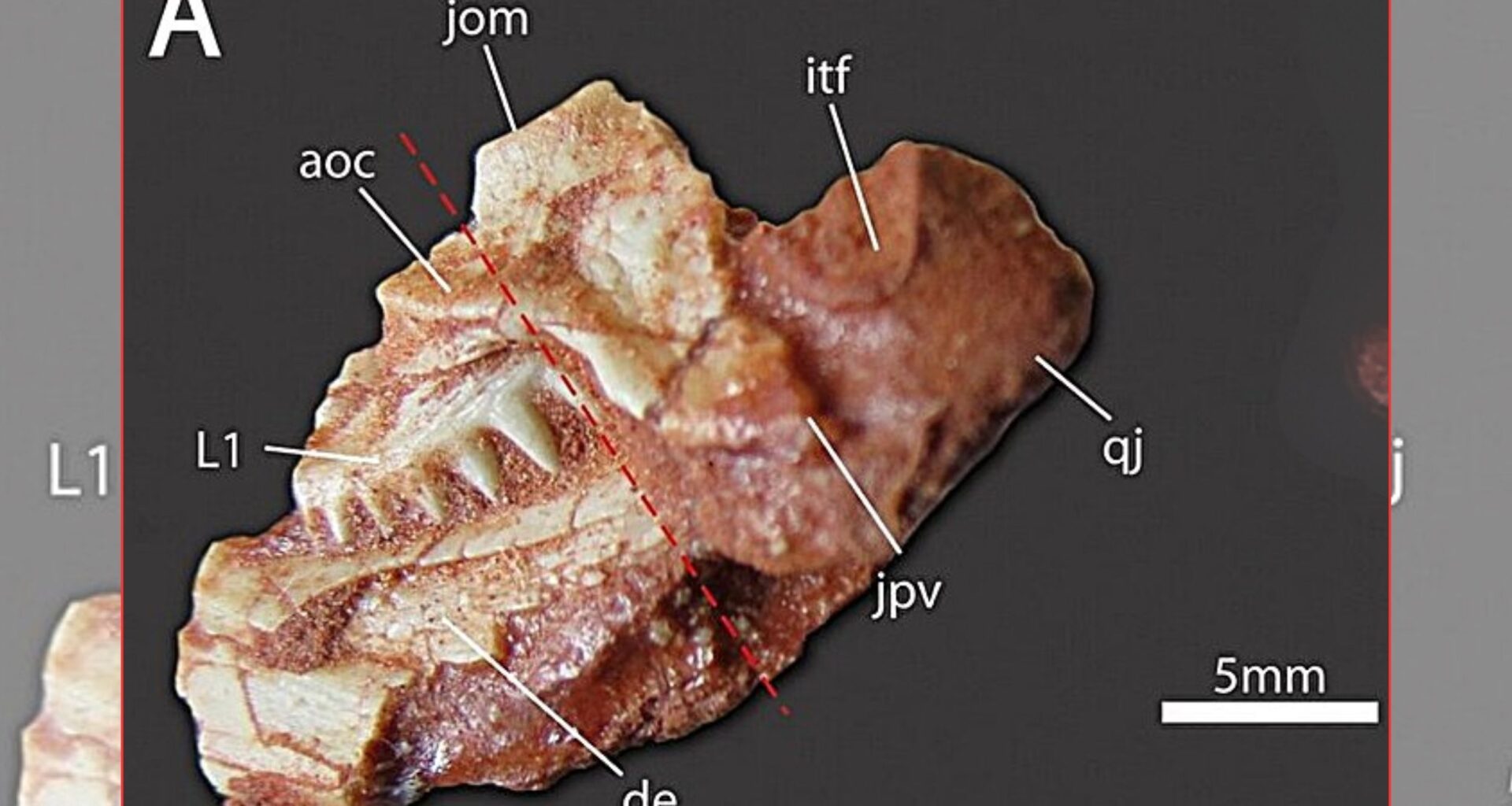
A fossil skull barely 1 inch long has proved to be a newborn reptile from Brazil’s Late Triassic, a period more than 230 million years ago when early reptiles dominated land ecosystems.
Its tiny jaw already carries the cutting surfaces seen in adults, but its still-growing teeth can fool classification.
Rhynchosaur skull in fragments

Two pebble-sized rock pieces from southern Brazil held a tiny skull and jaw, pressed flat but still intact.
Rebuilding those fragments in 3D, paleontologist Dr. Flávio Augusto Pretto at the Universidade Federal de Santa Maria (UFSM) identified a hatchling.
Unworn teeth and thin bones let Pretto’s UFSM team treat the animal as a hatchling, not a small adult.
Even at that age, the skull carried enough landmarks to compare with adults, yet it still lacked some finishing touches.
A rhynchosaur hatchling fossil
The analysis placed the hatchling among rhynchosaurs, plant-eating reptiles that spread across wide Triassic landscapes.
Instead of simple pointed teeth, many rhynchosaurs grew upper tooth plates that met a blade on the lower jaw.
Across southern Brazil, scientists have named only five rhynchosaur species, so a baby adds a rare new data point.
That early snapshot matters because young skulls can look unfamiliar, yet they capture growth steps adults no longer show.
Teeth show age
Clean tooth tips marked the fossil as a perinate, a baby still near hatching age. With little wear, the teeth had not yet scraped against tough plants, which usually dulls edges in adults.
Several adult markers still appeared, including a reinforced mouth edge and a lower-jaw shape built for tight closure.
Because teeth keep developing after hatching, some dental clues can look incomplete even when they belong to the right species.
Growing more tooth rows
Over time, rhynchosaurs added rows as their jaws widened, leaving young animals with simpler dental patterns.
New teeth likely formed behind older ones, and the chewing surface expanded as the skull grew longer and deeper.
In the Brazilian hatchling, only one row showed on each side of the upper tooth plate. Such early simplicity can make a newborn seem closer to distant relatives, even when it belongs inside a well-known branch.
When lineages mislead
To sort the hatchling into a lineage, the team ran a phylogenetic analysis, a method for mapping how species are related.
Including tooth-row counts pushed the fossil toward a more primitive spot, and several known species fell out of place.
Removing that age-sensitive feature let the skull return to the expected branch, and the displaced species returned too.
That swing showed why baby traits can scramble relationships, especially when scientists compare species by counts that change with growth.
A cautious species call
Detailed comparisons in the paper linked the hatchling to Macrocephalosaurus mariensis, a species known from southern Brazil. One groove on the upper tooth plate and two tooth rows on the lower jaw matched that species best.
At the Buriol Site in Rio Grande do Sul, Brazil’s far south, the find hinted at two close relatives living together.
Such overlap raises the stakes for getting juvenile traits right, since a misread tooth row could inflate diversity.
Where the rocks sit
Layered red rocks at the Buriol Site held the hatchling, but the exact layer still lacks a direct date.
Nearby rock layers limit the deposit to about 233 million years ago, near the middle of the Late Triassic.
At that time, rivers and floodplains covered parts of southern Brazil, burying bones quickly enough for rare baby fossils to survive.
Because hatchlings decay fast and attract scavengers, even one well-preserved skull can reshape what a site seems to contain.
Scanning without breaking
An accidental break would have ruined the skull, so the team avoided physical preparation on the fragile pieces.
Using micro-CT scanning, a 3D X-ray method for tiny objects, they mapped each bone without touching it.
“The fossil is indeed very fragile, so any accidental break during preparation would be practically irreversible,” said Pretto.
That scan also revealed how the teeth sat in the jaw, details that would have stayed buried in stone.
More fossils likely
Field crews from UFSM kept returning to the Buriol Site, and the team expected more bones from the same rock layers.
Each new juvenile could fill gaps between hatchlings and adults, letting scientists track when tooth rows and ridges appear.
“We visit the site several times per year, and it is still yielding fossils, so more discoveries shall be announced in the future!” said Pretto.
More hatchlings would also test whether that tentative identification holds, or whether a close cousin shared the same baby teeth.
Small skull, big caution
That tiny skull showed that some jaw traits matured early, while tooth patterns kept changing as rhynchosaurs grew.
Better growth series from Buriol could help scientists avoid mistaking youth for ancestry when they classify new fossils.
The study is published in Journal of Systematic Palaeontology.
—–
Like what you read? Subscribe to our newsletter for engaging articles, exclusive content, and the latest updates.
Check us out on EarthSnap, a free app brought to you by Eric Ralls and Earth.com.
—–