
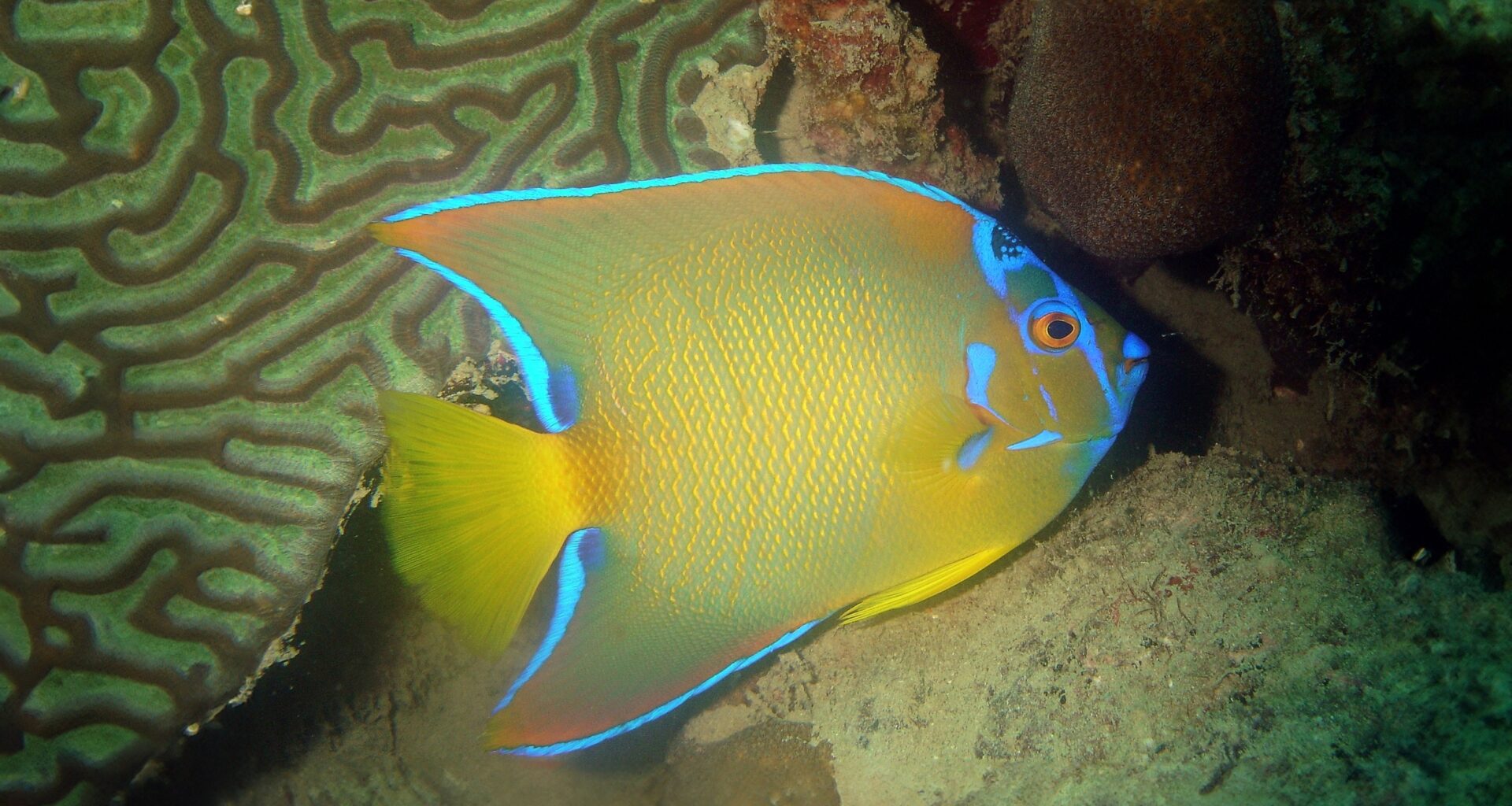
Coral reefs resemble underwater cities bursting with color. Bright yellow stripes, bold black bands, and eye-like spots glide across the reef as fish weave through the coral.
Researchers the University of Liège (ULiège) recently asked an intriguing question: Why does a Caribbean angelfish sometimes look strikingly similar to a fish living thousands of miles away in the Indo-Pacific?

Instead of assuming that color patterns appear randomly, the team looked closely at how these patterns evolve.
The study revealed something surprising. The diversity of patterns in reef fish follows clear evolutionary rules, and the number of species living in a region strongly influences how many patterns appear.
A closer look at reef fish colors
Anyone who has seen a coral reef knows how colorful reef fish can be. Some fish carry neat horizontal stripes that run along the body.
Other species have vertical bands, round spots, or large eye-shaped marks that can confuse predators. Certain fish even display patterns that look like saddles or complex maze-like designs.
These patterns do not exist just for decoration. Color patterns help fish communicate with each other, attract mates, and sometimes avoid predators.
A clear pattern also helps fish recognize members of the same species. When hundreds of species share the same reef, this recognition becomes extremely important.
Because coral reefs contain so many fish species, scientists have long wondered how such an incredible variety of patterns developed.
Studying nearly 1,000 species
To understand this diversity, evolutionary biologist Bruno Frédérich and colleagues studied pigmentation patterns in coral reef fish.
The team examined 918 species from six major fish families that live in reefs across the world – including surgeonfish, butterflyfish, snappers, goatfish, angelfish, and damselfish.
Researchers carefully analyzed photographs of each species and recorded about 30 different types of patterns. These included stripes, spots, blotches, and other shapes found on different parts of the fish body.
The study covered five large ocean regions: the Atlantic Ocean, the Western Indian Ocean, the Central Indo-Pacific, the Central Pacific, and the tropical Eastern Pacific.
Comparing fish across these regions allowed the scientists to see how pattern diversity changes around the world.
More fish species create more patterns
One important result appeared very quickly during the analysis. Regions that contain more fish species also show more color patterns.
“The most striking initial finding is that we were able to link color pattern diversity to the number of species present in a region,” said Frédérich.
This relationship makes sense when thinking about how species form. When new species evolve, clear visual signals help individuals recognize their own kind.
Different patterns help fish choose the right mate and avoid confusion with other species living nearby.
Patterns evolve quickly
Another discovery surprised the research team. Color patterns in reef fish can change very quickly during evolution.
“They evolve very quickly, but within a limited space,” said Frédérich.
In simple terms, fish explore many possible designs, but biological systems inside the body limit how far those designs can go. Even though patterns change rapidly, the basic types of patterns remain similar across many fish species.
The scientists also found that many pattern changes happened fairly recently in evolutionary history. Much of the diversity seen today likely appeared during the last several million years.
Distant fish that look alike
This combination of fast change and biological limits produces an interesting effect. Fish species that live far apart sometimes end up with very similar patterns. Scientists call this phenomenon evolutionary convergence.
Instead of creating completely new designs every time, evolution often returns to the same set of patterns. Stripes, spots, and simple shapes appear again and again in different fish families.
As a result, a fish swimming near Caribbean reefs can resemble a species living in the Indo-Pacific, even though the two species evolved in different oceans.
Biology shapes the color patterns
The limits on pattern diversity come from processes inside the fish body.
Special pigment cells interact with each other while the fish develops. These cells organize themselves in ways that produce stripes, spots, and other shapes on the skin.
Research on other fish, including zebrafish, has shown how signals between pigment cells help build these patterns.
Because many fish share similar pigment cells and developmental systems, similar patterns appear across many species.
Fish evolution and color patterns
The bright colors of coral reef fish may seem like pure beauty at first glance. A closer look reveals something much deeper.
Each stripe and spot carries clues about how species evolve and how animals recognize each other.
The work from the University of Liège shows that color pattern diversity depends on three main forces.
Species diversity increases the number of patterns, evolution changes patterns quickly, and biological systems limit the range of possible designs.
The study is published in the journal BMC Biology.
—–
Like what you read? Subscribe to our newsletter for engaging articles, exclusive content, and the latest updates.
Check us out on EarthSnap, a free app brought to you by Eric Ralls and Earth.com.
—–