
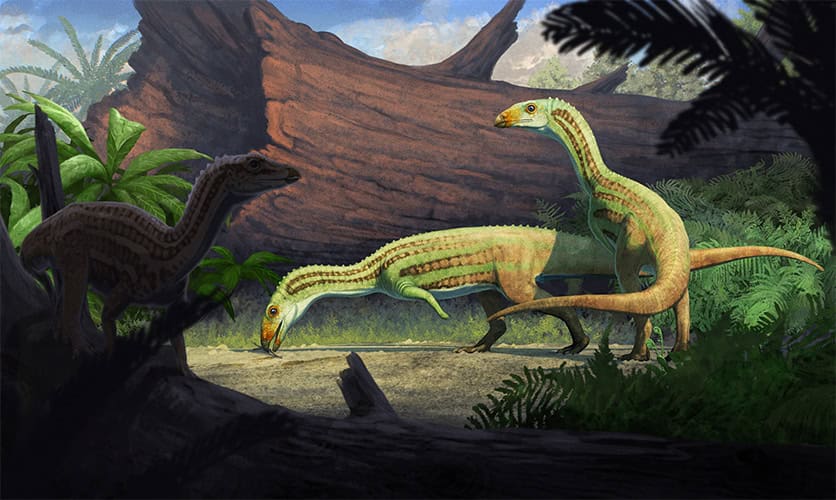
 Artist’s reconstruction of Sonselasuchus cedrus in its environment in what is now Petrified Forest National Park, 215 million years ago. Credit: Gabriel Ugueto.
When you picture an ancient crocodile from millions of years ago, you probably imagine a low-slung, scaly water predator waiting patiently to ambush its prey.
But the deep history of the crocodile family tree is far more bizarre and, frankly, interesting.
Crocodiles are often called “living fossils” because of their lineage dating back over 200 million years and their resemblance to ancient ancestors, but this label is misleading. Crocs have undergone significant evolutionary changes in their metabolism, immune systems, and ecological adaptations.
And as a new study shows, some members of the crocodilian line are completely different from what you’d expect.
A Curious Crocodile Relative
Deep in the Late Triassic period, roughly 225 to 201 million years ago, the crocodile family tree was experimenting with some wildly unconventional body plans. In the American Southwest, paleontologists have unearthed a poodle-sized, toothless ancient croc relative that actually learned to walk on two legs as it grew up.
This was Sonselasuchus cedrus, a peculiar ancient reptile that lived among evergreen coniferous trees.
“This animal belongs to a group called the Shuvosauridae, a group of crocodile-line archosaurs that have a number of convergently evolved features with dinosaurs, including a toothless beak and hollow bones,” lead author Elliott Armour Smith, a graduate student at the University of Washington, told ZME Science.
According to Armour Smith and his colleague Professor Christian Sidor, this animal actually changed its posture as it aged.
×
Thank you! One more thing…
Please check your inbox and confirm your subscription.
“Essentially, we think these creatures started out their lives on four legs . . . they then started walking on two legs as they grew up,” Armour Smith explains in a press release.
“This is particularly peculiar.”
A Bizarre Transformation in the Triassic
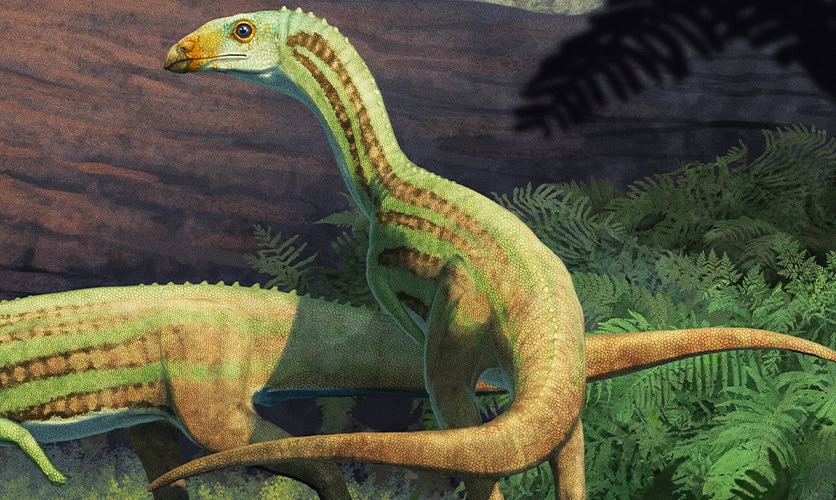 Credit: Gabriel Ugueto.
How do we know an extinct animal changed the way it walked? First, you need a lot of fossils.
Starting in 2014, a team led by Professor Sidor spent a decade excavating a massive bonebed in Arizona’s Petrified Forest National Park. They unearthed over 3,000 fossils, including fish, amphibians, and dinosaurs.
“What is particularly interesting about Sonselasuchus is that it is described from a large number of individual skeletons (at least 36 individuals) and over 950 bones,” Armour Smith told me in an email.
This massive sample size allowed researchers to see how the animal’s skeleton changed from youth to adulthood.
They noticed that the proportions of the limbs shifted dramatically, suggesting Sonselasuchus moved about on four legs as a juvenile but later walked (at least sometimes) on its hind legs in adulthood.
“We think that Sonselasuchus had more proportional forelimbs and hindlimbs as young, and their hindlimb grew longer and more robust through adulthood,” Armour Smith explains.
A Useful Adaptation
Does any modern animal do this? You need not look far.
“A transition from quadrupedalism to bipedalism is actually more common than one might think. We as humans undergo this transition,” Armour Smith points out.
Beyond human toddlers, you can find this “ontogenetic shift” in modern lizard species. Spiny-tailed iguanas are habitual quadrupeds that choose bipedalism when they need to hit top speeds, essentially shifting gears on the fly. Even some primates, like Japanese macaques, have been known to adopt bipedal gaits as they mature through behavioral training or environmental necessity.
As the ancient reptiles grew larger, they shifted from using all four limbs to primarily using their back legs.
“At the end of the day, this is a hypothesis and it will require more testing to understand how Sonselasuchus stood, walked, and behaved. Perhaps Sonselasuchus had the ability to transition between quadrupedal and bipedal behavior both voluntarily and seamlessly, what is known as being a ‘facultative’ biped,” Armour Smith adds.
The Ostrich-Crocs of the Ancient World
 Reconstructed skeleton of Shuvosaurus inexpectatus. Assembled and designed by Doug Cunningham. Credit: Photograph by Bill
Mueller.
Sonselasuchus belonged to a bizarre family of reptiles called the shuvosaurids. To understand just how strange these animals were, we can look at their close relative, Shuvosaurus inexpectatus.
Detailed anatomical studies of Shuvosaurus reveal an animal that looked astonishingly like an ostrich dinosaur, complete with a toothless beak and a highly specialized skeleton built for running. In fact, early paleontologists initially mistook Shuvosaurus remains for those of a theropod dinosaur because the resemblance was so striking.
This is a classic example of convergent evolution. While Sonselasuchus and Shuvosaurus are close relatives because they share a specialized branch of the reptile family tree, they belong to the Pseudosuchia (the crocodile lineage). They are biologically distinct from the Avemetatarsalia (the dinosaur-bird lineage).
These two groups — the ancestors of modern crocodiles and the ancestors of dinosaurs — diverged from a common archosaur ancestor over 250 million years ago. Despite being separated by this massive evolutionary gap, they faced similar environmental pressures in the Triassic landscape. And this caused them to independently evolve the exact same survival traits, such as bipedalism and beaked skulls. Evolution essentially arrived at the same high-speed runner blueprint twice, using two completely different sets of biological materials.
“Although similar to the ornithomimid dinosaurs these features would have evolved separately,” explains Armour Smith.
He notes that “this similarity was probably due to the fact that croc-line and bird-line archosaurs evolved in the same ecosystems and converged upon similar ecological roles.”
“Also, despite the fact that features like bipedalism, a toothless beak, hollow bones and a large orbit are characteristic of ornithomimid theropod dinosaurs, shuvosaurids like Sonselasuchus show that these features evolved on the croc-line as well,” he adds.
Surviving a Predator-Filled Forest
You might wonder why a crocodile relative would bother standing up. At a mere 25 inches tall, Sonselasuchus was not exactly an intimidating giant.
However, standing on its hind legs might have offered a distinct survival advantage. Being able to rear up could have allowed the animal to spot approaching predators over the brush or reach higher vegetation for food.
“I think Sonselasuchus was likely at a low to mid-tier in the food chain,” Armour Smith told ZME Science.
Without teeth, they likely used their beaks to eat soft plant matter, though they might have also snacked on small invertebrates or fish.
They needed to be fast and alert, because the Triassic period was full of massive apex predators.
“That being said, a top-tier predator like the carnivorous Postosuchus or the aquatic phytosaurs could have easily made Sonselasuchus lunch,” says Armour Smith.
Shattering the ‘Living Fossil’ Myth
We often call modern crocodiles “living fossils,” assuming they have remained unchanged for hundreds of millions of years.
Discoveries like Sonselasuchus and Shuvosaurus prove this idea completely wrong.
The ancient ancestors of crocodiles were incredibly diverse. They filled almost every ecological niche imaginable, from fully marine swimmers to fast-running, terrestrial herbivores.
“When we see today’s crocodiles and alligators, we call them “living fossils”,” Armour Smith says.
“However, when we look at their evolutionary history as documented by the fossil record, we see that these are animals that had a fantastic diversity of body shape, diets (herbivores and carnivores) and ecological domains (freshwater aquatic, terrestrial, and fully marine)”.
The crocodile line wasn’t a boring, stagnant evolutionary path. It was a wildly creative engine of biological innovation.
“So yes, I do think Sonselasuchus was evolutionarily “creative”, but I also think that today’s crocodiles and alligators are as evolutionarily creative in their own way compared to their extinct cousins,” Armour Smith concludes.
The new findings appeared in the Journal of Vertebrate Paleontology.