
They used to call your landline in the middle of dinner, back when most of us had landlines. Now, pollsters scrutinise us in more complex ways.
David Farrar and David Talbot are two of the most influential figures in New Zealand politics: they’re the pollsters for the major political
parties, as well as various other clients. Farrar worked in Parliament before setting up his own firm in 2004. John Key once described him as “the best pollster in New Zealand”. Talbot also worked in Parliament and served as pollster and strategist to Jacinda Ardern and Chris Hipkins before establishing Talbot Mills Research.
Farrar’s company, Curia, still calls landlines: they account for 10-15% of his responses. The rest of the data collection happens via online panels and cellphone surveys. “There are quite a lot of pensioners in their retirement homes who still make sure they get out and vote every three years,” and they’re hard to find online. The panels draw their respondents from pools of tens of thousands of voters, demographically weighted. Mobile phones capture 40- to 60-year-olds.
“It’s not as purely random as 40 years ago,” Farrar says. “Everyone was at home in the evening, everyone had a landline, everyone answered the phone.”
Now, pollsters build a representative picture from fragments, weighting for age, gender, region, sometimes previous party vote – itself unreliable.
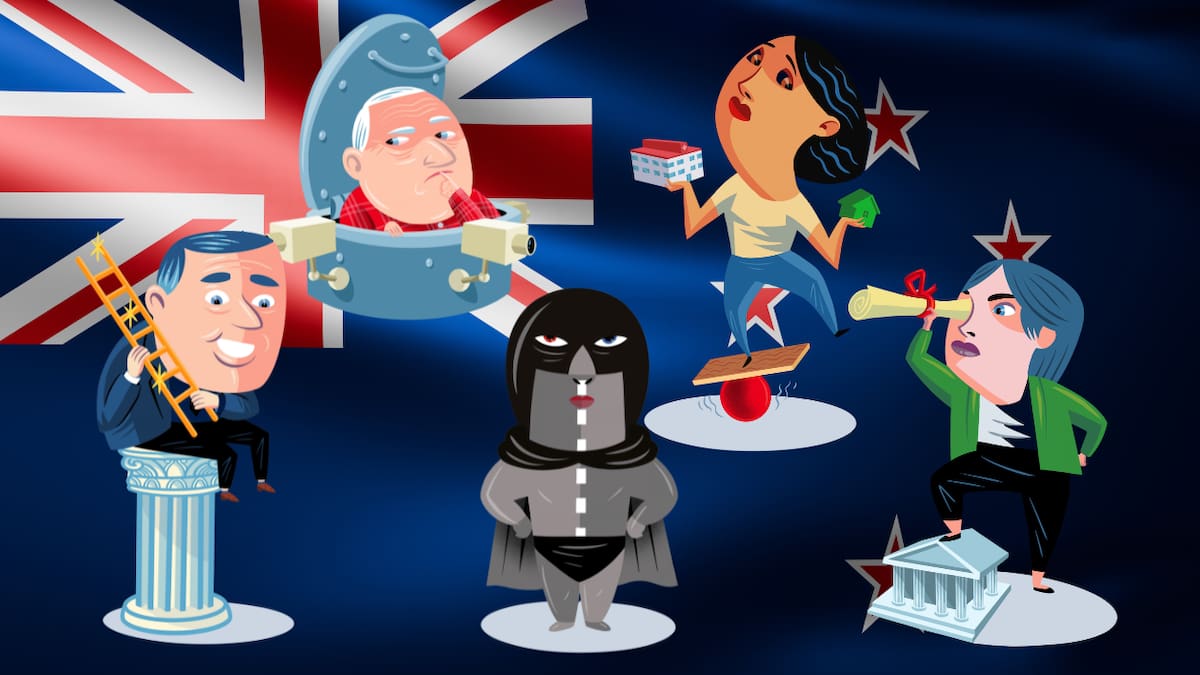
Image / Listener Illustration
“When a party becomes unpopular, you get fewer people saying they voted for that party. There have been times in the past you just couldn’t find a Winston [Peters] voter.”
To screen out people who aren’t taking the poll seriously, he includes trap questions. His recent favourite: “Do you have a current licence to pilot a space shuttle?” About 4% say yes.
Between them, Talbot and Farrar have briefed every prime minister since Helen Clark. Both agree that the electorate has become harder to read.
The Listener met Talbot on one of Wellington’s all-too-rare great days, sitting in the sun in Midland Park. (Chris Hipkins’ fiancée waved to him as she walked past.) In his focus groups, almost nobody reads a daily paper, even online. Almost nobody watches the six o’clock news. “It’s not just that the media market has moved somewhere else,” he says, “it’s that it’s contracted.”
The institutions that once gave voters a shared understanding of politics – newspapers, churches, unions – are weaker than they were. Voters still hold opinions, but they’ve lost the common frame that used to organise them.
Farrar sees the same thing from his side. “People used to be more tribal,” he says. “You would hear, ‘I’m a National voter,’ ‘I’m a Labour voter.’ Husbands and wives often voted the same way, and that’s definitely no longer the case.”
The baseline used to be roughly 40% Labour, 40% National, 20% up for grabs. “We’ve had Labour down to 25%, National down to 21%. The institutional loyalty is a lot lower than in the past. It’s far more fluid.”
Whose side are you on?
In 1987, Labour nearly won Remuera. For its then-leader David Lange, this rang alarm bells. “That was an apprehension on my part, that we had actually abandoned our constituency,” he later recalled. “And that struck me as being a dangerous flirtation, and an act of treachery to the people we were born to represent.”
That same year, academics Jack Vowles, now of Victoria University of Wellington, and the University of Auckland’s Peter Aimer undertook the first systematic survey of the New Zealand electorate. They asked a sample of voters what their values were, which party they supported and why, interrogating the questions Lange fretted over – Do you believe having a strong leader in government is good for New Zealand even if the leader bends the rules to get things done? Should references to the Treaty of Waitangi be removed from the law? Is abortion always wrong? – questioning who the parties sought to represent, and whether they really did so.
After the 1990 election, they expanded their work and the survey has followed every election since then. The result is a 36-year body of research holding up a political mirror to the nation, tracking the impacts of MMP, recessions, pandemics, the rise of Helen Clark, John Key, Jacinda Ardern, the many falls and miraculous returns of Winston Peters. It tells the same story Farrar and Talbot see in their own research: the old loyalties – Labour for the working class, National for farmers and business owners – are breaking down or have already broken.
The Listener took the responses to 40 questions about values, trust and political interest from the 2023 Electoral Survey and identified groups that gave similar answers to each other, and who shared similar levels of wealth, age and education. These are the tribes that occupy the political landscape of modern New Zealand.
Today, both the left and the right are divided by economic class. Left-wing political parties are run by “Educated Progressives”: upper-middle class professionals with advanced degrees who own their own homes, unlike the “Precarious Left”, who are disproportionately young, Māori and Pasifika, female, earning below average incomes. The “Establishment Right” are wealthy property owners, less educated but older. Beneath them sit the “Alienated Conservatives”: also older, predominantly male, but far less likely to own property or have an income in the top bracket.
Left and right both compete for a large centrist tribe, “Middle New Zealand”. It makes up 26% of the electorate and is the hardest group to characterise because its defining feature is the absence of strong positions. This group decides elections by voting for whoever seems competent.
On the left
In 2023, the most polarising topic in New Zealand politics was the Treaty of Waitangi. It wasn’t the most important issue to most voters – that would be the economy, followed by the cost of living. But it was the strongest indicator of which side of the political divide you cast your vote. Where you stood on the treaty connected to where you stood on almost everything else: redistribution, climate, unions, gender equity …
Back in 1990, the year of the first large-scale electoral survey, the majority of Labour voters were members of the traditional working class, an identity that’s largely vanished from New Zealand politics. They were economically left-wing, pro-union, pro-redistribution of wealth and in favour of a strong public health system, but sceptical of the treaty and opposed to Māori having more voice in how the country was run.
Labour’s leader that year was Mike Moore, who left school at 14 to become a meat worker and a union delegate. By 1993, the party was led by Helen Clark, a political science lecturer – an archetypal Educated Progressive whose tribe would come to dominate left-wing politics.
The archetypal Educated Progressive is a woman who votes Labour and Green. She works in health policy or law or runs a non-government organisation in Tāmaki Makaurau. She owns her home. She’s not wealthy by the standards of the leafy suburb she lives in, but not precarious, either.
Educated progressives: Highly qualified, though not wealthy, professionals who support co-governance, wealth redistribution and climate change policies. Believe their vote counts. Image / Anthony Ellison
She comprises 21% of the electorate, is three times more likely to hold a postgraduate degree, and is the most politically engaged tribe in the dataset. She trusts institutions. She votes. She has never seriously worried that a person like her has no say. She supports co-governance, wealth redistribution, stronger climate policy and union rights.
But she works in the sectors that grow when the government grows – healthcare administration, tertiary education, law, the public service, consultancies – and her vision for a larger state inevitably means more high-income jobs for people with advanced degrees. Her interests and her ideals are conveniently aligned.
Precarious Left: Qualifications haven’t translated into security: only 11% own their own homes. Cynical. Image / Anthony Ellison
The Precarious Left is a woman who votes Labour, too, when she votes. She’s younger – average age 42, the youngest tribe – and she is more likely to be Māori or Pasifika, more likely to be raising kids alone, more likely to rent. She works in early childhood education or aged care or as a community health worker: essential jobs that don’t pay enough for a deposit on a house in a city where she could find work. Only 11% of her tribe own their home outright. Another 11% are in social housing.
She is not uneducated – university rates are average, vocational qualifications above average – but her qualifications haven’t translated into security. She needs public healthcare, public transport, welfare benefits and childcare subsidies. She interacts with the state as a client and a low-paid employee, and her experience of it is one of failure and unresponsiveness.
She is the most cynical tribe in the dataset. She strongly agrees that government is run by big interests, that MPs are out of touch, that a person like her has no say. She depends on the institutions the Educated Progressive trusts – and she doesn’t trust them at all. She scores lowest of any tribe in her confidence that she can effect political change.
On the right
In 1990, National was led by Jim Bolger, who left school at 15 to work on the family dairy farm. In 2023, the party was led by Christopher Luxon, an independently wealthy former corporate executive with a master’s degree in commerce – the epitome of the Establishment Right.
This voter was already recognisable during Bolger’s day: male, highest income, most opposed to redistribution, most enthusiastic about private healthcare. Two-thirds of his tribe voted National then; two-thirds vote National now. He is the most stable tribe in the dataset – he decides his vote early and doesn’t change his mind.
Over a quarter of his tribe earn in the top income bracket. More than half own their home outright. Barely anyone rents. He is overwhelmingly Pākehā – he’d prefer to be labelled New Zealand European – overwhelmingly partnered, and at an average age of 56, the oldest cohort.
Establishment Right: High-income earning, mainly Pakeha and older males, they oppose co-governance and wealth redistribution. Image / Anthony Ellison
His conservatism is straightforwardly material: he opposes wealth redistribution because he’d be redistributed from, and opposes co-governance because the current system has served him well. He has the strongest feelings about co-governance of any tribe in the dataset. Like the Educated Progressive, he has a high sense of his own political efficacy. She runs nearly everything; he owns nearly everything. Both are confident they can change things to suit themselves.
In 1990, National’s core supporter was the Social Conservative: male, religious, middle-income, middle-class, and home ownership rates were at 78%. He trusted politicians and participated enthusiastically in the democratic process. He was moderate on the economy but conservative on social issues – pro-nuclear ship visits and US defence ties, opposed to gay rights and women’s equality.
Alienated Conservative: Older, mainly male and less wealthy, they distrust the system and are less likely to vote. Image / Anthony Ellison
His successor, 33 years later, is the Alienated Conservative, and almost everything about him has changed except the way he votes. The Alienated Conservative is older, predominantly male, but looks nothing like the Establishment Right voter. He is far less likely to own property or earn in the top bracket – home ownership has fallen to 30%, and his non-voting rate has quadrupled.
He is the most likely tribe to have been born overseas – only 65% are New Zealand-born. He might run a small contracting firm in the outer suburbs, or drive trucks or work a trade he brought with him from South Africa or the UK. And he distrusts everything: Parliament, government, the courts. He strongly agrees MPs are out of touch, that big interests run the government, that politicians don’t care what people like him think.
He is, in a sense, the mirror image of the Precarious Left – modest income, low trust, a strong feeling that the system doesn’t work for people like him – but where she turns left, he turns right. In 2023, he was twice as supportive of New Zealand First as any other tribe. Winston Peters speaks to his combination of social conservatism, economic modesty and disaffection in a way Christopher Luxon and David Seymour cannot.
The centre holds – for now
Middle New Zealand is the largest tribe – 26% of voters in 2023 – and the hardest to characterise because its defining feature is the absence of strong positions. Average age, average income, average education. On the many values that define the five tribes, these voters sit close to the centre on almost everything: economic policy, social values, the treaty and co-governance.
Middle New Zealand: Lacking in strong opinions, they are where elections are won and lost. Image / Anthony Ellison
There is one exception: on institutional trust they are the most trusting group in the country. They trust Parliament, the government, the courts and police. They trust National and Labour in roughly equal measure. They disagree with statements that politicians don’t care, that MPs are out of touch, that a person like them has no say. The system has worked for them: they own their homes, they have stable incomes, they live in suburbs where the schools are decent and the police come when you call.
In 2020, 42% of them voted Labour. In 2023, they went 39% National. They don’t hate either major party, they just vote for whoever seems competent.
Both Labour and National understand this is where elections are won and lost. It explains why leaders compete on managerial competence rather than ideology, and why both sides retreat from their base when the polls tighten.
Middle New Zealand doesn’t want a revolution. They want things to be slightly better than last year.
Ngā iwi e rua (two tribes)
Victoria University associate professor Lara Greaves studies Māori political behaviour. In 2019, she ran a representative survey of young Māori that included the statement “I am proud to be Māori.” The result wasn’t statistically significant because almost everyone agreed. “There’s just this wave of Māori, demographically and attitudinally, that are proud.”
Greaves calls them the kōhanga generation, shaped by the Māori language revitalisation movement even if they never attended kōhanga reo themselves. The median age for Māori is around 27, and this younger cohort is the most left-wing group in the entire dataset. Young Māori women sit furthest left of anyone. They support co-governance, back the treaty settlement process, and vote Labour or Green or Te Pāti Māori.
But roughly a third of self-identified Māori in the 2023 study place themselves on the centre right. They’re older – average age 47 – majority male, and they look a lot like the Alienated Conservatives: profoundly disengaged from politics. The latter’s largest “party” in 2023 is non-vote, at 32%. Those who do turn out go National (26%), Labour (14%), NZ First (10%). Almost none vote Green or Te Pāti Māori.
Greaves traces this back to a specific economic catastrophe. The closure of freezing works and meatpacking plants in the 1980s devastated Māori communities that had built their working lives around those industries. The men who survived Rogernomics didn’t become progressives. They became pragmatists, oriented toward local development, jobs, infrastructure, the politics of Shane Jones and New Zealand First, rather than the treaty-centric activism of their children and grandchildren.
Some grew up concealing their ethnicity because being Māori carried stigma. The kōhanga generation’s pride is not something they all share. And the 32% who don’t vote at all point to something neither left nor right has solved: a constituency that doesn’t recognise itself in any party on offer.
In 2023, more than 1000 people registered on the Māori electoral roll cast their party vote for Act, but there’s no Tangata Seymour tribe in the dataset. That number of votes is too small to be captured by a survey. The study sees the highways and rivers but can’t capture the crooked trails and errant streams of New Zealand’s electorate. And the tribes themselves are porous, with values and beliefs changing as voters pass the stages of their age and youth.
Shifting currents
There’s a warning in the long-term trends. Back in 1990, the Social Conservatives trusted our politicians, parties and institutions. Now, their successors are largely locked out of the housing market, and in 2023, their incidence of non-voting quadrupled to 20%. They became the Alienated Conservatives. The material foundation of their confidence in the political system eroded and their faith went with it.
Farrar notes the rightward drift of ageing is weakening. “There is still some shift,” he says, “but not as big as there used to be.” The 40- to 60-year-olds are up for grabs, more centrist than their parents were at the same age. “They’re the ones actually with kids in the health and education systems trying to make ends meet.”
Image / Listener Illustration
The lifecycle mechanism that once reliably created conservative voters – get a mortgage, get kids, get conservative – requires people to actually get mortgages. If the home-ownership rate among the young keeps falling, the constituency for right-wing politics contracts with it.
Farrar says policies matter less than they used to. “Issues have quite a big influence. If you can brand your party with an issue, then the policies don’t matter that much.”
Talbot draws the same conclusion from the other direction. “Every election, every society, every moment is a bit different. But a Tory pollster – this is one of my favourite lines in politics – has this quote, and he says, ‘If the election is an exam, it’s the voters who set the question. Parties who choose to answer a different question will be marked accordingly.’”
The implication is that the direction of causality runs upward: voters determine what matters, and parties that try to reframe the question usually fail.
In the dying days of first-past-the-post elections, David Lange worried his party was abandoning its constituency. Now, 30 years into MMP, both major parties face a harder problem: they each have two constituencies with overlapping values but different lives and different needs – and victory depends on winning a ruthlessly pragmatic third group, largely indifferent to values, who just want competent government.
“I see myself as bringing the voice of all of those tribes into the decision-making process,” Talbot says. “It’s getting harder.”
Across four of the five tribes, solid majorities want immigration either increased or kept where it is. Photo / Getty Images
Immigration is tearing apart conventional political parties across the Anglosphere and Europe. Anti-migrant sentiment helped drive Brexit, fuelled Trump’s rise, and reshaped Australian politics. New Zealand has one of the highest inward migration rates per capita in the OECD – and the issue barely registers. Only 0.4% of respondents named it as the most important problem facing the country.
Across four of the five tribes, solid majorities want immigration either increased or kept where it is. The exception is the Alienated Conservatives, where more than half want numbers reduced. This might seem paradoxical – it’s the tribe with the most migrants. But it’s a familiar pattern internationally: first-generation immigrants who arrived through skilled or investment pathways often want to pull the ladder up behind them.
Māori voters are also more sceptical of immigration than you’d expect given their overall leftward lean – and the most anti-immigration group in the entire dataset are Māori in the Alienated Conservative tribe. This too has parallels elsewhere: many indigenous peoples see large-scale migration as colonisation continued by other means.
More striking still, New Zealand moved sharply pro-immigration during exactly the period its peer nations were lurching the other way. The share wanting immigration nearly doubled between 2017 and 2023, possibly because Covid border closures made the costs of less migration painfully concrete.
The one party that has tried to make immigration a wedge issue is New Zealand First. Its voters are far more anti-immigration than any other party’s supporters. But there’s a catch: support for NZ First rises with migration numbers only when the party is in opposition. In government, the issue loses its charge.
SaveShare this article
Reminder, this is a Premium article and requires a subscription to read.
Copy LinkEmailFacebookTwitter/XLinkedInReddit