
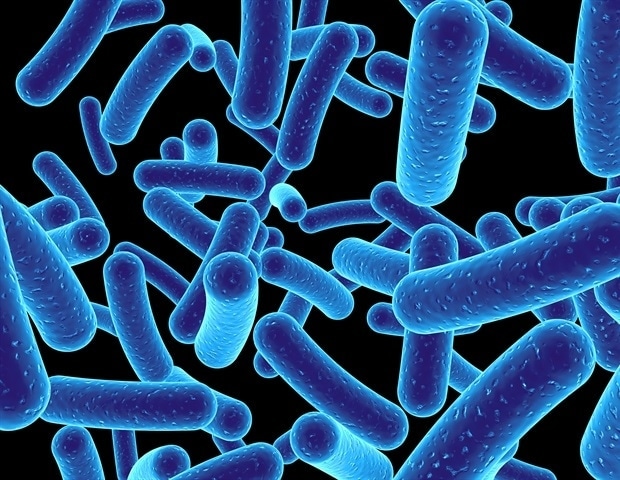
Baylor University researchers have published a novel approach to fight colorectal cancer, using modified bacteria as a courier to deliver potent cancer-killing proteins into tumor cells. Michael S. VanNieuwenhze, PhD, FRSC, University Distinguished Professor and chair of the Department of Biology, along with Baylor doctoral students and a colleague at Texas Tech University Health Sciences Center, published their promising research in Cell Chemical Biology.
Colorectal cancers accounted for the second-most deaths caused by cancer in 2025, according to the National Cancer Institute, highlighting the importance of new strategies for therapy and treatment. Building on growth in the use of bacteria as a tool in fighting cancer, VanNieuwenhze and his team attached saporin, a known cancer-killing toxin, to the surface of Listeria monocytogenes, which delivers the toxin to tumor cells.
Listeria, commonly recognized as a food-borne bacterium, can be modified for express therapeutic purposes while maintaining its ability to penetrate human cells – making it, VanNieuwenhze said, a particularly promising agent in the fight against colorectal cancer.
Our team asked the question, ‘What if we could hook saporin on the surface of a bug and let the bug get delivered into the cell as it normally would?’ We could then take advantage of chemistry inside the cell to release saporin to kill the cancer cell. That, in a nutshell, is what we were doing, and we were able to get it to work.”
Michael S. VanNieuwenhze, PhD, FRSC, University Distinguished Professor and Chair, Department of Biology, Baylor University
The article, “Bugs delivering drugs: Listeria monocytogenes-mediated cytotoxin delivery enhances anti-tumor activity in colorectal cancer,” features Baylor doctoral students Wyatt Paulishak and Jianan Lyu, along with VanNieuwenhze and Laurence Wood, Ph.D., associate professor at TTUHSC.
“Bugs into drugs” – A negative connotation, but a positive capability
Listeria can elicit negative reactions due to its wide recognition as a food-borne bacterium, but when genetically modified for therapeutics, it can be made safer for humans, while retaining the ability to kill cancer cells. Listeria monocytogenes has been reported as a cancer therapy agent since 1994, with many different strategies investigated for its use. The bacteria offer distinct properties that make them a valuable agent for cancer researchers.
“What makes it so useful from a therapeutic perspective is that it is an intracellular bug, which gives it unique access to the compartments inside cells,” Paulishak said. “As a living bug, we can modify it to make it safer and more effective. It further has a significant immunotherapy component to it and is naturally anti-cancer, and we look at it as a drug-delivery vehicle.”
By chemically attaching saporin to the bacteria, researchers multiplied its ability to fight cancer. As a cancer-killing toxin, saporin is only toxic once it is inside a cell, and Listeria enables it to reach that environment.
“We did fluorescent imaging on the saporin to make sure it was really attached to the bacteria,” Lyu said. “That allowed us to reach proof of concept, to prove the delivery was doable – delivered into the cell types of interest. So, we moved to in vivo and in vitro testing in mice to see the anticancer activities – and it turns out we see a significant increase in toxicity with this approach.”
With this phase of research completed, VanNieuwenhze hopes to further build on that foundation through genetic strategies that could make the process safer and more scalable, with a goal of eventual therapeutics – making colorectal cancer a meaningful starting place.
“If a therapeutic were developed from this, you could deliver it orally, in principle,” VanNieuwenhze said. “I think future steps in our research will move us toward that goal. We’ve got a great team here, and it’s exciting to look ahead to what’s next.”
Source:
Journal reference:
Paulishak, W., et al. (2026) Bugs delivering drugs: Listeria monocytogenes-mediated cytotoxin delivery enhances anti-tumor activity in colorectal cancer. Cell Chemical Biology. DOI: 10.1016/j.chembiol.2025.11.008. https://www.cell.com/cell-chemical-biology/abstract/S2451-9456(25)00388-5.