
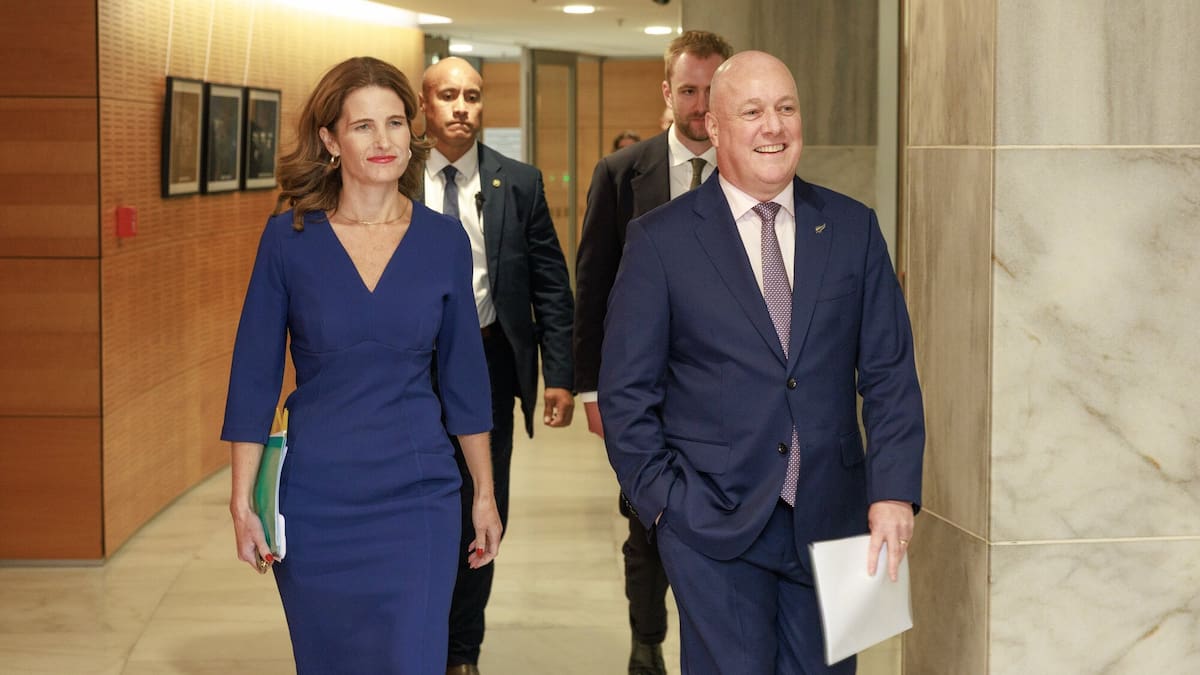
This week is a Parliamentary sitting week, which means Luxon, who shuns media more often than his predecessors, has more public engagements than usual. He does a round of broadcast interviews on Monday morning, a post-Cabinet press conference in the afternoon, a stand-up before his caucus meeting on Tuesday morning, and another before Question Time on Wednesday.
There’s a lot of pressure on Luxon, who is prone to verbal fumbles and gaffes – one of which landed him in hot water last week, to get this right.
Evidence from Monday and Tuesday is that he has, by the skin of his teeth. Luxon even squeezed in an extra press stand-up on Tuesday afternoon to stick the knife into Labour over findings from the second phase of the Covid-19 Royal Commission.
After last Monday’s dreadful post-Cabinet press conference, in which Luxon fumbled over the extent of New Zealand’s support for American and Israeli action in Iran, the pressure was on for a better performance this week to reassure his MPs he has the chops to lead them into the next election, in which National is effectively neck and neck with Labour.
Luxon succeeded and even performed well. With one more major media engagement in Parliament left for this week, he can probably breathe a sigh of relief at having survived what threatened to be his most precarious week in the job since becoming National leader in December 2021.
Most importantly, Luxon left Tuesday morning’s caucus meeting with the same job he had going in: leader.
During his weekly interview with Newstalk ZB’s Mike Hosking, Luxon managed to speak with some fluency on the effect oil prices would likely have on fuel prices. Over on RNZ, he even managed a passive aggressive gag when host Ingrid Hipkiss asked if he enjoyed talking to the media, he responded with a chirpy “love it!”.
During his post-Cabinet press conference, he seemed unflustered by repeated questions on his leadership and again responded to questions about the unfolding situation in Iran with a comfort that was lacking last week. Partly this was contextual. Last week’s questions focused on international human rights law, while this week’s questions were focused on international supply chains and oil prices.
As New Zealanders hardly need reminding, Luxon’s previous role gives him some experience at an organisation exposed to fluctuating fuel prices.
With Finance Minister Nicola Willis, Luxon tried to make a virtue out of being boring. No, the Government would not be cutting fuel taxes, no, there would be no reactive policy announcement to ease any inflationary pain.
We’ll see whether Luxon and Willis, whose fates seem more tied together than before, can keep to that, but for now they’re trying to refashion this non-reactivity as a strength.
Both were quick to lay into Labour on Tuesday when the second phase of the Covid-19 Royal Commission again questioned Labour’s spending during the pandemic, noting it was excessive and repeating that it contributed to the inflation spike.
“Fiscal and monetary policies became unaligned in 2021. The lag and persistence of fiscal stimulus meant that monetary policy had to work harder to fight inflation,” the report said.
In plain English that means the Reserve Bank had to jack up interest rates higher than it might have done otherwise because the Government’s spending was contributing to inflation. This isn’t the same as saying all of the inflation experienced after 2021 was the fault of the Beehive, but it does say that instead of helping deal with post-Covid inflation, the Beehive’s actions partly made it worse. It’s exactly the finding the Government wanted.
Prime Minister Christopher Luxon isn’t listening to leadership speculation. Photo / Michael Craig
Willis also took the opportunity to try the novel tactic of pre-releasing her Budget forecasts.
Treasury gives every Finance Minister a number of running economic forecasts in order to help put the Budget together before its final forecasts are locked down and included in the Budget Economic and Fiscal Update, published with the Budget in May.
A lot is riding on this document as it will be the second-to-last set of Treasury forecasts published before the election and a key indicator of whether National can claim to have got the country “back on track” as promised in 2023.
With economists reckoning the war in Iran will mean higher inflation and lower growth, the expectation is this Budget update will show a continued worsening of the economy.
On Monday, Willis decided to front-foot this by spilling the last forecasts Treasury gave her before the Iran crisis, leaving them hanging in the air as a hypothetical non-war scenario – and evidence that yes, in Treasury’s view, the economic recovery was underway.
The forecasts showed the economy grew 1.7% last year and was forecast to grow 3% this year and next.
Treasury also advised net debt would be 1.5% lower at the end of the forecast period, which would work out at about 44.6% of GDP.
Education Minister Erica Stanford says National is having a tough time. Photo / RNZ, Nick Monro
In each of her December economic updates, Willis has made something of a Christmas wish when unveiling Treasury’s latest downgraded forecasts.
“At some stage,” the exasperated minister said, “we are going to get some upwards surprises in the forecasts and I very much look forward to that day”.
Willis nearly got her wish at this year’s Budget. Alas for her, that day will have to wait.
The Iran war is going to weigh on the economy, which is likely to be bad news for the Government, but how bad it will be is an open question. Reassuring words from the G7 overnight led to oil futures falling, suggesting the market believes disruption from the war will not be as bad for as long.
And there’s some good news on the domestic front, too. Despite much of the commentary around the war implying the Government is foolish to build a new LNG terminal linking New Zealand’s electricity market to volatile international LNG prices, domestic electricity futures are still well down after the February 9 announcement of the new terminal.
Prices have ticked up after the war, but 2027, 2028 and 2029 futures are still about $20 MWh lower than before the LNG terminal announcement, suggesting markets in New Zealand are not spooked by the prospect of a long war.
So far, and every commentator warns we’ve got a long way to go yet, LNG looks to be a net positive for the Government.
Luxon’s future is deeply uncertain.
The stern words of leadership contender/Education Minister Erica Stanford today, saying National was having a tough time, will not reassure Luxon he has the confidence of his caucus – not that he seems particularly bothered by that, having claimed to have the confidence of his MPs without ever asking them.
At the moment, Luxon is trying to present last week’s wobble as a media fabrication. When he opened the floor for questions at his post-Cabinet press conference, he said, “just so we avoid the mistakes of [last] Monday, can we go one at a time?” as if it was the press pack that stumbled over whether New Zealand supported carpet bombing and not him.
Meanwhile, ministers are getting more comfortable calling out coverage they don’t like online. This is, the Herald understands, a deliberate tactic.
In the past, politicians tended to follow the advice of Paul Goldsmith, who noted last week in Parliament, “that a politician complaining about the media is like a farmer complaining about the weather. You may be right, but it makes no difference, and so you’ve got to figure out how to succeed in any respect”.
Members of this Government are taking a different tack, and are more regularly taking to social media to critique coverage they don’t like. Mark Mitchell and Chris Penk recently took to social media to criticise stories. Expect more of that as the election draws closer.
Luxon is likely to survive this week. Next week is a recess, with no regular caucus meeting.
That doesn’t mean an emergency caucus meeting can’t be called – emergency meetings were the method by which Simon Bridges and Judith Collins were rolled – but this seems highly unlikely.
Whether Luxon makes it to the election is still unclear. He’s undoubtedly wounded by the events of the past week. Another post-Cabinet shocker or dreadful poll could be the spark that ignites National’s caucus to move against Luxon.
MPs will take a breather over the recess. Fortunately for Luxon, his performance this week means he’s put his best foot forward, calming any unhelpful speculation.
Whether that’s enough to save him should another shocker poll land remains to be seen.