
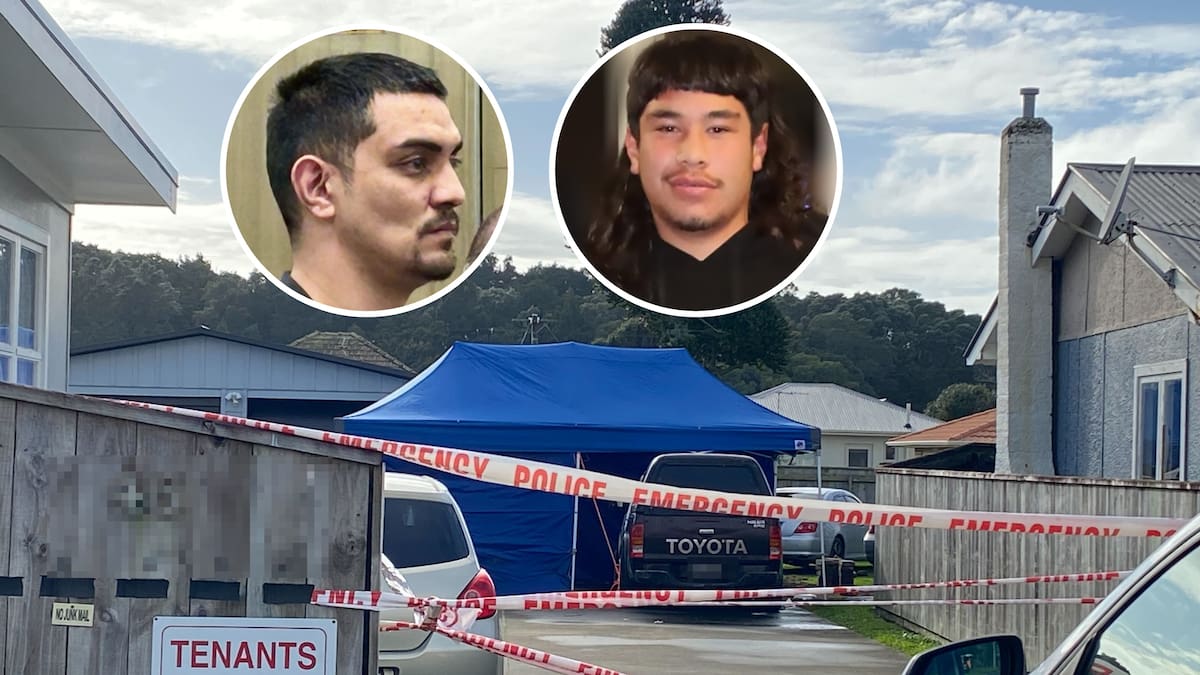
At the sentencing, the teen’s mother, Donna Akariri, said her son would never be defined by Thompson’s actions.
“His story was defined by the joy he brought, the mana he carried and the love he gave so freely,” she said in her victim impact statement.
The whānau was learning to live with a wound that Akariri said would never truly heal.
Recalling the teen’s many passions, Akariri said kapa haka was one of his greatest loves.
He also adored music, owning two acoustic guitars, an electric guitar belonging to his koro, two drum kits and a saxophone he hoped to learn to play like his koro.
Whānau of 17-year-old Te Omeka Pairama Akariri-Buckley gathered outside the High Court at New Plymouth after the sentencing of Rakai Jacob Thompson. Photo / Tara Shaskey
Akariri-Buckley was also a talented sportsman, representing Taranaki on the rugby league field, while also playing rugby, touch, indoor netball and inline hockey.
“He was fearless, he was enthusiastic and was always willing to give anything and everything a go,” his mother said.
Akariri remembered her son as the light in their home, sharing that he always gave her a kiss goodnight and when he left the house, followed by saying “I love you, mum, piki ora”.
She said he was loving, funny and full of life, heart and infectious laughter. He was a cherished son, brother, mokopuna, nephew, uncle, friend and partner.
“The impact of losing him has shattered our whānau. His death was sudden, violent and not just senseless, but his loving and caring generosity at that time was destroyed.
“It took from us not only a son, but a future, his future and the future we imagined with him in it.
“The music that once poured so effortlessly from him, filling our whare and our hearts, has fallen silent.”
Akariri-Buckley’s partner, who has name suppression, spoke of the trauma of being there when he died and of feeling helpless.
Te Omeka Akariri-Buckley was fatally stabbed in Waitara in 2024. Photo / Supplied
She recalled the love they shared and how he always supported her.
“It felt like we’d known each other forever. We knew everything about one another.
“I wish we had a forever, a future with each other. But, no, Te Omeka’s life was taken almost right in front of me.
“I would not wish this pain on anyone. Every single day, I wish I could change what happened that night.”
Tensions culminate in a fatal confrontation
The trial heard Akariri-Buckley died after being stabbed by Thompson early on July 30, 2024.
Earlier that day, the teen, his older brother Don Akariri-Buckley, Thompson and another friend had unsuccessfully been sheep-rustling in Taranaki in a bid to fill their freezers.
Tensions were brewing between the group as the night wore on and it was heard Thompson, a landscaper at the time, became increasingly “angered and agitated”.
After returning home to Waitara, Thompson contacted Don and asked him to pick up a road bike he had borrowed.
The Akariri-Buckley brothers had already planned to go to Thompson’s house to drop off some of his belongings.
The trial heard Thompson had a boning knife on him when the brothers arrived.
Rakai Jacob Thompson pictured at his trial in the High Court at New Plymouth last year.
During an altercation between the teen and Thompson on the driveway, Thompson was punched in the head several times.
Thompson stabbed Akariri-Buckley twice, to his chest and abdomen, in the seconds that followed. He also caused two incision wounds to his body.
The trial heard Thompson then tried to help save Akariri-Buckley.
He went on to tell police: “I didn’t want him to die. I didn’t mean to stab him.”
While the Crown argued it was murder, the defence accepted Thompson stabbed the teen but claimed he did not intentionally cause his death and his actions were in self-defence.
They said Thompson had long been mistreated by the brothers and wanted to sever ties with them, which is why he asked for the bike to be collected.
He did not want a confrontation and was carrying the knife because he had been making a sandwich when they arrived, the defence told the jury.
But the Crown had said Thompson was not scared of the brothers, as he claimed, highlighting that he had told them to come to his house.
Nor was he their “battered, beaten down, punching bag”, as he had claimed.
The Crown stated Thompson was more concerned with his property rights and stopping them from going into his shed.
After punches were thrown between Thompson and Akariri-Buckley, Thompson intentionally stabbed him, the Crown alleged.
Facts of the offending disputed
At the sentencing, Crown prosecutor Prue Lange submitted that the appropriate starting point should be no less than eight years’ imprisonment, describing it as a culpable homicide.
She said the harm caused by Thompson’s offending sat at the highest level; there was also the use of a weapon, extreme violence, a degree of premeditation and the offending was a grave breach of trust.
Lange submitted that Thompson had acted in a retaliatory and escalating manner and not a defensive one.
There were disputed aspects of the offending, with Lange submitting there was evidence Thompson had taken the knife from the kitchen outside and was on the verandah when the brothers arrived at his house.
Defence counsel, Paul Keegan, rejected the characterisation that Thompson had been lying in wait for the brothers to arrive, submitting the evidence showed he had been making a sandwich at the time, for which he had been using the knife, and there was nothing to prove beyond a reasonable doubt that he was outside when they arrived.
The fatal stabbing happened on the driveway at Rakai Thompson’s house in Waitara. Photo / Tara Shaskey
But Lange said the central point was that Thompson knew the brothers were arriving, he had the knife in his hand, and immediately confronted them, aggressively, before intentionally using the weapon on the teen.
Lange also said Thompson had admitted he had the knife for protection and intentionally stabbed Akariri-Buckley, which she said contradicted the defence’s “suggestion” the teen delivered more than three punches and Thompson was simply “flaying his hands about” and coincidentally had the knife hand.
She also submitted CCTV footage taken from a security camera at the house showed Thompson did not immediately provide first aid, and had acted in a celebratory manner after the stabbing.
Keegan submitted that Thompson did seek to immediately provide aid to Akariki-Buckley, stating the moments that followed the stabbing were dynamic and fast-moving, and everyone present was in a state of shock and confusion.
He also submitted there was no evidence Thompson was trying to celebrate after with a “cheer”, just that he put his hands in the air and yelled that he had a knife.
Keegan argued the appropriate starting point was one of between six and seven years’ imprisonment, and submitted the case did not involve extreme violence, stating it was an attack of mere seconds.
He also rejected there was a grave breach of trust and that the offending was premeditated.
Keegan suggested that overall, the Crown had made a “concerted effort” to characterise the offending as something that it was not.
Justice Jason McHerron sentenced Rakai Thompson in the High Court at New Plymouth. Photo / Tara Shaskey
In sentencing Thompson, Justice Jason McHerron accepted the jury had found Thompson was acting to defend himself when he stabbed Akariri-Buckley but had used unreasonable force.
Thompson had not initiated any violence, the judge said.
Justice McHerron accepted Thompson had been using the knife to make his sandwich and that “the evidence supports, but does not extend beyond, [his] consciously choosing to take the knife outside to dissuade [the brothers] from engaging in any violence against [him]”.
He ruled the violence was not extreme, nor was it a breach of trust.
While Justice McHerron also found it was not premeditated, he said Thompson carried the knife and “consciously and deliberately” used it to stab Akariri-Buckley.
It was an unreasonable and excessive act of self-defence, committed in rage, featuring multiple wounds, the judge said.
Justice McHerron took a starting point of seven years and six months’ imprisonment before applying 25% credit for a guilty plea, as before Thompson went to trial on the murder charge he had offered to plead guilty to manslaughter.
Justice McHerron accepted Thompson has expressed genuine remorse and that his daughter would be impacted by his imprisonment.
He added a further 8% credit for those two factors, resulting in an end sentence of five years’ imprisonment.
‘No sentence that will ever feel enough’
After the sentencing, the Akariri-Buckley whānau issued a statement saying the hearing marked the end of a long and harrowing court process.
But it did not mark the end of their pain, grief or the hole left in their lives.
“A life taken can never be measured, replaced or justified by any sentence handed down today.”
The whānau acknowledged the work of the court and police but said the trial process, and media coverage of the case, had been painful, frustrating and heartbreaking.
“The justice system, as it stands, often leaves victims and their whānau feeling unheard, unprotected and secondary in a process that directly impacts us the most.”
They hoped one day, meaningful change would occur to recognise the lifelong impact of violent offending on families and communities.
Tara Shaskey is an assistant editor and reporter for the Open Justice team. She joined NZME in 2022 and has worked as a journalist since 2014.