

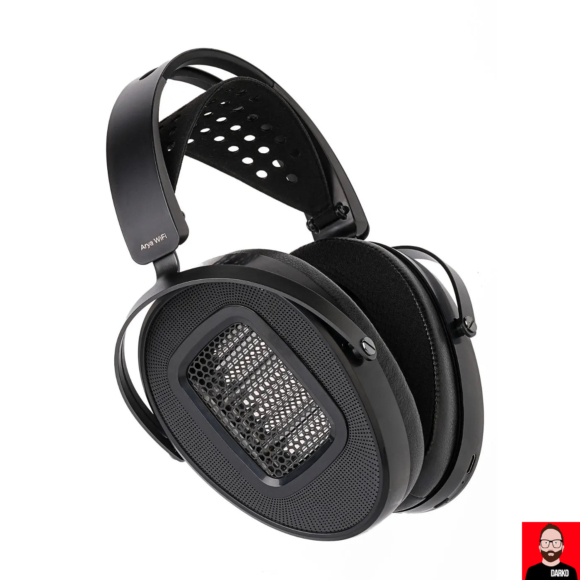
HIFIMAN has announced two new open-back planar magnetic headphones, the HE1000 WiFi and the Arya WiFi, that allow listeners to sidestep Bluetooth in favour of WiFi-based audio transmission.
The case against Bluetooth is straightforward enough. Its bandwidth is approximately 1.1 Mbps, which falls well short of the requirements for lossless hi-res audio. WiFi, by contrast, can transfer data at up to 5,064 Mbps, which comfortably accommodates any lossless format currently in circulation. To use either headphone, we open the WiFi network settings menu on a smartphone or tablet and connect to the headphone’s dedicated network to stream to it directly.
Both models also include Bluetooth 5.1 (with LDAC, aptX, aptX HD, AAC and SBC) and a USB-C port for wired connections and charging, so WiFi is the headline act rather than the only act.
Audiophile catnip: R2R inside
The onboard DAC is where HIFIMAN is really looking to turn heads. Both headphones incorporate the company’s Hymalaya chip, an R2R (resistor ladder) DAC, rather than the more common delta-sigma chips found in most consumer electronics. R2R DACs use a network of precision resistors to reconstruct the analogue signal from its digital source, a topology long associated with a particular smoothness and naturalness of presentation. Whether that reputation is entirely deserved or partly audiophile mythology depends on who you ask, but there’s no question that dropping an R2R chip into a wireless headphone qualifies as a catnip trigger conversation starter.
The Hymalaya chip is paired with a balanced Class A/B amplifier within each earcup. That last detail matters: locating both the DAC and amplifier inside the earcup housings rather than in a separate dongle or preamplifier keeps the signal path short, but it also adds mass precisely where headphones carry it least comfortably: on the ears themselves.
Weight and battery life
HIFIMAN’s announcement omits two specifications that anyone seriously considering these headphones will want to know: weight and battery life. We had to go looking for both. Online product listings put each model at 452g, a meaningful step up from the wired Arya variants, which come in at 404–413g depending on the version, with the extra mass attributable to the onboard electronics and battery. A redesigned headband is said to distribute the load more evenly across the head.
Battery runtime breaks down as follows: roughly 6.5 to 7.5 hours in WiFi mode, around 23 hours via Bluetooth, with a USB-C charge time of three to four hours and a standby rating of over 30 days. That WiFi figure is worth pausing on. Seven hours is a workable listening session, but it is a hard ceiling, one that a passive headphone driven by a plugged-in amplifier simply doesn’t have.
Drivers
On the driver side, the HE1000 WiFi uses HIFIMAN’s Nano Diaphragm, while the Arya WiFi steps down to the (thicker, more robust) Super Nano Diaphragm. Both incorporate the company’s Stealth Magnet technology, shared with flagship models including the Susvara.
Private listening spaces
Neither headphone is designed for the commute or the open-plan office. Open-back construction means the rear of each earcup vents freely to the room, which benefits soundstage and air at the cost of any meaningful isolation. Music leaks out; ambient noise leaks in. These are headphones for a quiet home listening space or a private office, anywhere you won’t be disturbing – or disturbed by – those nearby.
Pricing and availability
The HE1000 WiFi and Arya WiFi are expected to ship next month via authorised HIFIMAN dealers and the company’s online store. Pricing was not included in the press release; online searches suggest approximately US$2699 for the HE1000 WiFi and US$1499 for the Arya WiFi, though dealer prices may vary.
Further information: HiFIMAN
