
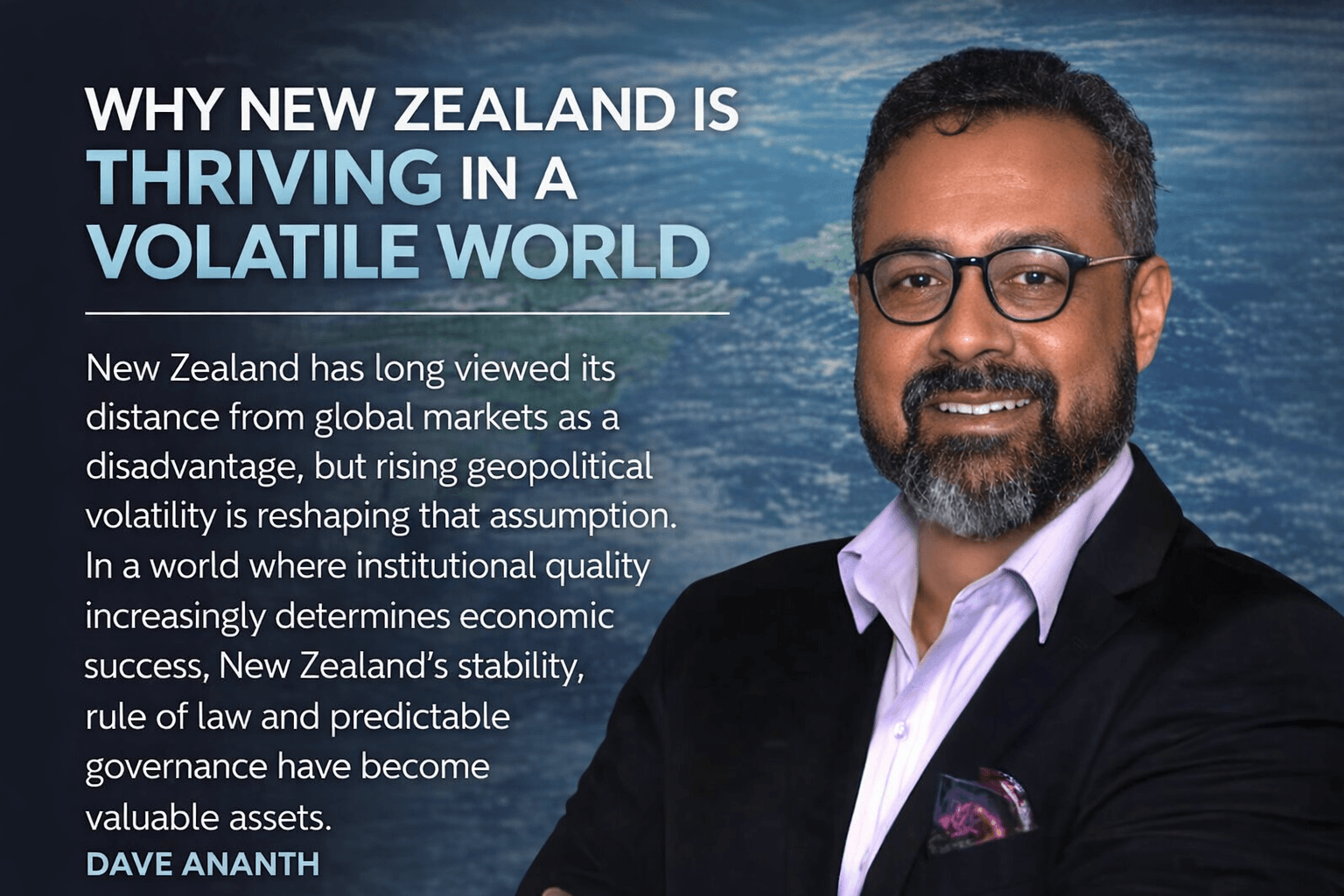
Dave Ananth
Auckland, March 11, 2026
For decades, New Zealand has apologised for its smallness and remoteness from the centres of global power. Politicians, economists and business leaders have repeated the same message. Distance is a handicap, and success requires overcoming geography.
That assumption may now be wrong.
In a world becoming more politically volatile and economically uncertain, distance from global turbulence may turn out to be one of New Zealand’s most valuable economic advantages.
In the 20th Century, geography often determined prosperity. In the 21st Century, institutional quality increasingly determines where capital chooses to live. Investors, businesses, and skilled workers are no longer looking only for scale. They are looking for predictability, legal certainty and environments where long-term decisions can be made with confidence.
Distance, not a disadvantage
Seen through that lens, New Zealand’s distance is no longer simply a disadvantage to overcome.
In a world marked by political strain and economic uncertainty, it may form part of a more valuable proposition, a stable, rules-based economy positioned at the edge of an increasingly disorderly world.
Political stability, strong public institutions, an independent judiciary, personal safety and a functioning rule of law are not merely lifestyle advantages. They are economic assets.
Capital does not search only for the highest return. It also searches for the most predictable environment in which returns can be generated and protected. For investors weighing political risk, institutional weakness or abrupt policy shifts elsewhere, that predictability matters enormously.
Yet New Zealand rarely presents itself in those terms.
Instead, the country still markets itself largely through commodities and scenery.
Dairy, Meat, Forestry and Tourism remain central pillars of the economy. Residential property absorbs an outsized share of household wealth. The country has built an asset the world increasingly values, institutional stability, yet continues to present itself like a commodity exporter.
That mismatch has consequences. Too much national wealth remains tied up in property, commodities and domestic consumption rather than in productive investment.
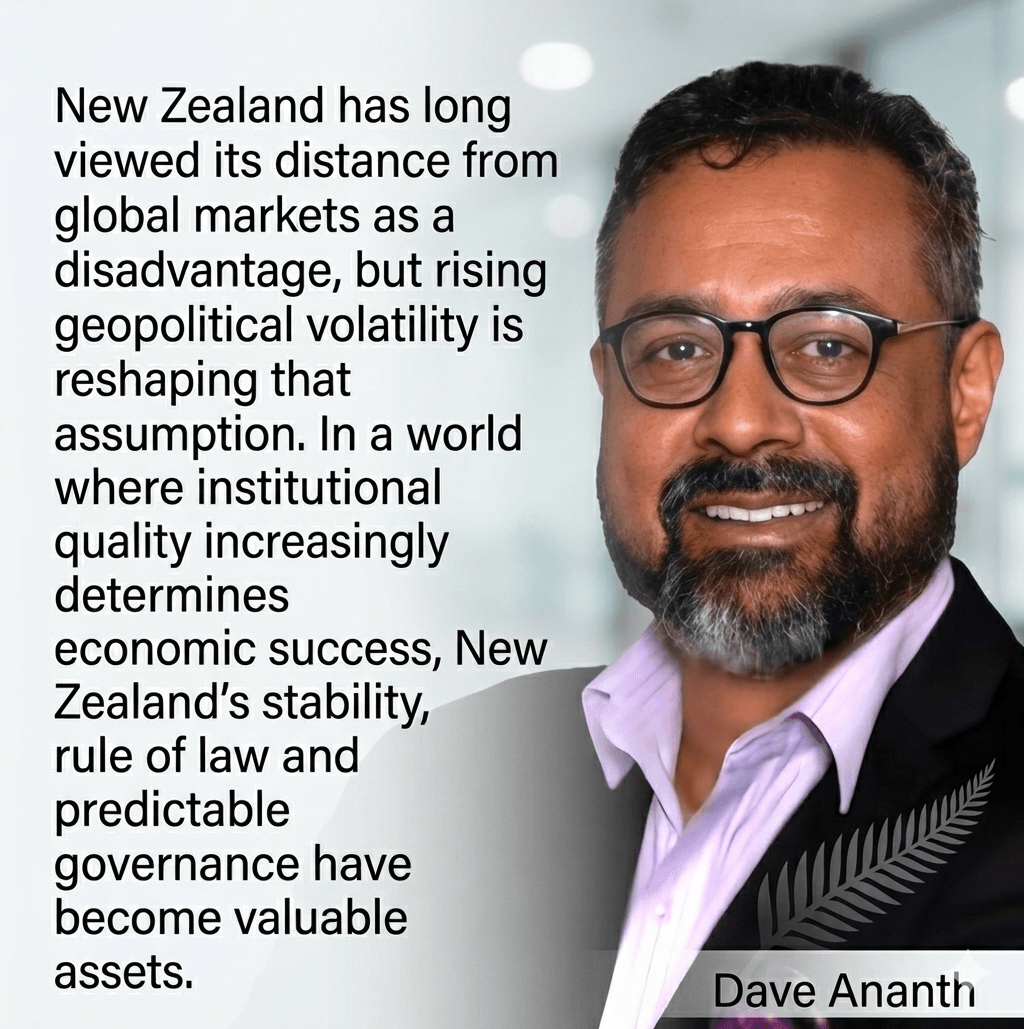
Low Productivity
The numbers reflect this. New Zealand’s labour productivity remains roughly 25 to 30% below the average of other high-income OECD economies. That gap has persisted for years. It does not close through optimism. It closes through capital, scale, technology and sustained investment.
Without productivity growth, wages struggle to rise, and businesses find it harder to expand.
The economy also becomes less able to retain its most capable people. That helps explain why many talented New Zealanders continue to build their careers abroad.
They are not leaving because they dislike the country. Many would prefer to stay.
They leave because larger economies offer deeper capital markets, larger industries and faster opportunities.
This question is not only about graduates born in New Zealand. It also concerns the skilled migrants the country attracts. For many migrants, New Zealand represents something increasingly rare in the modern world, a place where institutions function predictably, and personal safety is taken seriously. In an era of rising global political volatility, that reliability itself may become one of the country’s most powerful economic attractions.
Addressing structural issues
If New Zealand wants to change its trajectory, several structural issues need to be addressed.
The first is capital allocation.
For decades, too much domestic wealth has flowed into passive property investment rather than machinery, technology, research and export businesses. For households, property may feel safe. For the wider economy, it is often a low imagination use of capital.
A productive economy requires productive investment.
Tax settings should reward firms that invest in equipment, automation and new technologies.
Instead of forcing businesses to depreciate productivity-enhancing assets slowly over many years, the system could allow faster deductions for investments that materially increase output.
The second issue is human capital. For years, New Zealand has tried to address the so-called brain drain mainly through the enforcement of student loan repayments for graduates living overseas. That approach confuses collection with strategy.
Graduates do not leave because Inland Revenue failed to send reminders.
They leave because opportunities abroad are larger and better funded.
If New Zealand wants more of its educated workforce to remain, incentives should move in the opposite direction. One option would be to progressively reduce student loan balances for graduates who stay and work in New Zealand.
Each year spent contributing locally could extinguish part of the debt until it disappears entirely.
Regulatory Friction
The third issue is regulatory friction.
Businesses attempting to build infrastructure, housing, or major commercial projects still encounter approval processes that are slow and uncertain.
Environmental protection matters. But systems that take years to distinguish between sensible development and reckless proposals discourage both investment and confidence.
Infrastructure determines whether businesses can operate efficiently, whether housing can be supplied at scale and whether energy remains reliable. Without modern infrastructure, productivity inevitably stalls.
All of these point to a larger strategic question. In a more unstable world, some countries will compete on size, others on low-cost labour and others on natural resources. A smaller number will compete on something rarer: legal certainty and long-term institutional trust.
Countries such as Singapore and Switzerland recognised that early and built economic value from reliability.
New Zealand cannot replicate those models exactly, nor should it pretend that distance has ceased to impose real costs. Freight remains expensive, and the domestic market remains small. But that is precisely why the country should stop trying to imitate economies it cannot become and start extracting greater value from the strengths it already possesses.
Stability, safety and institutional trust are not background conditions. They are strategic economic assets.
Discovering the Distance
For too long, New Zealand has treated its distance as a handicap. In an increasingly unstable world, it may be discovered that distance, combined with strong institutions, is no longer a weakness but part of the premium.
In a turbulent world, stability may become one of the most valuable exports a country can offer.
New Zealand could go further and recognise this advantage explicitly. Rather than marketing itself primarily through scenery and agricultural exports, the country could position itself as one of the world’s safest jurisdictions for capital and talent. In an era of rising geopolitical tension, policy volatility and institutional erosion in many regions, that proposition carries real economic value. Investors and professionals are increasingly making long-term decisions based not only on tax rates or market size, but on whether the legal system is reliable, contracts are enforceable, and governments operate within predictable rules.
If New Zealand consciously developed a reputation as a jurisdiction where capital, enterprise and skilled people can operate with confidence for decades, it would be competing on something many larger economies are quietly losing, institutional trust.