
By Holly Tregenza, ABC
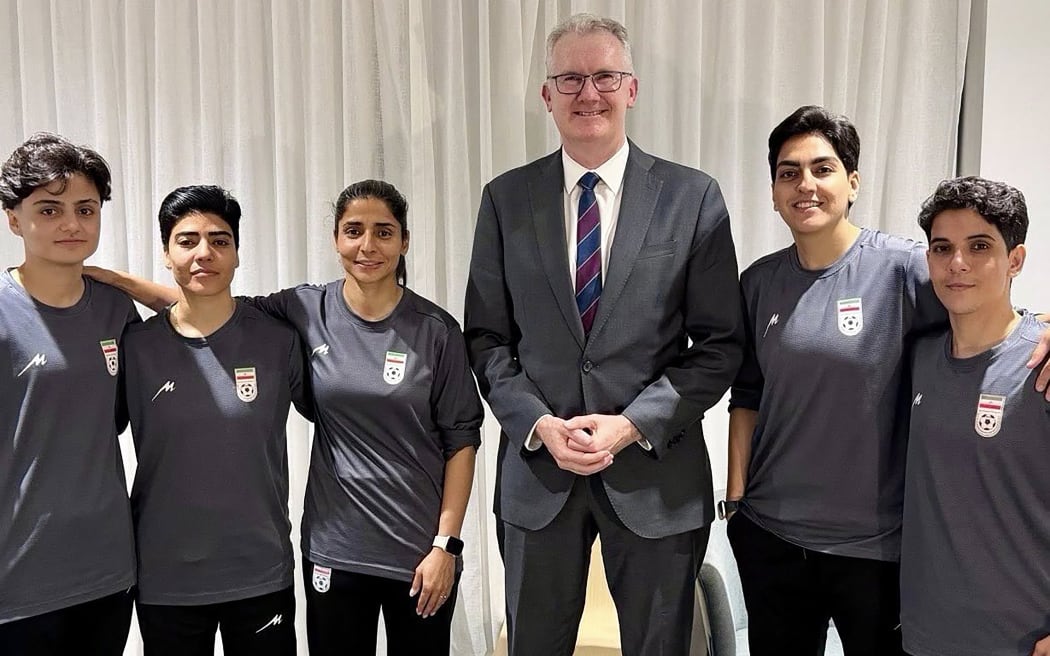
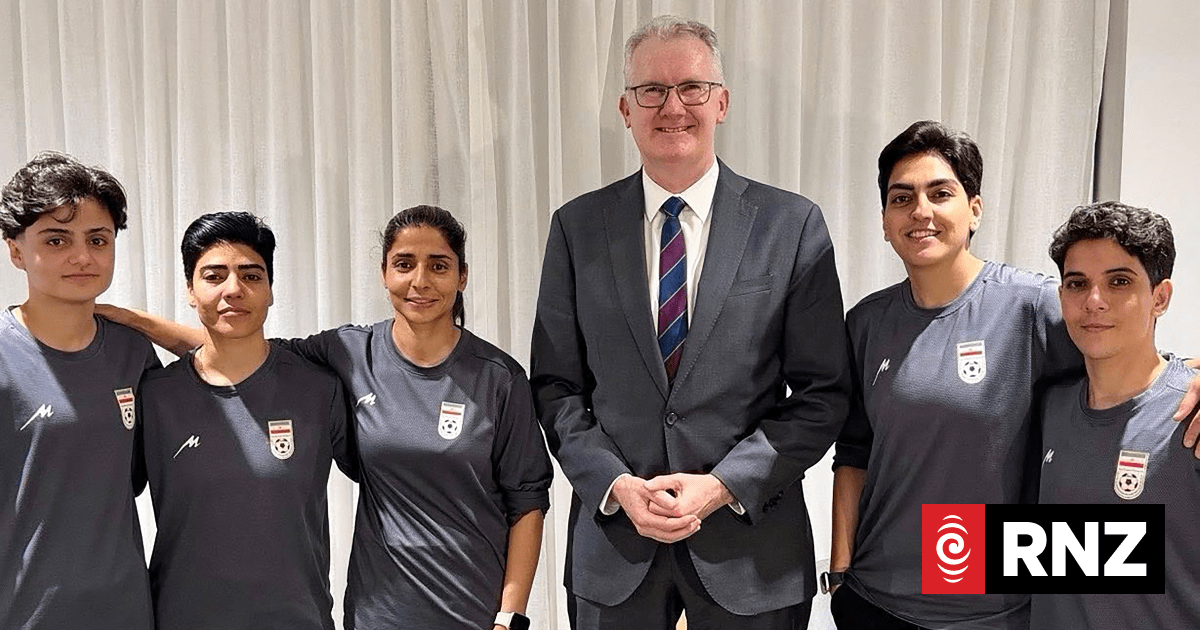
Home Affairs minister Tony Burke with five Iranian women football players who applied for asylum after competing in the Women’s Asia Cup tournament being played in Australia.
Photo: AFP PHOTO / DEPARTMENT OF HOME AFFAIRS
In the early hours of Tuesday, in a secure location in Brisbane, five Iranian footballers broke into a spontaneous cry of “Aussie, Aussie, Aussie!”
Australia’s Home Affairs Minister Tony Burke was in the room with them.
He had just confirmed the women would be granted temporary humanitarian visas by the Australian government, ending an agonising period for the athletes who had been in the spotlight since being labelled “traitors” on Iranian state TV for not singing the national anthem before a game.
Until this point, the government had been tight-lipped about their attempt to offer the athletes asylum, even as US President Donald Trump rubbished Prime Minister Anthony Albanese on social media for failing to protect them.
But Burke said the government’s silence had been part of a delicate operation to enable the players to safely express a desire to stay in Australia.
“These women are great athletes, great people, and they are going to very much feel at home in Australia,” he said.
“Australia has taken the Iranian women’s soccer team into our hearts.”
How did we get here?
Iranian women’s national football team players Fatemeh Pasandideh, Zahra Ghanbari, Zahra Sarbali, Atefeh Ramazanzadeh and Mona Hamoudi were among a group of players who did not sing the national anthem before their opening match with South Korea at the Women’s Asian Cup on March 2.
But days later, before their match against Australia, players sang the anthem with their hands either raised in a salute or across their hearts.
The next day, footage emerged of radical conservative television presenter Mohammad Reza Shahbazi calling out the players and calling for “traitors” to be dealt with “more harshly” in times of war.
“This is no longer some symbolic protest or demonstration. In wartime conditions, going there and refusing to sing the national anthem is the height of shamelessness and betrayal,” he said.
“The disgrace of this shameless betrayal should remain on their shoulders, and they must be properly dealt with so that others take a warning from it.”
Under the Islamic Republic’s penal code, corruption or treason can lead to lengthy prison sentences or the death penalty.
That same week, members of the team appeared to give the SOS hand signal to protesters gathered outside the Gold Coast hotel where the team had been staying.
On Sunday night the Iranian team, known as the Lionesses, played their final Women’s Asian Cup game, losing 2-0 to the Philippines.
Within 48 hours, five of them would have been moved out of the hotel to a secure location by Australian Federal Police and had their asylum cases approved.
How the players got out
We don’t know much about how the Iranian players communicated with the government or how they escaped from the team hotel.
Staff members believed to be connected to the regime are embedded with the team and the ABC understands the players are not allowed to move freely.
There are also suggestions communications are being monitored.
Burke said a police officer had been inside the hotel and made efforts to create “the maximum amount of opportunities” for players to ask for help.
The prime minister said the players had taken time to consider applying for asylum after contacting Australian authorities.
“We wanted to make it clear to the athletes that support was available,” he said.
“They then had to consider that and do that in a way that did not present any danger to them or to their families or friends back home in Iran.”
Burke said a conversation “started in earnest” Monday morning with the players who had decided they did want to request asylum.
“They were moved to a safe location by the Australian Federal Police, and last night I met with them at that location,” he said.
Burke called the head of ASIO, Australia’s spy agency, to confirm that all the asylum seekers had the necessary security clearance before meeting them.
Albanese said the government had been preparing “for some time” for this moment.
“Australians have been moved by the plight of these brave women. They are safe here, and they should feel at home here,” he said.
Trump’s call to Albanese

US President Donald Trump and Australia’s Prime Minister Anthony Albanese.
Photo: JIM WATSON / AFP
The US president had earlier lashed out at the prime minister, suggesting in a post on Truth Social that the women were being forced to leave Australia at a time when they could be punished back in Iran.
Albanese confirmed he had spoken to Trump just before 2am Tuesday and conveyed to him the government’s action, which at that stage had confirmed asylum for the five players.
Again taking to Truth Social, Mr Trump said he had spoken to Albanese and was satisfied he was “on it!”
The government was keen to point out the timeline of the call, which happened after the players had been granted temporary humanitarian visas at 1.30am.
“The views that the president put on this, I think, reflected what all good people are thinking about this. I think people were looking at this situation and saying, ‘Surely there is something we can do?”’ Burke said.
“Of course, we have been in a situation of not being able to talk publicly about what we were doing.”
What happens to the rest of the team?
The government said the door remained open to other members of the Iranian team who may want to request asylum.
It is unclear at this stage when the players will return to Iran, as airspace across the Middle East remains closed.
“If you want our help, help is here,” Albanese said.
The home affairs minister acknowledged it was an “incredibly difficult decision” for the women, but said it was important that the government provided them with agency to choose.
“While the offer is still there for other members of the team, it is quite possible and indeed likely that not every woman on the team will take up the opportunity that Australia would offer to them,” he said.
Iranian Australians who have spoken to the ABC said it was important to understand the players may not want to seek asylum, due to the reported pressures facing their families if they did not return.
Burke said the players who had been granted asylum were comfortable with sharing their stories, but stressed they were not activists.
“They wanted to be clear that they are not political activists, they are athletes who want to be safe and are very grateful that Australia is providing that opportunity for them,” he said.
Temporary humanitarian visas are valid for 12 months and provide a pathway to permanent residency.
These types of visas have previously been granted to Ukrainians, Palestinians and people from Afghanistan.
– ABC