
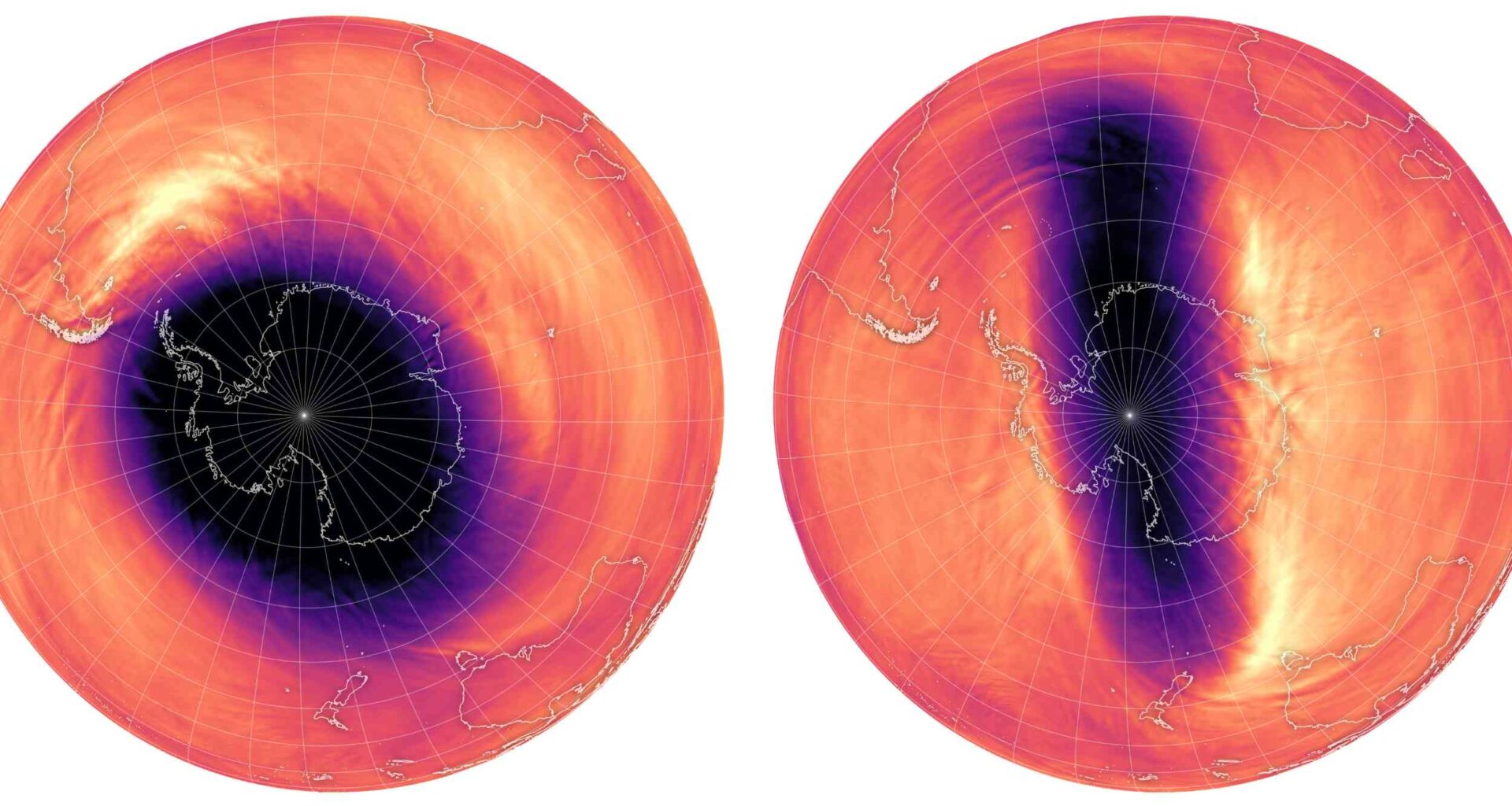
Scientists have confirmed that the Antarctic ozone hole has shrunk to its smallest size in six years and closed on December 1, 2025 after one of the shortest seasons in recent decades.
That unusually brief season strengthens the emerging picture of a slow atmospheric recovery that has taken shape after decades of chemical controls.
Observations of the ozone hole

Over Antarctica, atmospheric maps of the depleted region showed the seasonal ozone hole tightening through November before closing unusually early.
By analyzing those observations, scientists at the Copernicus Atmosphere Monitoring Service (CAMS) documented higher ozone concentrations across much of the region than in several recent years.
That pattern contrasted with the unusually large and persistent ozone holes recorded between 2020 and 2023.
Understanding why this season ended so early requires examining the atmospheric forces that shape the Antarctic ozone hole each spring.
Why the ozone hole shrank
High above the ice, a weaker polar vortex – a ring of strong winds around Antarctica – allowed more ozone-rich air to leak inward.
NASA and NOAA linked that looser circulation to warmer August temperatures, which reduced the clouds that help chlorine attack ozone.
Balloon measurements over the South Pole later showed a seasonal minimum of 147 Dobson Units, a standard measure of total ozone overhead.
Even so, those conditions helped shrink the hole, but they also showed how much one unusual spring can change the story.
Cold clouds and sunlight
Each Antarctic spring, industrial chemicals once used in refrigerants and aerosols become most destructive high in the stratosphere, the cold upper layer where ozone is concentrated.
After the dark winter, extremely cold air forms polar clouds that give those chemicals surfaces for fast reactions.
When sunlight returns, those reactions free active chlorine, and the released chlorine breaks ozone molecules far faster than normal.
Once temperatures rise and winds weaken, ozone-rich air mixes back over Antarctica and the seasonal hole disappears.
Why recent years swelled
From 2020 through 2023, Antarctica saw several large, long-lived holes even as the banned chemicals kept declining.
One reason was the 2022 Hunga Tonga eruption, which blasted huge amounts of water vapor into the upper atmosphere.
That added moisture sped ozone loss by creating better chemical surfaces and by cooling the air where those reactions happen.
Seen that way, a smaller 2025 hole can coexist with the memory of very bad seasons just before it.
The treaty effect
Back in 1987, countries signed the Montreal Protocol and began phasing out the chemicals that tear ozone apart.
Since about 2000, the amount of ozone-destroying chemicals in the Antarctic stratosphere has fallen by roughly one-third.
“The earlier closure and relatively small size of this year’s ozone hole is a reassuring sign and reflects the steady year-on-year progress we are now observing in the recovery of the ozone layer,” said Laurence Rouil, Director of the Copernicus Atmosphere Monitoring Service.
Climate gains also mattered, because a 2022 assessment estimated the controls would avoid roughly 0.9–1.8°F (0.5–1.0°C) of warming.
Evidence of ozone recovery
By March 2025, scientists had something stronger than hopeful claims: a statistical signal that matched the chemistry they expected.
Using satellite records, researchers isolated the recovery pattern expected after ozone-destroying gases decline across Antarctica.
The resulting study reported 95 percent confidence that falling ozone-destroying chemicals are driving Antarctic recovery.
So the debate changed from hope to measurable evidence, even though small holes were not guaranteed every year.
Why the ozone layer matters
Less ozone means more ultraviolet radiation, higher-energy sunlight that can damage DNA, reaching people, crops, and ocean life.
Long exposures raise risks of skin cancer and cataracts, while stressed plants and plankton can weaken food webs.
Far beyond Antarctica, the recovery still matters because the same ozone layer shields Southern Hemisphere communities from extra ultraviolet light.
For that reason, scientists treat a good year as public-health news, not just an atmospheric curiosity.
Monitoring ozone from space
Satellites, weather balloons, and forecast models gave CAMS several angles on ozone instead of forcing it to rely on one measure.
Inside CAMS, those observations feed global forecasts, letting scientists follow the hole’s shape, depth, and likely closure days ahead.
Because shape matters, a thin, stretched hole can look deceptively large even when the most ozone-depleted areas are shrinking.
Better monitoring makes it easier to separate a strange season from a real change in the underlying trend.
Recovery is uneven
No single season settles the argument, because ozone depends on chemistry, volcanic debris, winds, and temperature all at once.
If current policies hold, Antarctica could return to roughly 1980 ozone levels around 2066, scientists project.
Scientists project that Antarctica’s ozone layer could return to roughly 1980 levels by about 2066 if current policies hold.
“This progress should be celebrated as a timely reminder of what can be achieved when the international community works together to address global environmental challenges,” Rouil said.
Keeping bans in place and watching for new pressures will decide how quickly that future arrives.
Future of ozone recovery
A small 2025 hole mattered because it matched the chemistry, the policy history, and the long measurements pointing the same way.
Natural swings will keep testing that progress, but the broader lesson is already hard to miss.
The study is published in Nature.
—–
Like what you read? Subscribe to our newsletter for engaging articles, exclusive content, and the latest updates.
Check us out on EarthSnap, a free app brought to you by Eric Ralls and Earth.com.
—–