
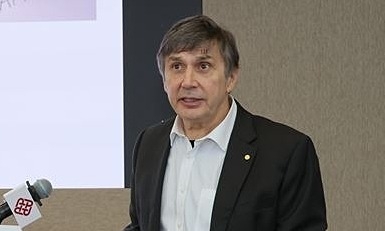
Geim, 67, said he was drawn to Hong Kong’s East-West academic environment and research infrastructure when accepting the role at the University of Hong Kong (HKU), ranked second in Asia in the 2026 QS World University Rankings.
The physicist, widely known for pioneering research on graphene, the world’s thinnest and strongest material, said the university’s collaborative research approach influenced his decision.
“HKU’s forward-looking approach to interdisciplinary research and its commitment to supporting bold ideas creates the conditions in which great science happens,” HKU quoted him as saying.
His appointment comes as Hong Kong seeks to attract leading scientists amid intensifying global competition for top research talent, according to the South China Morning Post. HKU president and vice-chancellor Xiang Zhang said Geim’s work reflects the university’s ambition to strengthen its global research standing.
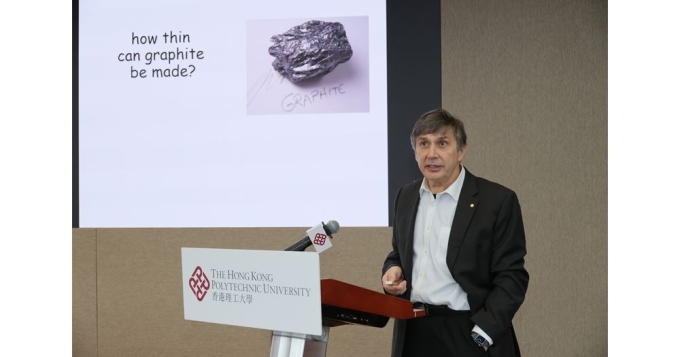
Nobel laureate physicist Andre Geim at an 2025 event at the Hong Kong Polytechnic University. Photo courtesy of the university
Born in Sochi, Russia, to German parents, Geim comes from a family of physicists, with both his father and grandfather working in the field.
He earned his PhD in physics from the Russian Academy of Sciences in Chernogolovka before conducting postdoctoral research in Britain and Denmark. In 1994 he secured a tenured position as an associate professor at Radboud University Nijmegen in the Netherlands. Geim joined the University of Manchester in 2001.
In an interview with MIT Technology Review China in Shanghai in October last year, he recalled that his first PhD student in Manchester was a Chinese researcher, Jiang Da, who worked on thinning graphite layers. In 2004 Geim led a team including Jiang and Konstantin Novoselov to isolate graphene using adhesive tape.
Geim and Novoselov were later awarded the Nobel Prize in Physics in 2010 for groundbreaking experiments regarding the two-dimensional material graphene.
Over the course of his career Geim has supervised dozens of Chinese graduate students and has maintained close ties with researchers in China. He became a foreign member of the Chinese Academy of Sciences in 2017. He has also collaborated with Chinese companies and research institutes, describing the country as “a leader in both industrial application and basic research” in graphene technologies.
Among his many distinctions, Geim is the only person to have received both a Nobel Prize and an Ig Nobel Prize. The latter was awarded in 2000 for an experiment that used magnets to levitate a live frog.