
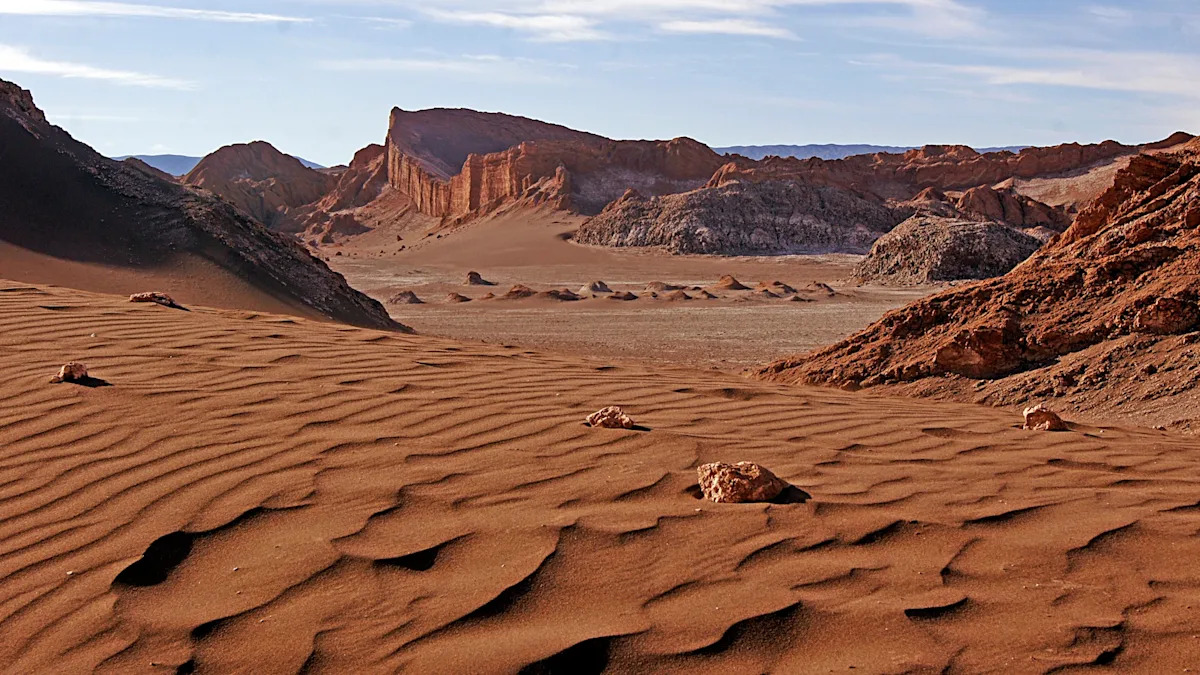
Even in the most hostile places on Earth, new research shows that organisms are able to survive and even thrive.
A University of Cologne-led team published its findings on nematodes from the Atacama Desert, the world’s driest non-polar desert, in Nature Communications.
Researchers collected soil samples from six locations in and around the Atacama in Chile, as Discover Wildlife noted. Past research has looked at above-ground life in the desert and the Atacama Trench, but there was a gap in knowledge around life in the soil. The area is so inhospitable that NASA uses it to test its Mars rovers.
Nematodes, or roundworms, inhabit environments worldwide, from deep-sea sediments to the highest mountains. Meanwhile, they play an important role in those ecosystems, as Philipp Schiffer, an author of the study, noted in a news release.
“Soils are important for the performance of an ecosystem; for example, for carbon storage and nutrient supply,” he said. “This is why understanding the organisms — i.e., not microbes but multicellular animals — that live there is so important.”
Across the desert’s sand dunes, salt lakes, river beds and mountains, the research uncovered 21 families of nematodes and 36 genera.
In the highest-altitude areas, the team confirmed that asexuality helped nematodes survive. Another finding was that the areas with more precipitation had more biodiversity. Temperature differences also played a major role in the types of nematodes that were observed.
There was one negative pattern the researchers observed. They found that select regions exhibited “simplified food webs” linked to damaged ecosystems that could be threatened in the future. It’s fair to wonder if the desert’s use as a dumping ground for fast fashion is part of the problem.
Still, the discovery of more diverse and thriving nematodes than expected holds promise for the future. As the world experiences greater dry spells, it’s critical to learn more about these resilient organisms and how to sustain them in the future.
“In light of increasing global aridity, which is affecting more and more regions worldwide, these results are becoming increasingly relevant,” Schiffer said. “Understanding how organisms adapt in extreme environments and which environmental parameters cause them to spread can help to improve estimation of the ecological consequences of climate change.”
Get TCD’s free newsletters for easy tips to save more, waste less, and make smarter choices — and earn up to $5,000 toward clean upgrades in TCD’s exclusive Rewards Club.