
By Annika Burgess and Ahmed Yussuf, ABC
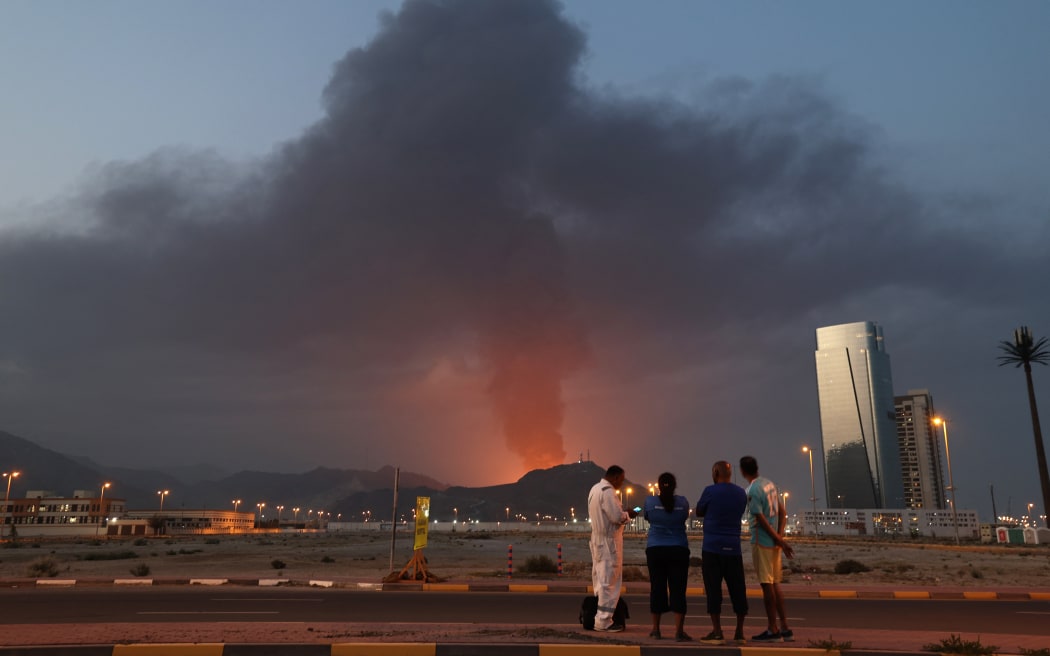
Black smoke ascends following an explosion in the Fujairah industrial zone, in the United Arab Emirates.
Photo: AFP
Within hours of the war breaking out in the Middle East, the gleaming skylines that define cities across the United Arab Emirates were filled with smoke.
More than a week on, upscale neighbourhoods in Dubai are still being littered with shards of broken glass.
The menacing whirr of approaching drones continues to send passengers at Dubai’s international airport scrambling for cover.
At least 11 countries and territories have come under attack from Iran in retaliation for ongoing US and Israeli strikes.
But it appears none more so than the UAE.
Mid- last week, the Pentagon said more than 500 Iranian ballistic missiles and 2000 drones had been launched across the region since the war began on February 28.
About 1700 missiles and drones have been fired towards the Emirates alone, according to the country’s defence ministry.
It has also been estimated that Iran has launched more air strikes against the UAE than Israel, which joined the US in waging war on Tehran.
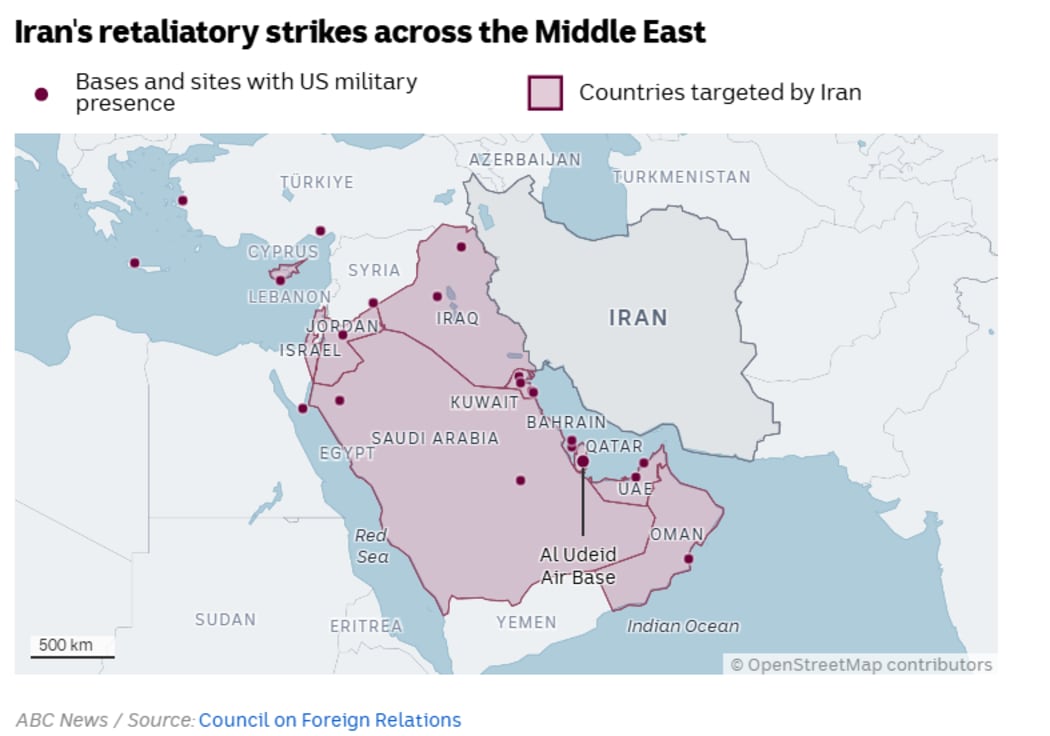
Iran’s retaliatory strikes across the Middle East.
Photo: ABC News/Source: Council on Foreign Relations
The UAE says it is intercepting about 90 per cent of the barrages, but Iran’s strikes have impacted airports, tourist attractions, and the US consulate in Dubai.
At least six people have been killed and 122 wounded.
The situation prompted the Australian government to respond, with Prime Minister Anthony Albanese announcing it was sending a E-7A Wedgetail aircraft and additional personnel to the country.
“This growing wave of dangerous and destabilising attacks from Iran puts civilian lives at risk, of course, including Australian lives, of which there are more than 20,000 people based in the UAE,” he said.
So why has Iran been hitting the UAE harder than all the other neighbouring Gulf countries?
A blow to business
Of the UAE’s population of 11 million people, about 90 percent are expats.
Over the past three decades, the country has built a reputation as a luxurious, sun-drenched tax haven bursting with business opportunities.
Last year, the UAE was also on track to attract a record 9800 relocating millionaires, more than any other country on earth, according to migration consultancy Henley & Partners.
Dubai benefits from the flood of international wealth, with its economy boosted by a mix of trade, tourism, high-end real estate and financial services.
The country also holds 6 percent of the world’s oil reserves and exports tens of billions of dollars in petroleum each year.
Neighbouring Abu Dhabi, which holds more than 90 percent of the UAE’s oil reserves, remains reliant on oil revenue for growth.
Jessie Moritz, a lecturer at the ANU’s Centre for Arab and Islamic Studies, said Iran was seeking to disrupt international commerce by taking aim at the UAE – a global business hub.
“The disruption to international commerce, supply routes, and travel is deliberate,” she told the ABC.
“By striking at Dubai, Iran is extracting a global cost for threatening its regime.
“It is a deeply risky strategy – they are betting that most countries who have citizens stranded in the UAE or other parts of the Middle East are not interested in joining a conflict with unclear end goals and that the US and Israel will come under more pressure to find an off-ramp.”
UAE’s many military targets
The UAE is not just an international business mecca, it is also home to key Western military bases.
The UAE Air Force shares Al Dhafra Air Base, situated south of the capital Abu Dhabi, with the US Air Force.
The base has supported US missions against the Islamic State and reconnaissance deployments across the region, according to the US Air Force Central Command.
While not a formal military base, Dubai’s Jebel Ali Port is the US Navy’s largest port of call in the Middle East that regularly hosts American aircraft carriers and other vessels.
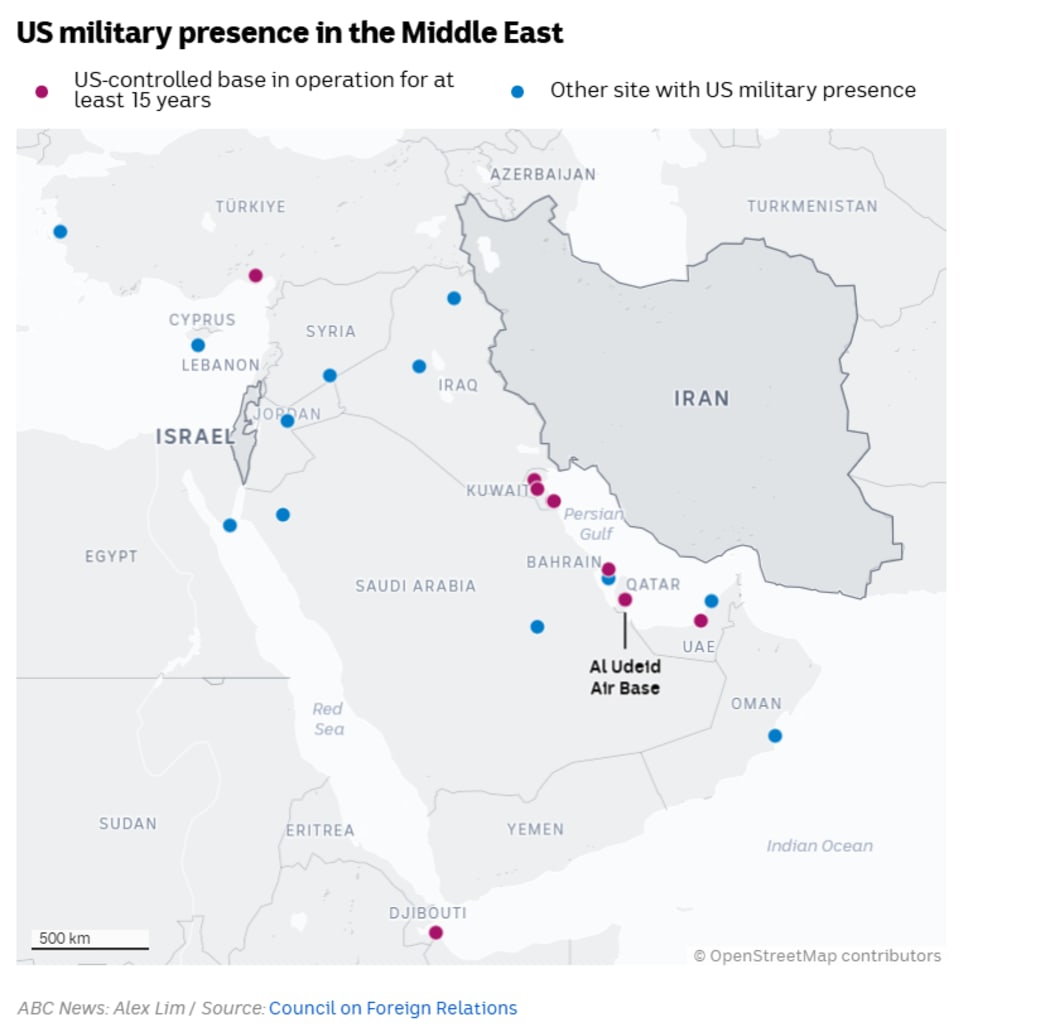
US military presence in the Middle East.
Photo: ABC News: Alex Lim/Source: Council on Foreign Relations
Iran vowed to attack American targets in the Gulf region in response to US and Israeli strikes.
Former army director-general Ian Langford, who served extensively in the Middle East, said the US used the Al Dhafra airfield to support strikes on Iran in June last year.
This would not have gone down well with Tehran, he said.
“In the 12-day war [in 2025], the Americans generated a lot of air-power out of those airfields inside the UAE,” Mr Langford told the ABC.
“That makes them a military target.”
Australia also has a military presence in the UAE with personnel based at Al Minhad Air Base, about 24 kilometres south of Dubai.
Langford described the base as Australia’s “regional hub for the entire Middle East”.
“Whether you’re doing an evacuation operation out of Southern Israel, like we did in 2006, or if you’re doing anti-ISIS operations out of Iraq like we did in 2014-2015, it all tends to generate out of that regional base,” he said.
In May last year, the Department of Defence said there were fewer than 50 core Australian Defence Force staff and a total of 70 to 80 Australians on base at any time.
Defence Minister Richard Marles said an additional 85 ADF personnel would be heading to the UAE to support with the deployment of the E-7A Wedgetail, one of the country’s most sophisticated military surveillance planes.
Geographical firing line
The UAE has been calling for de-escalation, saying it was being targeted “in a very unwarranted manner”.
“Our bases are not being used to attack Iran,” Jamal Al Musharakh, the UAE’s ambassador to the United Nations in Geneva, told reporters.
“We’ve been very clear before and leading up to the current events we are witnessing in the region that as the UAE we will not partake in any attacks against Iran from our territory, and that we will not be involved in such a conflict.”
Iranian President Masoud Pezeshkian has argued that Tehran was not attacking its neighbours, but rather “targeted US military bases, facilities, and installations in the region”.
Langford said there were several factors contributing to the UAE being drawn heavily into the conflict.
With just 100km of water separating Iran and the UAE, he said geography was also putting the country in the firing line.
“The proximity to Southern Iran makes the UAE a likely target because you’ve got overflight if you want to hit anyone else,” Langford said.
“A drone or missile shot at by the UAE may have been intended to go to Qatar or Bahrain or even the Saudis.”
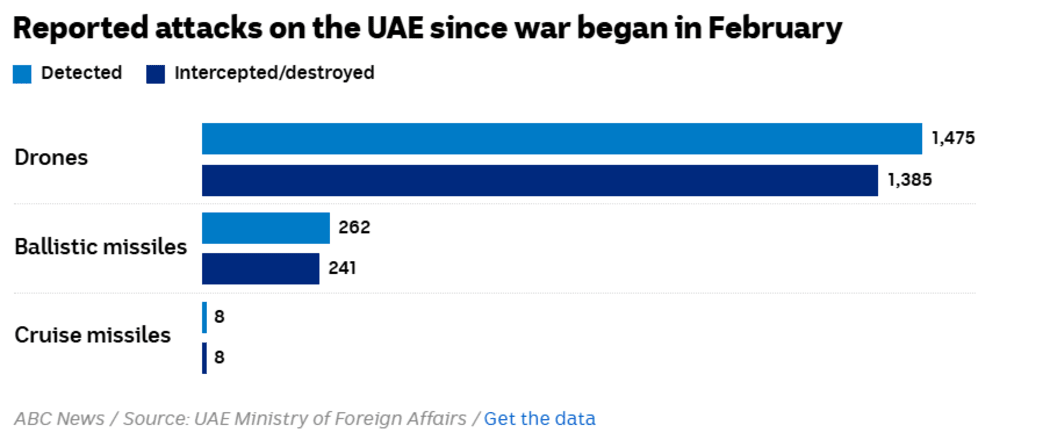
Reported attacks on the UAE since war began in February.
Photo: ABC News/Source: UAE Ministry of Foreign Affairs
The UAE said it was ready to continue defending its territory while working to prevent the conflict from spreading further across the region.
The country has sophisticated air defence systems such as the US THAAD (Terminal High Altitude Area Defense) and France’s Rafales fighter jets.
It also operates the US Patriot system, which is designed to intercept aircraft and ballistic missiles at lower altitudes.
Langford said the country’s defences were strong, but expensive to operate.
Patriot missiles could cost $US1 million ($1.4 million) per shot.
Close Israeli ties
Historically, Iran and the UAE have had tensions based on territorial disputes and clashing regional strategies.
Shahram Akbarzadeh, a professor of Middle East and Central Asian politics at Deakin University, said Iran’s attacks on Gulf states appeared to be “a sign of desperation by the Iranian authorities”.
But he said the focus on the UAE was also reflective of the two countries’ “difficult relationship”.
“The UAE has been quite vocal about Iranian regional ambitions for decades,” Professor Akbarzadeh said.
“And the UAE was among the first GCC [Gulf Cooperation Council] states to sign up to American-engineered Abraham Accords.”
The Abraham Accords are a series of joint agreements between Israel and several Arab nations to normalise relations.
Brokered by the United States in 2020, the agreements focused on areas such as trade, technology, and tourism, and strengthening security ties.
“So the combination has meant that UAE is seen in Iran as an agent of the United States,” Professor Akbarzadeh said.
The war was already shattering the UAE’s sense of “tranquillity and safety”, and directly impacting financial activity, he added.
“Also, I think long-term political implications are very significant,” he said.
Dr Moritz from the ANU said for all Gulf states, long-term regional instability was among the worst of outcomes.
“Unfortunately, for countries such as the UAE that rely on being perceived as stable to attract global business, the economic impact of the conflict will be felt for many years to come,” she said.
“And, of course, the people paying the greatest cost of this conflict are civilians – in Iran, Israel, the Gulf states, Lebanon, and across the Middle East.”
– ABC