
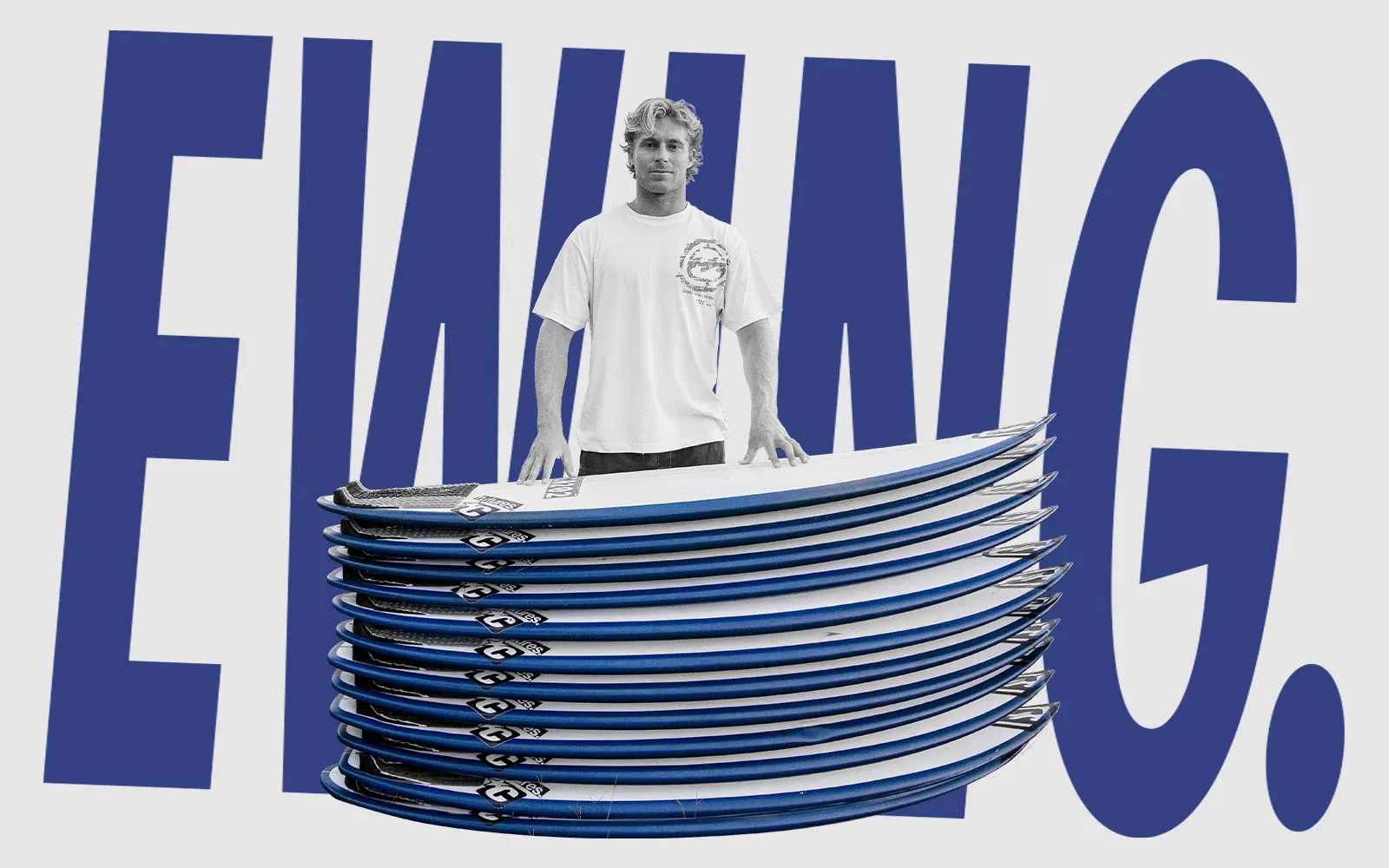
Ethan Ewing might be the most aesthetically precise surfer on the planet.
But going into this Stab In The Dark, the bigger question wasn’t the surfing. It was more so the enigma behind it. Because if your exposure to Ethan comes from post-heat interviews, the experience can feel… limited. He knows it too. “I keep my WSL interviews pretty bare minimum,” Ethan told us early in the trip. “And I repeat myself a lot,” he laughs. “But a lot of it is they just ask the same questions. I’m happy to stay quiet.”
That restraint is by design, and spills over into everything else.
For instance, Ethan never changes the sticker placement on his boards. Ever. Same position, same spacing, every board. “I just want everything to be under control,” he says. “Surfing’s so out of control, I like to control the things that I can.” That mindset: removing variables wherever possible, is exactly what makes him such a compelling Stab In The Dark test pilot.
SITD X was an anomaly, for reasons we’ve spoken about ad nauseum. But at its roots, the entire concept is built on reducing bias. Shapers submit boards anonymously, logos are covered, and the surfer rides them without knowing who made them. In theory, surfboard performance should be the only differentiating factor. But that only works if the surfer provides a consistent baseline.
Thankfully, Ethan does. Watch him over a run of six pumping days and the patterns start to emerge: the lines, the tempo, the pacing through turns. His make rate is absurd. And when he has to nurse turns, it’s obvious.
Eth did his homework too, “When they first offered [Stab in the Dark] to me, I didn’t feel like I had enough knowledge on boards,” he admitted. “I’ve watched every one since Julian and loved them. So I thought, ‘if I’m gonna do it, I’m gonna do it really well’. And try come across as someone who knows what makes a board go, because it’s part of my career to learn about that stuff.”
So what’s his criteria for what makes a good board? If he can’t find its ‘breaking point’ — loosely defined as the point at which any extra force/pressure will cause the board to skip or flatten out…
Ethan’s path to the CT didn’t follow the conventional prodigy arc. And perhaps there’s a lesson there: while the prodigies burned bright and fast, he was still building without the pressure of constantly being in the spotlight. “I did my first contest when I was 10,” he told us. “Rusty Gromfest at Lennox. I don’t think I made a heat for the first three or four years.” The routine was simple: lose early, drive home, surf Straddie.
“I’d go back to Straddie and not leave for another year. It was kinda fun. The way it should be at that age.” While other juniors chased rankings, Ethan stacked water time and repetition. He describes himself as a late bloomer. “Pretty much until I was 15 or 16 the other kids just seemed bigger and more mature.”
Now? “A 90-kilo meat axe,” in the words of Taj Burrow, his surf buddy and host during our stay at Lakey Peak.
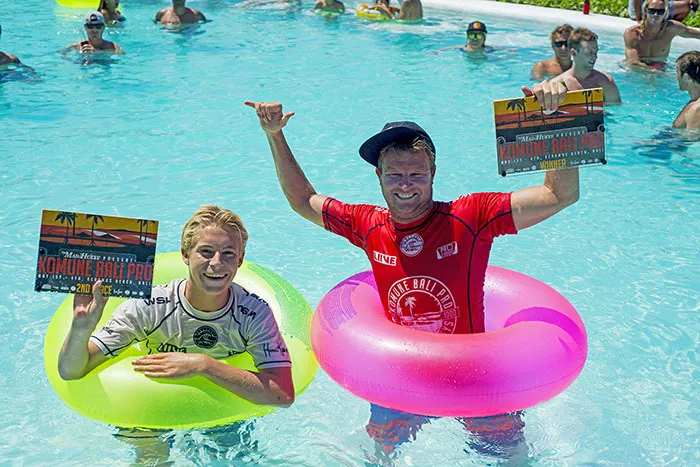 Taj and Ethan never overlapped on tour, but they did share one final in 2015 Komune Bali Pro at Keramas, when EE was just 16. “He was surfing so much better than me it was crazy,” laughs TB. “I remember thinking, I’m not losing to this little cunt. He was doing these big, proper carves while I was on this flicky, slidey Mayhem just thrashing around trying to milk every section. He’d do one or two huge swoops and get an eight. I needed a score at the end, forced something pretty ugly, and got the win. But it didn’t feel like I did.”
Ethan grew up facing serious adversity after losing a parent, something he’s spoken about sparingly but acknowledges shaped his outlook early. The result is a personality that avoids spectacle. Big moments get described in muted language. Achievements get downplayed. Humor, when it appears, tends to be directed back at himself. Ethan’s restraint creates its own paradox: the less he reveals, the more you want to know what’s behind it.
This edition of Stab In The Dark drops early April, bi-weekly. After the Kelly Slater season, where the conversation drifted well beyond the boards, this one returns to the original premise: a double-blind test. No shaper politics. No narrative gymnastics. Just boards, waves, and a surfer whose relationship with equipment might be the most methodical we’ve seen in the series. Six days. A biblical wave count per day. And if Ethan’s theory about control holds up, the differences between these boards should be impossible to miss.
See you in a month.