
image:
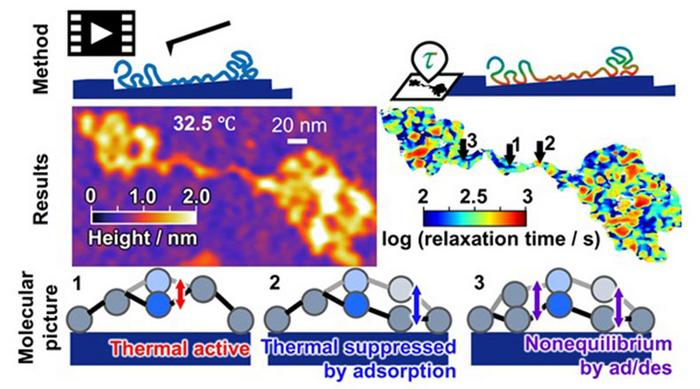
Using atomic force microscopy, the researchers measured nanometric changes in height along different segments of a single polymer molecule. Through careful mathematical processing of these measurements, they found that individual segments can be in three distinct states, deepening our understanding of how polymer-based adhesives attach to surfaces at the single-molecule level.
Credit: Keiji Tanaka / Kyushu University
Fukuoka, Japan—Kyushu University researchers have directly observed, for the first time, how individual polymers—chain-like molecules—behave when in contact with solid surfaces. Published in the Journal of the American Chemical Society on March 11, 2026, and selected to be featured as an ACS Editors’ Choice, the study reveals a previously unseen behavior in which molecules repeatedly stick to and release from the surface. The findings may contribute to enhancing the performance of adhesives for joining different materials.
About 30% of global energy consumption is linked to transportation. One promising strategy to reduce this is by making vehicles lighter, which often requires bonding different materials—such as metals and plastics—into a single structure, which is a persistent engineering challenge. That’s where adhesives come in.
Improving bond strength and durability requires a deeper understanding of what happens at the adhesive interface, which is a nanometer-thin layer where polymers meet the solid surface. While we know that the structure and thermal mobility of polymer chains can strongly affect adhesion, this knowledge comes from measuring average behavior. What has remained unclear is how individual polymer chains and their segments actually move at the interface.
To address this knowledge gap, a team of researchers led by Distinguished Professor Keiji Tanaka of Kyushu University’s Faculty of Engineering set out to observe the motion of individual interfacial polymer chains. The researchers used a technique called atomic force microscopy (AFM), which measures surface structure at atomic precision by scanning a needle-like probe over a sample while maintaining minuscule forces.
“We sought to establish a more realistic molecular picture of adhesive interfaces,” says Tanaka. “Our recent studies have shown that the way polymer chains behave on the adherend surface strongly affects adhesion performance. By observing this motion, we can better understand the underlying mechanisms.”
Molecular motion, including that of polymers, is driven by thermal energy. Although theoretical frameworks such as the fluctuation–dissipation theorem have been developed to describe thermally induced motion, directly visualizing molecular motion has remained difficult. Capturing thermal fluctuations on the scale of a molecular diameter requires measuring chain height at the atomic scale, continuously and over extended periods, with a temporal resolution under 100 seconds—all without damaging the sample.
The team met these demands with AFM. Though previously used to image polymer morphology, the team pushed AFM further by acquiring time-resolved images and applying time-series analysis to extract relaxation times, turning it into a tool for directly quantifying polymer dynamics. Their setup achieved a spatial resolution of approximately 0.4 nanometers along the surface and less than 0.1 nanometers vertically, with a time resolution between 0.3 and 26 seconds. By observing the same chain at different temperatures, the researchers further evaluated how the motion at each position responded to heat.
The observations revealed that within a single interfacial polymer chain, three distinct types of segments coexist. Some segments were “thermally activated,” meaning their movement increased as the temperature rose. Others were “thermally suppressed” or temporarily immobilized because they were adsorbed (weakly attached) to the surface. Interestingly, certain regions repeatedly switched between thermally activated and suppressed states in a random manner, displaying what’s known as “non-equilibrium behavior.”
In physics, a system at equilibrium has stable, balanced dynamics; here, the observed switching indicated ongoing, fluctuating processes that do not settle into a single steady state.
“Our findings provide the first real-space, molecular-level evidence, overturning the conventional view that interfacial polymer chains exhibit uniform, equilibrium dynamics,” remarks Tanaka.
Looking forward, the researchers plan to investigate how behavior changes when multiple polymer chains overlap and interact, moving closer to real-world adhesive systems. This could provide a general framework for linking the structure, dynamics, and function of confined polymers. The implications span adhesives, coatings, and composite interfaces, and extend to the broader pursuit of sustainable materials engineering.
“We expect the insights uncovered to advance molecular design principles for adhesives, and to contribute significantly to the performance enhancement and lightweighting of materials, including those used in next-generation automobiles and transportation systems,” says Tanaka.
###
For more information about this research, see “Direct visualization of segment-like dynamics in isolated polymer chains on solid surfaces,” Shuji Morita, Yuma Morimitsu, Shiho Tanizaki, Tomohiro Kubo, Satoru Yamamoto, Kotaro Satoh, Keiji Tanaka, Journal of the American Chemical Society, https://doi.org/10.1021/jacs.5c23137
About Kyushu University
Founded in 1911, Kyushu University is one of Japan’s leading research-oriented institutions of higher education, consistently ranking as one of the top ten Japanese universities in the Times Higher Education World University Rankings and the QS World Rankings. Located in Fukuoka, on the island of Kyushu—the most southwestern of Japan’s four main islands—Kyushu U sits in a coastal metropolis frequently ranked among the world’s most livable cities and historically known as Japan’s gateway to Asia. Its multiple campuses are home to around 19,000 students and 8,000 faculty and staff. Through its VISION 2030, Kyushu U will “drive social change with integrative knowledge.” By fusing the spectrum of knowledge, from the humanities and arts to engineering and medical sciences, Kyushu U will strengthen its research in the key areas of decarbonization, medicine and health, and environment and food, to tackle society’s most pressing issues.
Journal
Journal of the American Chemical Society
Method of Research
Observational study
Subject of Research
Not applicable
Article Title
Direct visualization of segment-like dynamics in isolated polymer chains on solid surfaces
Article Publication Date
11-Mar-2026
Disclaimer: AAAS and EurekAlert! are not responsible for the accuracy of news releases posted to EurekAlert! by contributing institutions or for the use of any information through the EurekAlert system.