
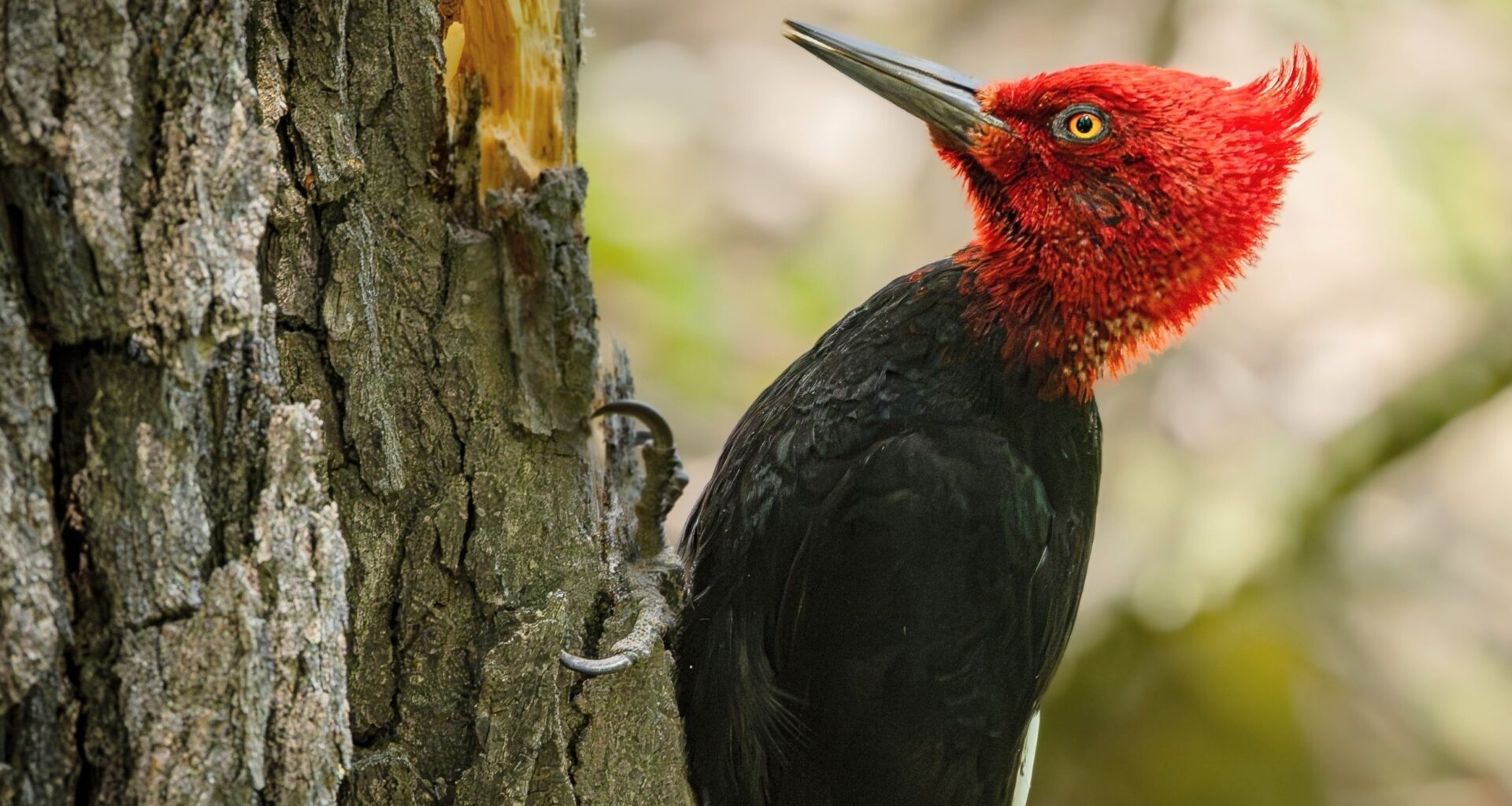
Woodpeckers strike tree trunks thousands of times a day, driving their beaks into solid wood with remarkable speed and force. For years, scientists assumed their skulls worked like shock absorbers that cushioned each blow.
A new study suggests the real solution is different. Instead of softening impacts, woodpeckers’ skulls appear to control how forces move through the head.

Their anatomy keeps the beak, jaw, and skull tightly aligned so that powerful strikes travel along stable paths rather than twisting the head.
This structural design allows woodpeckers to hammer repeatedly without damaging their skulls or joints.
How woodpeckers keep impacts stable
Each strike from a woodpecker sends force directly through the skull. Even small rotations during impact could destabilize the joints connecting the beak, jaw, and skull.
To understand how birds avoid that problem, Sebastián Lyons of the National University of La Plata examined skull structures across many bird species. His team found that woodpeckers maintain unusually tight alignment between the beak, jaw, and braincase.
This alignment keeps the force of each strike moving straight through the head instead of allowing twisting motion to build up during impact.
The design centers on the jaw hinge. In birds, the lower jaw connects to the skull through a movable bone called the quadrate. In woodpeckers, this hinge sits in a more compact and flattened arrangement.
Because the impact occurs closer to these joints, less leverage develops. That reduces torque – the twisting force that can strain or damage structures during repeated impacts.
“The woodpecker’s skull is not designed to absorb impacts,” said Lyons. Instead, its shape helps keep the entire system aligned so that powerful forces remain stable rather than rotational.
Woodpeckers break bird rules
The researchers also discovered that woodpeckers depart from a common pattern seen in many birds.
As most birds grow larger, their faces extend forward while the braincase becomes proportionally longer and narrower. Biologists call this pattern allometry, where body parts change size together as animals grow.
That forward extension increases the distance between impact points and skull joints, which could amplify rotational forces.
Woodpeckers partly avoid this problem. Even in larger species, they maintain a relatively compact face and a more rounded braincase.
This arrangement allows the birds to grow larger heads without creating long lever arms that would increase twisting stresses during pecking.
Brain size also shapes the skull
The study also found that changes in brain size appear to influence skull structure. Rather than stretching the face to make room for a larger brain, woodpeckers reorganize the proportions inside the skull.
A rounder braincase can hold more brain tissue while keeping the striking end of the skull compact.
This combination suggests that brain evolution and impact mechanics may have influenced each other over time, though the study did not directly test behavior.
Pecking uses the whole body
The skull is only part of the system that allows woodpeckers to drill safely. Woodpeckers can strike wood thousands of times per day. Older estimates place the total near 12,000 strikes daily.
Recent research shows that each hit recruits muscles across the head, neck, hips, tail, and abdomen. The birds also time their breathing so they exhale during each strike, which stiffens the body and helps channel energy into the tree.
Together, these movements create a stable body brace that supports the skull during repeated impacts.
Skull designs differ across species
The study also found that these stabilizing features vary among species. Woodpeckers specialized for powerful drilling show stronger reinforcing surfaces where the jaw hinge meets surrounding parts of the skull.
Smaller species or those that peck less forcefully show these features in a weaker form. This variation suggests that the skull design evolved gradually, tuning itself to the different lifestyles and behaviors of each species.
The mechanics behind pecking
Previous research in 2022 showed that woodpecker heads absorb surprisingly little shock and remain mechanically stiff during pecking.
The new study adds another piece to the puzzle by showing how skull proportions and joint geometry help make that stiffness possible.
Engineers often study biological materials when designing impact-resistant structures, but this research suggests that geometry and force direction may be just as important as material strength.
“Our results show that cranial geometry is a key factor enabling their remarkable impact performance,” Lyons said.
What scientists still need to learn
Despite these insights, skull shape alone does not explain everything about woodpecker pecking.
Living birds also rely on muscles, posture, breathing, and precise timing. The new research focused mainly on bones and evolutionary patterns, so it did not test how soft tissues distribute forces during real strikes.
Future studies could examine how skull shape, neck motion, and brain dynamics interact across species that peck frequently, drill deeply, or rarely strike hard.
What woodpeckers can teach us
Woodpeckers may not survive their intense hammering by cushioning impacts after all. Instead, their skulls appear designed to guide forces along stable lines.
That insight helps bridge the gap between anatomy and performance. It could also inspire new engineering designs where controlling the direction of force is more effective than simply trying to absorb it.
The study is published in the Journal of Anatomy.
—–
Like what you read? Subscribe to our newsletter for engaging articles, exclusive content, and the latest updates.
Check us out on EarthSnap, a free app brought to you by Eric Ralls and Earth.com.
—–