
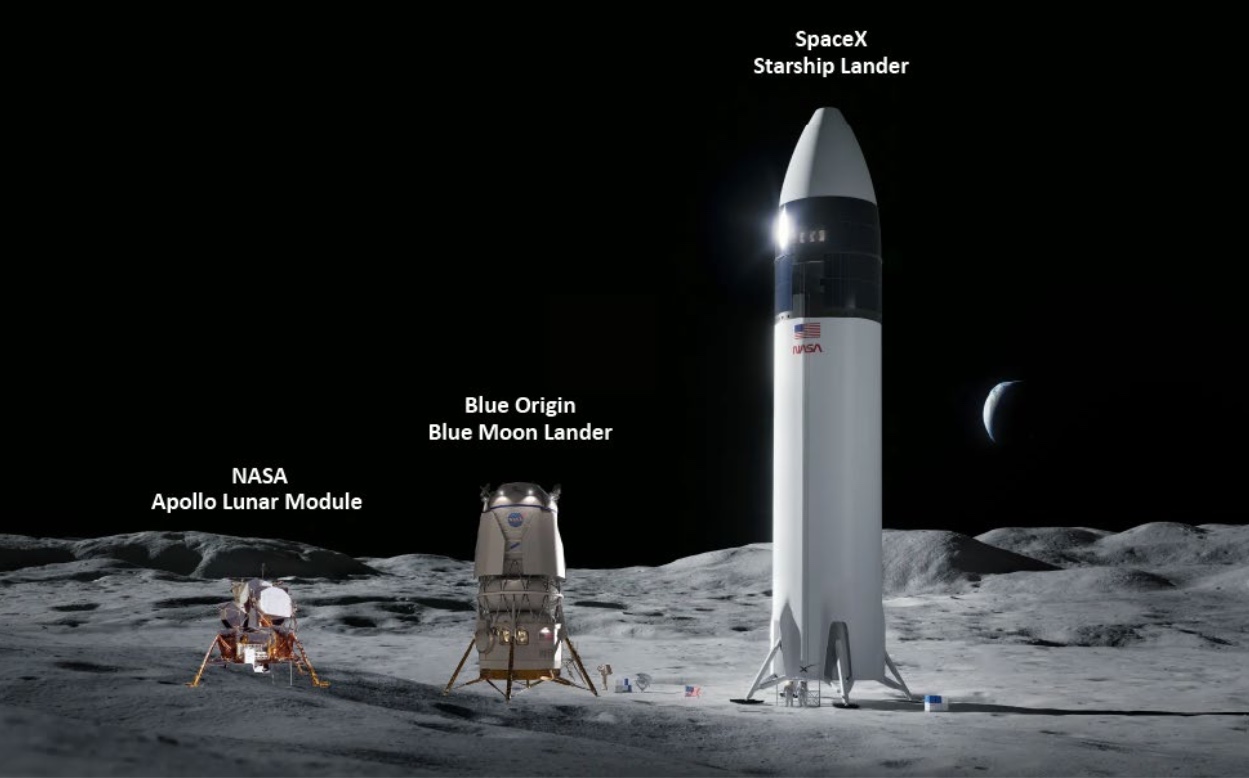
WASHINGTON — NASA’s approach to managing the development of crewed lunar landers for Artemis has successfully controlled costs but not schedule, raising questions about NASA’s desire to accelerate those efforts.
NASA’s Office of Inspector General (OIG) released a report March 10 analyzing the management of the Human Landing System (HLS) program, which is overseeing development of crewed lunar landers by Blue Origin and SpaceX. The review was completed before NASA announced changes to the Artemis architecture Feb. 27.
The review found that NASA’s used of fixed-price, milestone-based contracts had been successful in containing costs. SpaceX’s contract has increased by $253 million, or 6%, since its award in 2021, while Blue Origin’s has increased by $13 million, less than 1%, since its 2023 award.
“NASA’s acquisition approach for the HLS contracts has been effective at controlling costs to the government,” the report stated, with at least some of the increases coming from changes required by NASA to interface with other elements of the Artemis architecture.
The OIG report, though, found both companies had fallen behind schedule. “SpaceX’s development of the Artemis III Starship has been delayed at least 2 years, with additional delays expected,” the company said, based on the earlier plan of Artemis missions where Artemis 3 would have been the first crewed landing.
Blue Origin, whose lander was originally first set to be used on Artemis 5, is at least eight months behind schedule, the report found.
OIG found that both companies are struggling with a key technology, cryogenic fluid management, required for the propellants their landers are using and the ability to transfer those propellants between vehicles. “NASA is tracking a top risk that some of the cryogenic technologies and capabilities SpaceX is developing will not be adequately mature ahead of the Artemis III mission,” the report stated, threatening additional delays.
The report noted that one key test for SpaceX’s Starship, an in-space propellant transfer between two Starship vehicles, was scheduled for March 2025 “but has been delayed 12 months to March 2026.”
SpaceX will not meet that revised date in the report. The next Starship launch, which will not perform a vehicle-to-vehicle cryogenic fluid transfer demonstration, is now expected to launch no earlier than early April.
The scheduled included in the report for Starship included a critical design review for the lander in August 2026 and an uncrewed demonstration landing at the end of 2026, ahead of having the lander ready for the Artemis 3 landing in June 2027.
The OIG report found that Blue Origin was still working to address shortfalls in its Blue Moon Mark 2 lander architecture identified in a preliminary design review, or PDR, in 2024. “As of August 2025—more than a year after PDR was held—nearly half of the official requests for action from the PDR remain open,” the report stated, with the company needing to reduce vehicle mass, mature its propulsion system and improve propellant margins.
The report cited other concerns about the landers. Starship’s design, with its crew compartment 35 meters above the surface, requires astronauts to use an elevator to go down to the surface and back. That is a “top risk” for the HLS program, the report notes, since there is currently no other way for the astronauts to get back into the vehicle should the elevator malfunction.
The report added that NASA and SpaceX disagree with whether SpaceX’s landing approach meets NASA’s requirements that astronauts be able to take manual control, citing the use of manual control on all the Apollo lunar landings. There are also concerns about how the plumes from the landers’ engines might kick up regolith and rocks, interfering with landing sensors and possibly damaging the spacecraft.
Current and future architectures
The report did provide some details not widely publicized about both companies’ lander concepts — or, at least, the lander concepts they were originally funded to develop.
SpaceX’s approach involves using one Starship as a propellant depot in low Earth orbit, filled with liquid oxygen and methane by tanker Starships. That would involve “more than 10” tankers, the report noted, but did not give a more precise range given past, widely varying estimates. Those tankers would launch every six days from sites in Florida and Texas, with fueling starting more than 200 days a crew is launched.
One the depot is filled, the Starship lander would launch to low Earth orbit to fill its tanks with propellant before going to a near-rectilinear halo orbit around the moon. Once in that orbit, NASA would have about 100 days to launch Orion to that orbit to dock with that lander, or with the Gateway with the lander also docked there, to carry out the landing mission.
Blue Origin also uses a depot, called the “transporter,” initially placed in LEO on a New Glenn launch and subsequently loaded with liquid oxygen and liquid hydrogen with refueler missions. The Blue Moon lander would launch to LEO and be fueled by both the transporter and a refueler, then go to the Gateway.
The transporter would then be fueled again in both LEO and a higher “stairstep” Earth orbit, then travel to the vicinity of the Gateway. Blue Moon would undock from the Gateway, top off its tanks with the transporter, and redock with the Gateway to await the arrival of Orion.
However, those plans are now subject to change after NASA requested acceleration plans from both companies last fall to speed up development of the their landers. Neither NASA nor the companies have released details about those plans.
“At the time of this writing, it is too early to determine the technical feasibility, financial implications, and schedule impacts of these proposals,” OIG stated in its report.
NASA also revised its plans for Artemis Feb. 27, turning Artemis into a mission in LEO where Orion will dock with the Blue Moon and/or Starship landers. That mission is planned for mid-2027, followed by two lunar landing attempts with Artemis 4 in early 2028 and Artemis 5 in late 2028.
OIG, in an addendum to the report, acknowledged the changes and added that NASA “plans to further define the Artemis III low Earth orbit flight test after completing detailed reviews between NASA and its Artemis partners.” However, OIG said it could not assess cost, schedule or technical impacts of the changes.
The report did emphasize the need for NASA to test the landers in a flight-like environments before using them on crewed landings, an approach known as “Test Like You Fly.” However, it criticized NASA for falling short of that principle in uncrewed landing tests that will not exercise some lander systems or complete a full flight profile.
Related