
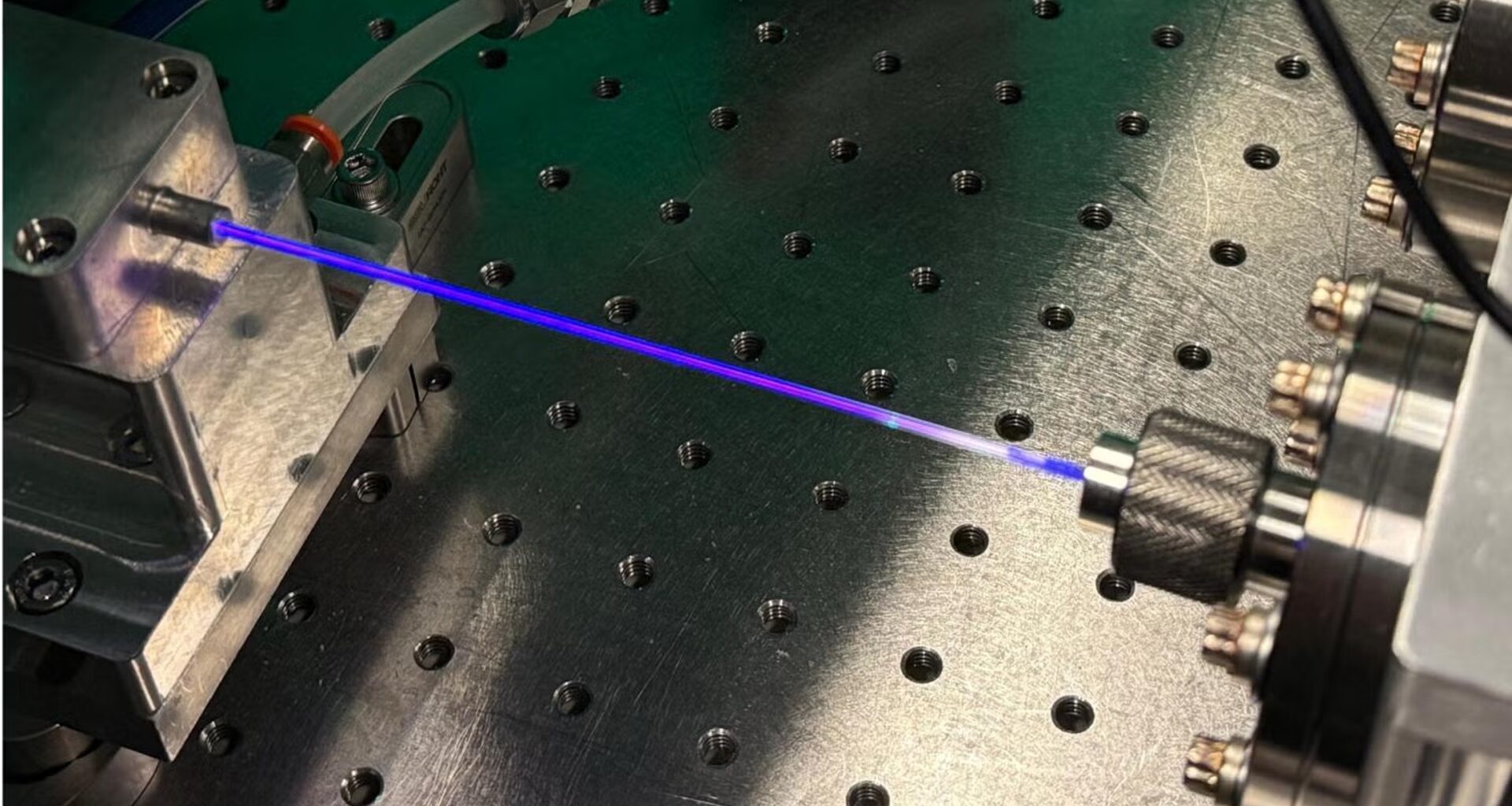
Physicists at the University of Colorado Boulder have demonstrated a new type of vacuum ultraviolet laser that is 100 to 1,000 times more efficient than existing technologies.
The device could allow scientists to observe processes currently beyond the reach of powerful microscopes and help advance ultra-precise nuclear clocks.
The research team says the laser can generate bright light in the vacuum ultraviolet region of the electromagnetic spectrum, an area scientists have struggled to access with practical systems.
Such lasers could allow researchers to track chemical reactions in real time, detect microscopic defects in nanoelectronics, and study materials with much higher resolution than before.
The device is compact enough to sit on a desk, a major shift from existing systems that often require large laboratory setups.
Breaking the VUV barrier
The work is led by physicists Henry Kapteyn and Margaret Murnane of JILA, a joint institute of the University of Colorado Boulder and the National Institute of Standards and Technology.
“Scientists have been working toward vacuum ultraviolet lasers for decades,” Kapteyn said. “We think we might have finally found a great route that can be scaled in power, and that is compact in size.”
Visible light wavelengths range from about 380 to 750 nanometers. Vacuum ultraviolet wavelengths are much shorter, roughly 100 to 200 nanometers, allowing scientists to see much smaller structures.
“Shorter wavelengths matter because you can use them to make higher resolution microscopes,” Murnane said.
But generating stable and powerful light in this region has proven difficult because most materials strongly absorb it.
To overcome this challenge, the team combined red and blue laser beams and passed them through a specialized chamber called an anti-resonant hollow core fiber.
Inside the fiber, the laser light interacts with xenon gas atoms. The atoms absorb the incoming light and re-emit it at much shorter wavelengths, producing vacuum ultraviolet radiation.
“To our knowledge, no other approach, either at big or small facilities, has the VUV power levels, tuning ranges and coherence that our new approach has shown,” Murnane said.
Clocks beyond atomic precision
The laser could also help build practical nuclear clocks, a long-sought technology that measures time using transitions inside atomic nuclei rather than electrons.
These clocks would rely on thorium atoms, which oscillate in energy when illuminated with light at a specific wavelength.
Murnane explained that thorium atoms “tick” only when exposed to light at 148.3821 nanometers, a wavelength that falls within the vacuum ultraviolet range.
Today, producing this light typically requires room-sized laser systems. A compact tabletop source could make nuclear clocks more practical and portable.
Such clocks could enable navigation without GPS, improve space missions, and support searches for planets beyond our solar system.
The researchers also say the laser could benefit industries that depend on nanoelectronics, including semiconductor manufacturing, by helping engineers detect extremely small defects in chips.
The team plans to continue refining the design and making the system smaller and more efficient.
The researchers will present their findings at the APS Global Physics Summit.