
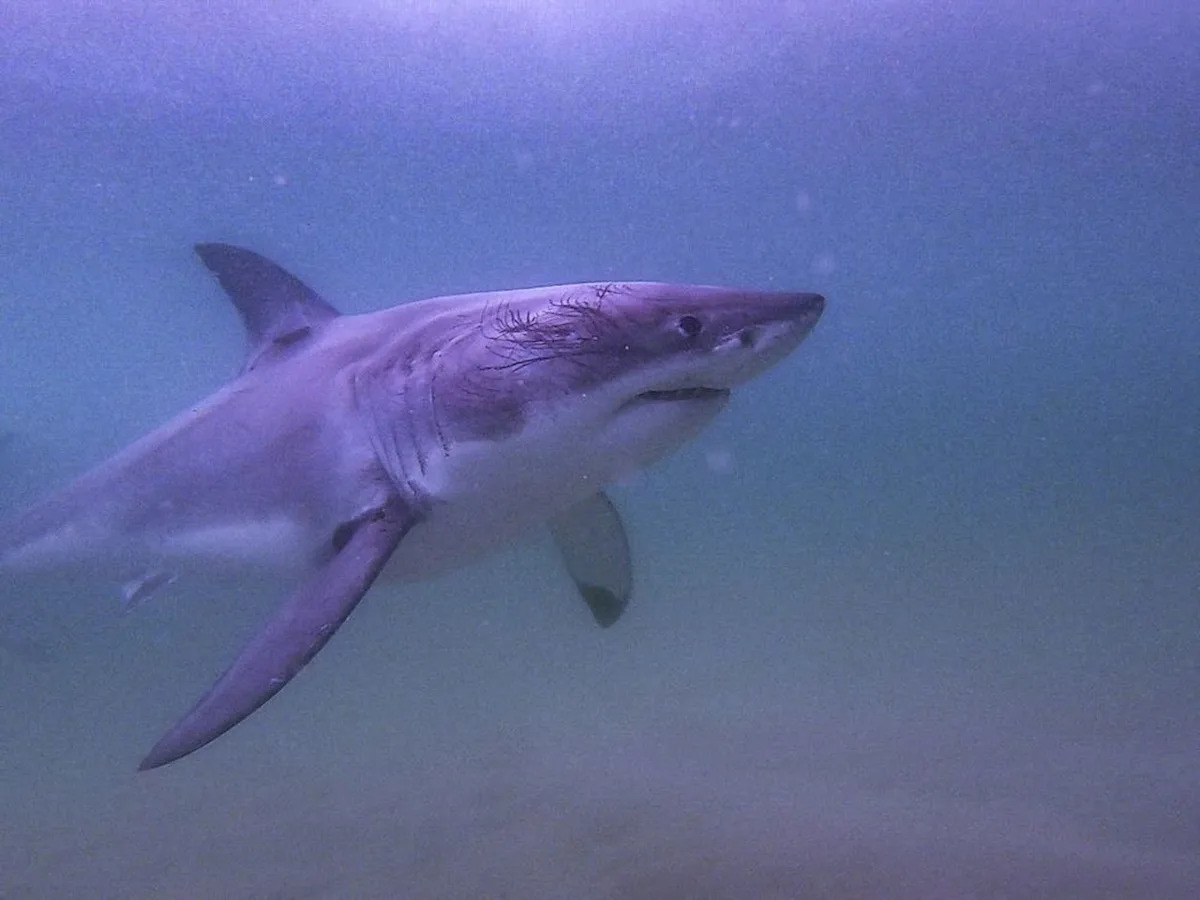
Marine researchers say a 1,000-kilogram great white shark made an “extremely rare” appearance near Vancouver Island this week.
It’s unusual that a great white shark would travel this far north during the winter but it could have been following a food source, said Nicole Nasby Lucas, a research biologist with the Marine Conservation Science Institute.
She said the nearly five-metre long mature female great white shark named Kara was one of six sharks fitted with a tracking device in October in Southern California to determine their migration path to give birth in California and Mexico. The device pings researchers when a shark is at the surface with its dorsal fin out of the water.
“It’s extremely rare … It’s not common for these sharks to come all the way up as far as Oregon or Washington. We’ve had a few near Oregon but none that we have tracked that far,” she said of the Vancouver Island ping.
She added that researchers will continue to study the sharks that go north over years to see if they repeat the behaviour and figure out why they travel so far.
Kara may have followed a whale or previously had a successful feeding experience with seals and sea lions in the area, she said.
There has been a recent surge in the seal and sea lion populations in B.C., which has caused a significant spike in Bigg’s killer whale sightings in the Vancouver and Victoria harbours.
Nasby Lucas said it could be the abundance in marine mammals that led Kara to B.C. waters.
“At some point, she will turn around and go back, and they’re pretty tolerant to cold water, so I’m not sure temperature is a motivation. But food is usually the primary motivation for movement,” she said.
She said mature females usually stay in Southern California for half a year and then migrate over two years.
“So they go offshore for pretty much the whole time that they’re pregnant, and then they come back and have their pups. It’s one of the things we’re trying to learn about these large females, is where they go to pup,” she said.
Researchers hope that by studying the sharks’ migration path when pregnant they will learn about what areas are important to protect.
There have been great white shark sightings in northern waters before but they are rare, with only 29 sightings in B.C. and Alaska between 1960 and 2000, according to Villy Christensen, a professor at UBC’s Institute for the Oceans and Fisheries.
He said because the ocean is warming and that climate change is accelerating that warming, there could be more white shark sightings off the B.C. coast in the future, for example if their food source migrates to cooler water.
“Because the ocean is warming at quite a rapid pace, it’s likely that we’ll see more of them,” said Christensen.
“This is, to my knowledge, really early for them to be seen here. The water temperature cannot have been that warm out there so this is a little bit special.”
Christensen said it’s unlikely that great white sharks will ever become a dominant species off the B.C. coast because the ocean has warmed 1°C and may warm up 2°C or 3°C, which is not enough for great whites to call the north home.
He added that great whites also tend to stay away from areas with their main predator, the transient orcas.
“The ocean is warming and we are just at the northern edge of the great white shark distribution, so it’s likely we will see more,” he said.
He said in the Strait of Georgia, for example, the water has increased by about 1°C in the last century, and it’s accelerating.
“So we may see two or three degrees warming this century.”
Related