
Space is no longer just a scientific frontier or a playground for billionaires with rockets. It has quietly become the nervous system of modern civilization, and, inevitably, of modern warfare. Satellites coordinate military strikes, guide navigation systems, enable financial transactions, and keep global communications alive. Whoever controls orbit, in many ways, controls the fight below. As military powers have rapidly expanded their launch capabilities and orbital assets, the question is no longer whether space would factor into a major conflict, but how fast, and how catastrophically.
To get a clearer picture, several experts; space policy scholars, military strategists, and legal analysts ,were asked to walk through what the first seven days of a world war in space might actually look like. What emerged was a scenario that moves from invisible cyberattacks to physical satellite destruction, all within a single week, potentially leaving Earth wrapped in a prison of its own shrapnel.
The First 48 Hours: A War You Can’t See
For this piece, Gizmodo reached out to Scott Shackelford, provost professor of business law and ethics at Indiana University-Bloomington and a specialist in cybersecurity and international law, who argues that the opening moves wouldn’t start with a bang. “The first 48 hours wouldn’t start with a ‘bang’ but likely with a ‘glitch,’” he writes. The initial phase would be almost entirely cyber-based, chosen precisely because it offers plausible deniability and asymmetric advantages.
Think massive, coordinated distributed denial-of-service attacks hammering ground stations. Think GPS spoofing on a global scale. Before any kinetic weapon is deployed, the primary objective is to blind the enemy. The downstream effects on civilian life would be immediate and disorienting: global logistics chains freeze, high-frequency financial trading halts, ride-sharing apps malfunction, and so do military drone arrays.
It’s a peculiar kind of chaos, one that spreads through spreadsheets and navigation apps rather than through explosions. But its consequences on trust and operational confidence could be just as destabilizing as any missile strike.
Days Three to Seven: From Dazzling to Destruction
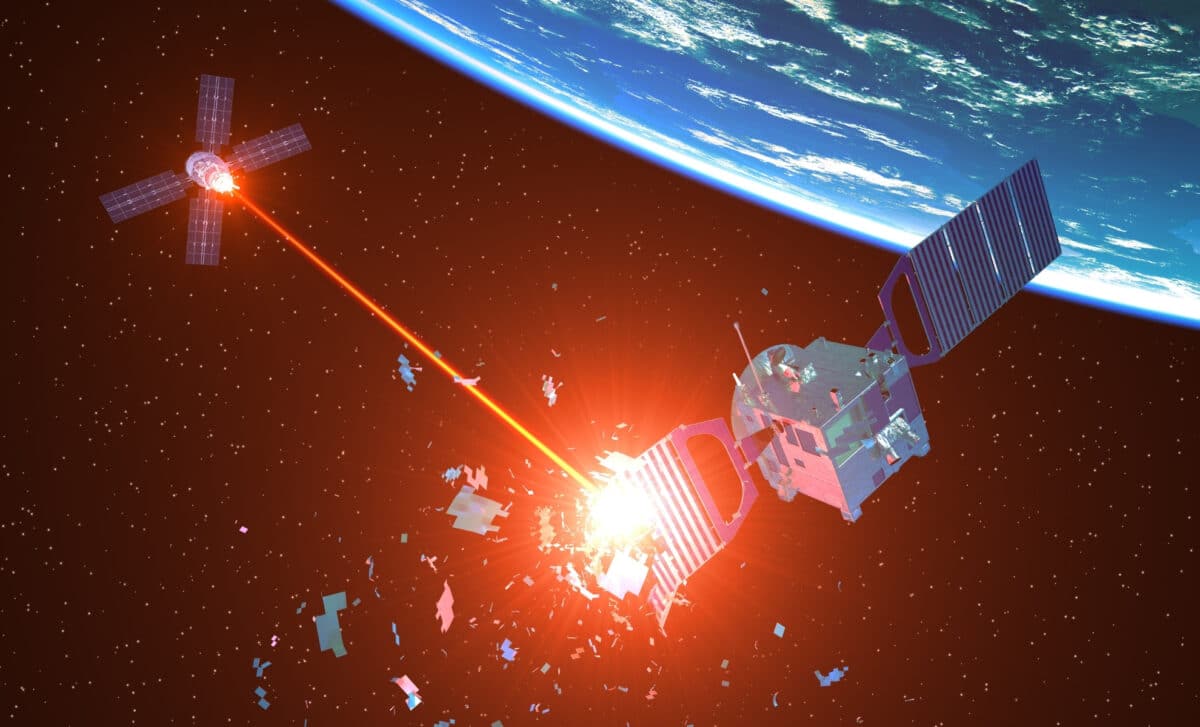
By the middle of the week, according to Shackelford, the conflict shifts from soft interference to hard disruption. This is where what he calls the “grey zones” of international law become literal battlegrounds. Directed-energy weapons, lasers, could be used to permanently blind reconnaissance satellites. The legal and ethical knots this creates are significant: when does an attack on a private commercial satellite constitute an act of war against its host nation?
It’s not a hypothetical question. Companies like SpaceX now operate what is effectively critical military infrastructure, the company even maintains a “StarShield” program. Space policy expert Wendy Whitman Cobb, whose research focuses on the political dynamics of space conflict, notes that attacks in a full-blown WWIII scenario would include kinetic anti-satellite strikes originating both from the ground and from orbit, alongside non-kinetic methods like jamming, lasing, and blinding that render satellites permanently or temporarily inoperable. Cyber attacks on computer operating systems and ground-level strikes on satellite downlink stations and launch facilities would compound the damage.
The goal, she explains, is straightforward: disrupt operations on the ground by severing the space-based systems that modern militaries depend on to see, communicate, and execute precision strikes.
The Kessler Trap: A Prison of Shrapnel
If the conflict escalates to kinetic anti-satellite missiles by days six or seven, the consequences could outlast the war itself. Shackelford describes it bluntly: “A single destroyed satellite creates a cloud of thousands of high-speed projectiles.” The risk is what scientists call Kessler Syndrome, a cascading chain reaction of collisions that could render Low Earth Orbit unusable for a prolonged period. “We wouldn’t just be fighting a war,” he says. “We’d be building a prison of shrapnel around our own planet.” Think Wall-E, he adds. Just a lot more depressing.
Whitman Cobb reinforces this point, noting that the danger of generating harmful debris is normally considered a deterrent to open conflict in space. But in a world war scenario, that deterrent disappears. The result could be debris clouds so dense that entire orbital zones become effectively useless. Were a nuclear anti-satellite weapon deployed, the damage would be indiscriminate, destroying everything in its vicinity regardless of nationality or purpose.
Strategist Peter W. Singer, senior fellow at New America and author of Ghost Fleet, adds another layer to the picture that is easy to overlook: the real center of gravity in space warfare isn’t up in orbit at all. It’s the ground stations, fiber nodes, and undersea cables that make space-based data usable. Conventional and special operations forces could hit this terrestrial infrastructure anywhere on the planet, South America, East Africa, even Antarctica.
Strip away those links and the satellites above become useless, however sophisticated they are. The side that wins, Singer argues, will be the one that maintains its terrestrial connections and can rapidly replenish destroyed satellite constellations using reusable rockets and resilient production lines. Space, in his framing, is not a static sanctuary. It is a dynamic battlefield, and the fight on Earth determines the conflict among the stars. Our current legal frameworks, including the 1967 Outer Space Treaty, are nowhere near equipped to manage this reality.