
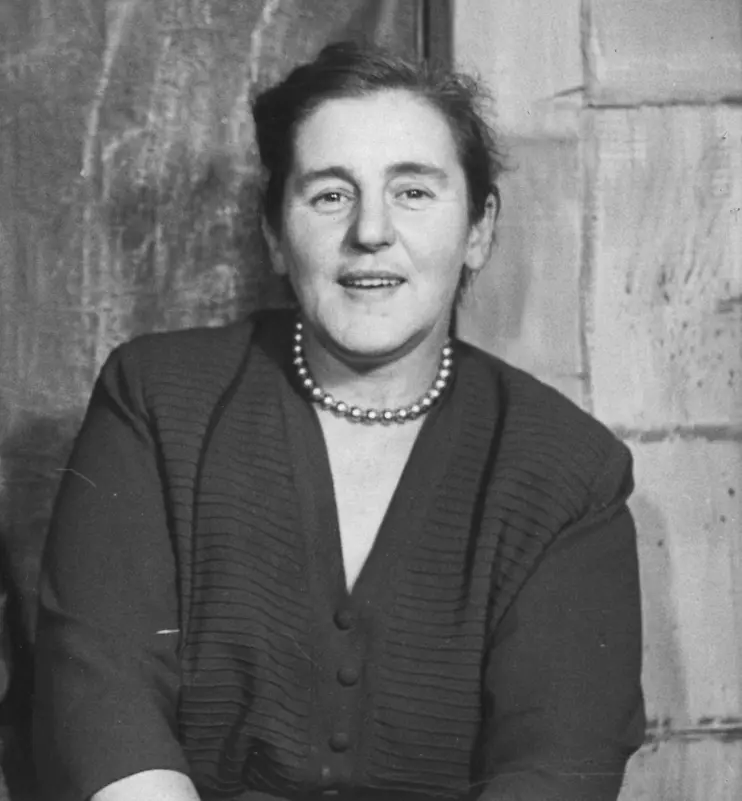


Foundation Secretary/Treasurer, NZ Basket Ball Association (1924–25)
A Netball NZ Centenary project by Margaret Henley.
Netball’s passionate defender both on and off the court
Dorothy Rangi Crumpton (1903–1954) was a quietly influential figure in the early development of netball in Aotearoa – known as basketball in New Zealand until 1970. As the founding secretary/treasurer of the New Zealand Basket Ball Association (NZBBA) in 1924, she was part of a visionary group determined to unify and promote the sport across the country.
Raised in Reefton and inspired by her mother Nellie’s dedication to sport and community, Crumpton excelled both academically and athletically. During her teacher training years in Wellington, she emerged as a standout defence player and a passionate advocate for basketball. She captained Wellington in New Zealand’s first inter-provincial basketball match in 1923 and later established the Hawke’s Bay association in 1927. Throughout her life, she contributed to the sport as a player, coach, umpire, administrator and spokesperson.
Her lifelong commitment to empowering young women through sport led her to collaborate with netball pioneers such as Irene McInnes, Myrtle Muir, and Betty Armstrong, and to serve in leadership roles across regional basketball bodies. In 1947, she became director of Christchurch’s Risingholme Community Centre, where her dynamic leadership expanded programmes in arts, education, and sport which included basketball.
Though not widely recognized alongside the sport’s most celebrated founders, Dorothy Crumpton’s contributions quietly advanced the vision and infrastructure that enabled basketball to flourish in the 1920s and 1930s. Her life exemplifies how grassroots leadership—driven by dedication, intellect, and generosity—can shape social institutions within the community and provide a pathway for others to follow.
The Formation of national body in 1924
Irene McInnes, Myrtle Muir, and Betty Armstrong are rightly recognised as the visionary game changers whose determination led to the formation of the New Zealand Basket Ball Association (NZBBA) in May 1924. McInnes’ bold initiative to affiliate the five national basketball centres under one governing body laid the groundwork for much needed national unification. However, there was another pivotal figure on the founding committee who also deserves recognition.
Newly elected NZBBA president, Irene McInnes sought a promising young woman to take on the role of secretary—someone dependable, capable, and open to growing through the opportunity. Dorothy Crumpton, a teacher trainee and one of Wellington’s first representative basketball players, was shoulder-tapped for the honorary secretary/treasurer position. Even before this appointment, her organisational and secretarial skills had impressed both McInnes and Armstrong.
McInnes had great confidence in Crumpton, having already appointed her captain of the Wellington team and secretary of the Wellington Ladies Basketball Association (WLBBA) at the same meeting where McInnes—then president of the Wellington YWCA Basketball Club—became WLBBA president, and Armstrong was named vice president. At the time, Myrtle Muir, president of the Canterbury Ladies Basketball Association (CLBBA), though based in Christchurch, was already collaborating closely with McInnes and Armstrong.
During her brief NZBBA tenure, Crumpton’s pen-and-ink handwriting and meticulous record-keeping became a hallmark of the Association’s early documentation. Her handwritten minutes from executive meetings—including the 31 clauses that outlined the guiding principles—provide a vital timeline of the NZBBA’s foundational years.

Dorothy Crumpton’s meticulous handwriting documenting the inaugural NZBBA meeting, 21 & 22 May 1924.
Source: NZBBA Executive Minute Book 1924-35.
Though initially accepting the role as a favour to her mentors, her contribution quickly proved indispensable. The Association’s 1925 Annual Report offered special thanks, remarking that it was “impossible to find her successor”. Her unwavering dedication underscored a deep loyalty not only to her mentors but to their shared belief in basketball as a force for social good—empowering women and enriching communities.

NZBBA Annual Report 1925-1926 records special thanks for Dorothy Crumpton.
Source: NZBBA Minute Book 1924-35
Early life and education
Dorothy’s athletic talent, leadership, and exceptional organisational skills—first evident in her foundational work with the NZBBA in 1924—were shaped by the influence of both her parents, particularly her mother, Helen (née Collings) Crumpton. Raised in Reefton, a then thriving gold-mining town on New Zealand’s West Coast, Dorothy enjoyed a culturally vibrant upbringing despite the town’s remote location.
Her parents were prominent contributors to local life, serving as dynamic role models through business, sports, and the arts. Their guidance—especially her mother’s—instilled values that Dorothy would carry into her artistic, sporting, and professional achievements.
Her father, Henry Crumpton, inherited the family blacksmithing business in 1904 and quickly became a respected local entrepreneur.

Crumpton Wheelwright & Blacksmith, Broadway, Reefton, 1896. Thomas Crumpton (Dorothy’s grandfather) 3rd from left. Her father, Henry Thompson Crumpton, unidentified in the photo, took over the business upon the death of his father in 1904.
Source: https://westcoast.recollect.co.nz/nodes/view/27057
By 1907, he had sold his father’s blacksmith business and purchased the town’s livery and coach stables from hotelier William Cochrane. As well as providing the usual public transport and livery services, he became well known for his flower-decked coaches ferrying brides to weddings and sports clubs to dances and picnics—Reefton’s horse-drawn Uber service of the 1900s!
Though a sports enthusiast, Henry’s heart lay in the arts. A talented painter and musician, he played piano and cornet at local dances and was a longstanding member of the local Brass Band – a common feature of mining community life. His 1938 obituary in The Inangahua Times celebrated him as “a talented musician, and for many years a valued member of the Inangahua Silver Band”. That love of music and the arts passed to his daughter Dorothy, enriching her life and the classrooms she taught in throughout her teaching career.
However, the strongest influence in Dorothy’s life appears to have been her mother, Helen—more commonly known as Nellie. The daughter of a quartz mine manager, Nellie was an excellent sportswoman and a tireless community organiser. She played hockey and tennis both before and after her marriage in 1899 and the birth of her five children, two of whom died in early infancy.
Nellie’s passion for advancing women’s recreational opportunities was notable. In 1907, she co-founded the Reefton Koronui Ladies Hockey Club, became its first Club Captain, as well as a player and umpire. In 1921, representing Reefton at a Wellington conference, she advocated for the inclusion of a Reefton player in a national women’s hockey team to tour Australia the following year (Greymouth Evening Star, 1921).
Her activism wasn’t confined to sport. She ran the popular Haeremai Tea Shop in Reefton’s main street and catered for countless local events, including fundraisers for sports clubs and the local brass band. There were few social occasions during this time that didn’t have a touch of the Crumpton organisational magic —either run by Nellie herself, supported through the Tea Shop, or led by her at the community level. Her obituary in The Inangahua Times, 22 May 1931, highlights her tireless work, particularly her efforts “for the proper conduct of sports” to enhance the recreational lives of women in her local community. Her ethos of leading by example would deeply influence Dorothy’s adult life.
Around 1917, Nellie Crumpton relocated to Nelson to seek stronger educational opportunities for Dorothy and her younger sister Thelma. There, she became the proprietress of Wainui House, a well-regarded boarding establishment on Nile Street, while the girls attended Nelson College for Girls.
Dorothy and Thelma flourished in Nelson’s cultural scene, excelling musically in both the piano and flute and winning regional awards in dance competitions throughout the upper South Island. Dorothy’s academic record at Nelson College for Girls, from 1919–1920, was outstanding. In her final year, she earned a school scholarship and ranked 11th out of 581 candidates nationally in the 1920 Public Service Entrance examinations reported in the NZ Gazette, 3 February 1921.
After completing her probationary year for teaching certification, Dorothy relocated to Wellington in early 1922 to begin her training at Wellington Teachers’ College and Victoria University College.
Wellington Teachers’ College Basketball A Team (1922–1923)
Crumpton likely played basketball throughout her school years in Reefton and Nelson. Upon enrolling at Wellington Teachers’ College (WTC) in 1922, she immediately joined the newly established WTC Basketball Club, which fielded four teams in the Wellington Association competition. As was common for teacher trainees at the time, she also attended lectures at Victoria University College which qualified her to play in the University A Basketball team.
This period preceded the development of Hataitai Park, and the growing number of women’s teams competed on a mix of asphalt and grass courts across central Wellington—venues included Clyde Quay School, Mount Cook Boys’ School, and Newtown School. According to Wellington stalwart Betty Armstrong’s invaluable first-hand account, the Newtown School location offered an unexpected advantage: it helped promote the visibility and popularity of the game in the city.
As a member of the Wellington Training College A team, Crumpton regularly competed in both inter-provincial Training College tournaments and early iterations of the University Easter Tourney competitions. Reports in WTC student magazines at the time highlight Crumpton as an outstanding player across her two years with the Training College’s A team—even if the team’s results didn’t always reflect her reported prowess!
In 1923, Crumpton was part of the WTC team that faced Christchurch Training College (CTC) in a memorable inter-college match on the notorious Karori Park ‘grass’ courts in Wellington. The teams slid through thick mud, and although the final score was 4–2 in favour of CTC, the Ako Pai student magazine argued that the result did not reflect the tightly contested nature and speed of this “exciting exhibition of the game”. The report concluded that Christchurch’s players had “more ability in keeping their footing on the slippery ground than did the Wellington team”, perhaps due to their weekly endeavours to keep upright on Hagley Park’s equally infamous grass courts during a southern winter.
Later that season, Wellington faced Auckland Teachers’ College (ATC) in an inter-provincial exchange, where Crumpton’s WTC team suffered a harsh 30–1 defeat. The Ako Pai write-up was notably loyal in its explanation, offering two key reasons:
“The height of the goal posts customarily used in Wellington is considerably lower than that of the Auckland posts,” which “affected the aim of the Wellington forwards.”
The Wellington side was “depleted of two of their strongest players, Miss Crumpton (back) and Miss Connors (centre), who, on account of an attack of influenza, was unable to make the trip”. The report claimed that had Crumpton been available, “the score would not have been quite so uneven.”
Despite these losses, Crumpton’s WTC A team excelled locally, leading the Wellington Association Senior A Shield competition for the 1923 season.
Pathway to Wellington Representative honours
Crumpton’s reputation as a standout defender in the WTC A team placed her at the forefront of the urgent need to standardise basketball across New Zealand. In 1922, basketball rules still varied from region to region (hence varying goal post heights for example) fuelling the momentum to form a national governing body and unify the rules to facilitate regular provincial and national competitions.
Wellington took the initial step by forming its first representative team to play an invitation side from Auckland Teachers’ College. While not a fully provincial competition, the Wellington representative team was the first of its kind in the country, and Crumpton earned her spot as one of the three defenders in the 9 a-side game being played at that time.
In 1923, McInnes once again identified Crumpton’s leadership potential, inviting her to stand for secretary/treasurer of the Wellington Ladies Basketball Association (WLBA). That September, McInnes also named Crumpton captain of the Wellington side for a landmark game: the first fully inter-provincial match of women’s basketball in New Zealand, held at the Clyde Quay School courts against Canterbury. The Canterbury side was led by coach/manager Myrtle Muir, while Wellington’s coach/manager was veteran referee and former WLBBA president (1920), Miss Mana Tompkins. Wellington won 24–10, with the Evening Post, 25 September 1923, attributing the result “in great part to the efficient coaching of Miss Tompkins.”
Growing advocacy skills
Following the landmark provincial match against Canterbury, Crumpton, as captain of the Wellington team, took on a growing public role. She was frequently involved in demonstration games, including one described by The Dominion in 1924 as an “exhibition of scientific play.” These games became a strategic tool in the NZBBA’s campaign to attract young players and elevate basketball’s status—aiming to surpass hockey as the dominant sport for girls and women in New Zealand. For Crumpton, it marked a turning point: she began to find her voice not just as a standout representative player, but as a passionate advocate for the sport.
Echoing the legacy of her mother’s tireless work in women’s sport, Crumpton was selected by the WLBBA—mentored by Irene McInnes—to lobby for increased recreational space at the 1925 Sports Protection League meeting. Detailed in The Dominion, 17 April 1925, the meeting brought together major Wellington sports organisations to draft a set of questions aimed at local council candidates regarding urgent sports facility shortages.
In her oral submission, Crumpton cited the Wellington Basketball Association’s rapid growth: 240 members in 1923, surging to 513 in 1924, with an expected 1,000 registrations for the 1925 season. The key challenge she raised was the need for more hard-surface courts—perhaps informed by her own experience slithering around in the Karori Park mud during the 1923 Teachers’ College tournament.
Despite generous support from the City Council at the time, available hard courts were limited to school grounds. Crumpton proposed that Wellington’s sports bodies collaborate more strategically to share facilities and secure more sustainable access for basketball’s expanding presence. Her delivery clearly made an impact: she was the only woman appointed to a six-member committee tasked with drafting and presenting the sports bodies questions to local body candidates.
Teaching career and enduring commitment to basketball
After graduating as a primary school teacher, Crumpton began her teaching career in the Wellington area before being appointed assistant teacher at Hastings Central School in 1927. Although she stepped away from her role as NZBBA secretary/treasurer, her passion for expanding basketball into the provinces remained undiminished. A NZBA Council press release published in the Southland Times (4 June 1927) credited her as the “prime mover in the formation of the association in the Hawke’s Bay.” She served as a Hawke’s Bay representative selector and attended the 1927 Dominion Tournament in Wellington as the region’s delegate.
Competing in the Dominion Tournament marked a significant step up for the inexperienced Hawke’s Bay team. Crumpton not only selected and coached the squad but also took the court as centre—departing from her usual role as a defender—to help guide the young and inexperienced team. A game report in The Evening Post (29 August 1927) noted that D. Crumpton was a key player in the team and did “most of the work” for Hawke’s Bay. Although the team lost all their matches by considerable margins—for instance, suffering a 65–5 defeat to Wellington—the tournament was nonetheless considered a highly successful venture for the newly formed Hawke’s Bay Basketball Association.

Games in action at the 1927, 2nd Dominion Basketball Tournament, Newtown School courts, Wellington – well before referees wore uniforms.
Source: ‘New Zealand Free Lance’, September 7,1927.
In 1928, she was elected president and organised a representative team trip to Wellington—an opportunity for Hawke’s Bay players to experience higher-level competition in a major basketball centre. Crumpton, still only 25, also played in the team marking the last known record of her as a player, although she continued to be highly active in the association. Later that year, in her role as coach/selector, she took the team to the 4th Dominion Tournament in Auckland. Under her experienced guidance, Hawke’s Bay had a significantly more successful tournament, beating both Southland and Taranaki to finish in fourth position, tying with Canterbury.

Dorothy Crumpton (4 th from left back row) with her Hawke’s Bay Representative team at the 3rd Annual Dominion Tournament in Auckland, 1928.
Source: ‘New Zealand Sporting and Dramatic Review’, 30 August, 1928.
As the association’s delegate, she met with regional representatives and team officials at the tournament to address the challenges posed by the sport’s rapid national growth. Back in Hawke’s Bay, she worked tirelessly as president to affiliate with neighbouring sub-associations—such as Napier—and to build a stronger base of representative basketball players. Drawing inspiration from Hawke’s Bay rugby’s Ranfurly Shield dominance 1922-1927, she envisioned a future “All Black basketball team” in which local women could play a leading role, just as Hawke’s Bay men had long contributed to “All Black football teams” (Hawke’s Bay Herald, 5 April 1928).

Regional delegates and NZBA officials attending the 3 rd Dominion Tournament, Auckland, 1928. Dorothy Crumpton (middle row, 1st left), Myrtle Muir (front 2 nd left), Irene McInnes (front 3 rd left).
Source: ‘New Zealand Sporting and Dramatic Review’, 30 August, 1928.
As President and Hawke’s Bay delegate, Crumpton attended the 1929 Dominion Tournament in Christchurch and continued to advocate at each NZBA annual Council meeting for Hawke’s Bay to host a future tournament. The following year, likely influenced by her highly regarded leadership skills and her close ties to Irene McInnes and Myrtle Muir, Hawke’s Bay was awarded hosting rights for the 5th Annual Dominion Tournament, with Crumpton playing a key role on the Tournament Management Committee.
Despite the time demands of her teaching career and leadership in the Hawke’s Bay Association, she also refereed weekly games and remained an active sportswoman in the community. Throughout the 1930s, she won numerous trophies in tennis and golf and played indoor basketball and badminton. In 1930, the Grey River Argus praised her return to the West Coast as a “former Reeftonite,” noting her sweep of all four women’s titles at her former tennis club’s annual championships.
During her time with the NZBBA founders, Crumpton cultivated a close and enduring friendship with Irene McInnes, based on their shared backgrounds in teaching and their belief in basketball’s role in enriching young women’s lives. In the late 1920s and 1930s, when her teaching schedule allowed, Crumpton joined McInnes and Myrtle Muir on promotional tours across the country, fostering regional affiliation with the national body. Throughout her teaching career in primary schools around the country, she remained a regular guest of the McInnes family in Invercargill, often holidaying with them at their rural Southland retreat in Athol.
In 1943, Crumpton made her final teaching move to Invercargill, joining the newly founded Tweedsmuir Intermediate School. As in Hawke’s Bay, she quickly re-engaged with basketball and became secretary of the Southland Basketball Association in 1944—a group originally founded by McInnes in 1925. During this time, Crumpton is reported as contributing to the development of “a film illustrating coaching and technique in the game” (Press, 4 October 1954). Commissioned by the Department of Education in 1944, the filmstrip series was overseen by Otago’s umpiring expert Sara Foster and Wellington’s Betty Armstrong. Though only two of the planned three filmstrips were produced, one—The Basketball Referee—miraculously still survives today in the NNZ archive.

‘The Basketball Referee’ filmstrip, 1944. Located in the Wellington Netball Association archive. This film strip is number 5 of 137 copies distributed to schools throughout the country as a coaching aid to assist with the rapid growth of the game post WW2.
Photo: Margaret Henley.
The final chapter: The Risingholme Years (1947–1954)
Crumpton’s formal engagement in regional basketball management lessened as she shifted focus to a new professional challenge. In 1947, she was appointed as the director of Risingholme Community Centre in Christchurch. Her two decades of teaching across regional and rural New Zealand, coupled with her organisational talents and deep-rooted passion for sport, music and the performing arts, made her an ideal candidate to lead this pioneering hub for adult and community education.

Dorothy Crumpton upon her appointment as Director of Risingholme Community Centre, 1947.
Photo: Risingholme Community Centre Archive.
Under Dorothy Crumpton’s dynamic leadership, the Centre quickly expanded its offerings—introducing classes in the creative arts, crafts, sports, music, and later, pottery. She had a deep love for nurturing the performing arts in young children, reflecting the joy she herself had experienced in her youth. Where there was music, drama and a piano, Crumpton was sure to be found at the heart of the activity.

Music was always an integral part of her life as can be seen in this impromptu photograph taken of Dorothy at a Risingholme event.
Photo: Risingholme Community Centre Archive.
Although she no longer held an official role in a provincial basketball association, it was hardly surprising that one of her first initiatives at Risingholme was to establish a basketball club connected to the Centre. While records are incomplete, photographic and game fixture evidence confirms that at least two Risingholme teams competed in the Canterbury Basketball Association competition at Hagley Park between 1947 and 1950. It is highly likely that these teams were coached by Crumpton during her time as Director of Risingholme as they disappear from the Canterbury Basketball Association weekly club fixtures by 1950, although junior basketball continued to be offered at the Centre.

Risingholme basketball team formed by Dorothy Crumpton, late1940s.
Photo: Risingholme Community Centre Archive.

Opening Day tournament, Hagley Park Courts, Canterbury Basketball Association, late1940s. Risingholme Club teams, 2nd group of players from left in dark uniforms as indicated by the arrow.
Photo: Risingholme Community Centre archive.
Tragically, her visionary tenure at Risingholme was cut short. Crumpton died from cancer in 1954 at just 51 years of age, after overseeing seven remarkable years of growth and innovation at the Centre. The outpouring of grief that followed was substantial, and her legacy remains etched into Risingholme’s fabric. Memorial plaques throughout the buildings and grounds still honour her contribution, and tributes from staff who worked alongside her paint a picture of a woman deeply respected and dearly missed.
She was remembered as “a gifted and cultured woman” wholly devoted to her work. Her leadership, both collaborative and bold, drew others into her orbit of enthusiasm—but she also wasn’t afraid to take the reins herself:
No subject seemed to daunt her and her untiring optimism and breadth of vision were evident in her fearless handling of any situation. (Risingholme Newsletter, Nov/Dec 1954)
Her significance was recognised at the national level as well. Mr. A.G. Thompson, Officer of Higher Education at the Department of Education, offered this tribute:
…those who know the history of the Centre will know just how much of that effort drew its inspiration from Miss Crumpton… Risingholme will always represent for me the things that Miss Crumpton stood for and worked to achieve. If these things do not continue, Risingholme will have failed, and failure was somehow a word that I never heard her use. I don’t think she knew its meaning. (Risingholme Newsletter, Nov/Dec 1954)
Dorothy Crumpton’s lasting contribution to the history of netball in Aotearoa
Though her name does not often appear beside netball’s most celebrated pioneers, Dorothy Crumpton’s influence is deeply embedded in the sport’s early development. As one of the first women to represent Wellington in basketball during the early 1920s, she stood among those whose drive helped establish basketball as New Zealand’s leading women’s sport by the late 1920s.

Photo: Risingholme Community Centre Archive.
Her lifelong commitment to education and youth development was interwoven with her love for the game. Through her work in the sport’s women-led governance and administration, she quietly helped advance the values of first-wave feminism in Aotearoa: building confidence, agency, and community through a sport women both played and managed. In her own understated way, Crumpton found her voice within this movement—standing alongside other women who shaped the sport with purpose and vision.
Her contribution, like that of many women of her era, was quietly revolutionary—an enduring testament to how sport can be a site of societal change, and how female leadership can flourish in an era when such talents were largely unrecognised or recorded.

Dorothy Crumpton – Netball’s passionate defender on and off the court.
Photo: Risingholme Community Center Archive.
Notes:
Although the game was known as basketball for nearly the first 70 years of its existence in New Zealand, it was also referred to or spelled as ‘Basket-ball’, ‘Basket Ball’, ‘netball’, and occasionally ‘net-ball’. Where possible, I have aimed to be historically accurate and have used the appropriate term within the context of the era under discussion.
There were also variations of the game being played with 6, 7 or 9 a-side teams. The provincial representative teams and the competitions in the main urban centres in this era were all playing 9 a-side.
Another possible confusion is that NZBBA opted for spelling Basketball as one word from 1927 and was consequently renamed as the NZ Basketball Association (NZBA).
‘Indoor basketball’, refers to the international game of modern basketball, played indoors in a gymnasium, invented by James Naismith in 1891 with which netball shares a common origin. The indoor game spread rapidly throughout the YMCA movement and was first played in NZ in 1908 and had a similar growth pattern to the female outdoor variant of the game – basketball (netball) – although never as dominant. To avoid ongoing confusion between the two different games, the indoor game was colloquially called ‘indoor basketball’, or just ‘indoor’ and to ensure even further clarity for the general public, the NZ press sometimes called the women’s game ‘outdoor basketball’.
Crumpton descendants: If you are a relative or wish to know more about Dorothy Crumpton please contact: Margaret Henley, University of Auckland, This email address is being protected from spambots. You need JavaScript enabled to view it.. I would love to hear from you.
Thanks to:
The Royal Society Marsden Humanities and Social Sciences Fund which made this research possible. This article was written as part of a larger Marsden fund project entitled: Netball’s enduring role in the intergenerational health and wellbeing of Aotearoa women.
Netball New Zealand for their ongoing support of historical research as part of their Centenary Celebrations 2024/5.
Tobey Keddy, University of Auckland Communication Intern, who made a valuable contribution to the initial research for this article.
Maria Hegerty, archivist Wellington Netball Association, for her meticulous archival skills and instant recall of early Wellington netball facts and figures.
Risingholme Community Centre, Christchurch, for assisting with photographs from their archive and of the various tributes to Dorothy Crumpton still evident at the Risingholme facility.