
Landrigan, P. J. et al. The Lancet Commission on pollution and health. Lancet 391, 462–512 (2018).
International Agency for Research on Cancer (IARC). Outdoor air pollution a leading environmental cause of cancer deaths (Press release No. 221) (2013). Retrieved October 15, 2025, from https://www.iarc.who.int/news-events/iarc-outdoor-air-pollution-a-leading-environmental-cause-of-cancer-deaths/.
Committee on the Medical Effects of Air Pollutants (COMEAP). Air pollution: Cognitive decline and dementia. UK Health Security Agency (2022). Retrieved November 8, 2025, from https://www.gov.uk/government/publications/air-pollution-cognitive-decline-and-dementia.
Di Gessa, G. et al. Cognitive performance and long-term exposure to outdoor air pollution: findings from the harmonized cognitive assessment protocol substudy of the english longitudinal study of ageing (ELSA-HCAP). J. Gerontol. Ser. A 80, glaf060 (2025).
Calderón-Garcidueñas, L. et al. Air pollution, cognitive deficits and brain abnormalities: a pilot study with children and dogs. Brain Cognit. 68, 117–127 (2008).
Cserbik, D. et al. Fine particulate matter exposure during childhood relates to hemispheric-specific differences in brain structure. Environ. Int. 143, 105933 (2020).
World Health Organization. Ambient Air Pollution: A Global Assessment of Exposure and Burden of Disease (WHO, 2016).
Health Effects Institute. State of Global Air 2024: Special Report (Health Effects Institute, 2024).
World Health Organization. WHO Global Air Quality Guidelines (WHO, 2021).
Underwood, E. The polluted brain. Science 355, 342–345 (2017).
Pryor, J. T., Cowley, L. O. & Simonds, S. E. The physiological effects of air pollution: particulate matter, physiology, and disease. Front. Public Health 10, 882569 (2022).
Yuan, A., Halabicky, O., Rao, H. & Liu, J. Lifetime air pollution exposure, cognitive deficits, and brain imaging outcomes: a systematic review. Neurotoxicology 96, 69–80 (2023).
Tokuda, T. et al. Association of air pollution exposure during pregnancy and early childhood with children’s cognitive performance and behavior at age six. Environ. Res. 236, 116733 (2023).
Block, M. L. & Calderón-Garcidueñas, L. Air pollution: mechanisms of neuroinflammation and CNS disease. Trends Neurosci. 32, 506–516 (2009).
Wilker, E. H. et al. Long-term exposure to fine particulate matter, residential proximity to major roads and measures of brain structure. Stroke 46, 1161–1166 (2015).
Majumder, P., Chaudhary, E. & Dey, S. Exposure to ambient PM2.5 and its association with the loss of labor productivity of manufacturing plants in India. Environ. Res. Lett. 19, 104010 (2024).
Xia, Y. et al. Assessment of socioeconomic costs to China’s air pollution. Atmos. Environ. 139, 147–156 (2016).
World Health Organization. Global Status Report on the Public Health Response to Dementia (WHO, 2021).
Saenen, N. D. et al. Recent versus chronic exposure to particulate matter air pollution in association with neurobehavioral performance in a panel study of primary schoolchildren. Environ. Int. 95, 112–119 (2016).
Bos, I. et al. Subclinical effects of aerobic training in urban environment. Med. Sci. Sports Exerc. 45, 39–447 (2013).
Faherty, T., Raymond, J. E., McFiggans, G. & Pope, F. D. Acute particulate matter exposure diminishes executive cognitive functioning after four hours regardless of inhalation pathway. Nat. Commun. 16, 1339 (2025).
Mallach, G. et al. Randomized cross-over study of in-vehicle cabin air filtration, air pollution exposure, and acute changes to heart rate variability, saliva cortisol, and cognitive function. Environ. Sci. Technol. 57, 3238–3247 (2023).
Yang, D. et al. Cognitive benefits of reducing indoor particulate matter exposure during sleep: new evidence from a randomized, double-blind crossover trial. Ecotoxicol. Public Health 58, 20873–20882 (2024).
Shehab, M. A. & Pope, F. D. Effects of short-term exposure to particulate matter air pollution on cognitive performance. Sci. Rep. 9, 8237 (2019).
Gao, X. et al. Short-term air pollution, cognitive performance and nonsteroidal anti-inflammatory drug use in the Veterans Affairs Normative Aging Study. Nat. Aging 1, 430–437 (2021).
Wang, P. et al. Socioeconomic disparities and sexual dimorphism in neurotoxic effects of ambient fine particles on youth IQ: a longitudinal analysis. PLOS One 12, e0188731 (2017).
Lim, Y.-H. et al. Lifetime exposure to air pollution and academic achievement: a nationwide cohort study in Denmark. Environ. Int. 185, 108500 (2024).
Shier, V., Nicosia, N., Shih, R. & Datar, A. Ambient air pollution and children’s cognitive outcomes. Popul. Environ. 40, 347–367 (2019).
Alter, N. C., Whitman, E. M., Bellinger, D. C. & Landrigan, P. J. Quantifying the association between PM2.5 air pollution and IQ loss in children: a systematic review and meta-analysis. Environ. Health 23, 101 (2024).
Maynard, R., & Atkinson, R. Basic Mathematics for Students of Air Pollutants (Royal Society of Chemistry, 2024).
World Bank. Population ages 0–14, total (SP.POP.0014.TO). World Bank Open Data. https://data.worldbank.org/indicator/SP.POP.0014.TO (2026).
Delgado-Saborit, J. M. et al. A critical review of the epidemiological evidence of effects of air pollution on dementia, cognitive function and cognitive decline in adult population. Sci. Total Environ. 757, 143734 (2021).
Shi, L. et al. Long-term effects of PM2·5 on neurological disorders in the American Medicare population: a longitudinal cohort study. Lancet Planet. health 4, e557–e565 (2020).
Rogowski, C. B. B. et al. Long-term air pollution exposure and incident dementia: a systematic review and meta-analysis. Lancet Planet. Health 9, 101266 (2025).
Salana, S. et al. Inter-continental variability in the relationship of oxidative potential and cytotoxicity with PM2.5 mass. Nat. Commun. 15, 5263 (2024).
Tassel, C. et al. Oxidative potential of atmospheric particles in Europe and exposure scenarios. Nature 647, 109–114 (2025).
Streissguth, A. P., Barr, H. M., Sampson, P. D., Darby, B. L. & Martin, D. C. IQ at age 4 in relation to maternal alcohol use and smoking during pregnancy. Dev. Psychol. 25, 3–11 (1989).
Streissguth, A. P., Barr, H. M. & Sampson, P. D. Moderate prenatal alcohol exposure: effects on child IQ and learning problems at age 7 1/2 years. Alcohol. Clin. Exp. Res. 14, 662–669 (1990).
Jacobson, S. W., Jacobson, J. L., Sokol, R. J., Chiodo, L. M. & Corobana, R. Maternal age, alcohol abuse history, and quality of parenting as moderators of the effects of prenatal alcohol exposure on 7.5-year intellectual function. Alcohol. Clin. Exp. Res. 28, 1732–1745 (2004).
Sayal, K. et al. Binge pattern of alcohol consumption during pregnancy and childhood mental health outcomes: longitudinal population-based study. Pediatrics 123, e289–e296 (2009).
Russell, M., Czarnecki, D. M., Cowan, R., McPherson, E. & Mudar, P. J. Measures of maternal alcohol use as predictors of development in early childhood. Alcohol. Clin. Exp. Res. 15, 991–1000 (1991).
Mortensen, E. L., Michaelsen, K. F., Sanders, S. A. & Reinisch, J. M. A dose-response relationship between maternal smoking during late pregnancy and adult intelligence in male offspring. Paediatr. Perinat. Epidemiol. 19, 4–11 (2005).
Shen, S. et al. Enhancing global estimation of fine particulate matter concentrations by including geophysical a priori information in deep learning. ACS EST Air 5, 332–245 (2024).
World Bank Group. “The World by Income and Region.” World Development Indicators. https://datatopics.worldbank.org/world-development-indicators/the-world-by-income-and-region.html (2025).
Jones, G. IQ and national productivity. In The New Palgrave Dictionary of Economics (Palgrave Macmillan, 2018).
Lv, Z. & Xu, T. Does intelligence affect health care expenditure? Evidence from a cross-country analysis. Intelligence 55, 86–89 (2016).
Sram, R. J., Veleminsky, M. Jr, Veleminsky, M. Sr. & Stejskalová, J. The impact of air pollution on the central nervous system in children and adults. Neuro Endocrinol. Lett. 38, 389–396 (2017).
Liu, X. et al. Neurodevelopmental toxicity induced by PM2.5 Exposure and its possible role in Neurodegenerative and mental disorders. Hum. Exper. Toxicol. 42, 9603271231191436 (2023).
Banks, E. C., Ferretti, L. E. & Shucard, D. W. Effects of low level lead exposure on cognitive function in children: a review of behavioral, neuropsychological and biological evidence. Neurotoxicology 18, 237–281 (1997).
Shih, R. A. et al. Environmental lead exposure and cognitive function in community-dwelling older adults. Neurology 67, 1556–1562 (2006).
Sanders, A. P., Claus Henn, B. & Wright, R. O. Perinatal and childhood exposure to cadmium, manganese, and metal mixtures and effects on cognition and behavior: a review of recent literature. Curr. Envirn. Health Rep. 2, 284–294 (2015).
Saxena, R. et al. Mixed metals exposure and cognitive function in Bangladeshi adolescents. Ecotoxicol. Environ. Saf. 232, 113229 (2022).
Heng, Y. Y. et al. Heavy metals and neurodevelopment of children in low and middle-income countries: a systematic review. PLoS One 17, e0265536 (2022).
Axelrad, D. A., Bellinger, D. C., Ryan, L. M. & Woodruff, T. J. Dose–response relationship of prenatal mercury exposure and IQ: an integrative analysis of epidemiologic data. Environ. Health Perspect. 115, 609–615 (2007).
Central Pollution Control Board. National Ambient Air Quality Standards 2019, https://cpcb.nic.in/upload/NAAQS_2019.pdf (2019).
Flynn, J. R. Massive IQ gains in 14 nations: What IQ tests really measure. Psychol. Bull. 101, 171–191 (1987).
Makri, A. & Stilianakis, N. I. Vulnerability to air pollution health effects. Int. J. Hyg. Environ. Health 211, 326–336 (2008).
Faherty, T. et al. HIPTox—hazard identification platform to assess the health impacts from indoor and outdoor air pollutant exposures, through mechanistic toxicology: a single-centre double-blind human exposure trial protocol. Int. J. Environ. Res. Public Health 21, 284 (2024).
OECD (Organisation for Economic Co-operation and Development) Integrated Approaches to Testing and Assessment (IATA), https://www.oecd.org/en/topics/sub-issues/assessment-of-chemicals/integrated-approaches-to-testing-and-assessment.html (2022).
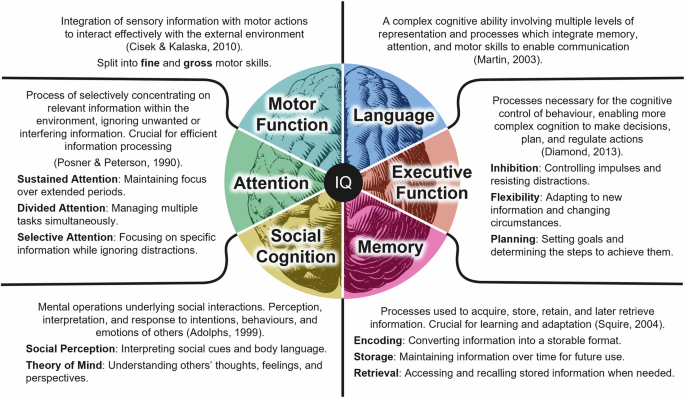
Cisek, P. & Kalaska, J. F. Neural mechanisms for interacting with a world full of action choices. Annu. Rev. Neurosci. 33, 269–298 (2010).
Martin, R. C. Language processing: functional organization and neuroanatomical basis. Annu. Rev. Psychol. 54, 55–89 (2003).
Diamond, A. Executive functions. Annu. Rev. Psychol. 64, 135–168 (2013).
Squire, L. R. Memory systems of the brain: a brief history and current perspective. Neurobiol. Learn. Mem. 82, 171–177 (2004).
Adolphs, R. Social cognition and the human brain. Trends Cogn. Sci. 3, 469–479 (1999).
Posner, M. I. & Petersen, S. E. The attention system of the human brain. Annu. Rev. Neurosci. 13, 25–42 (1990).
Graser, A., Sutton, T. & Bernasocchi, M. The QGIS project: spatial without compromise. Patterns 6, 101265 (2025).