
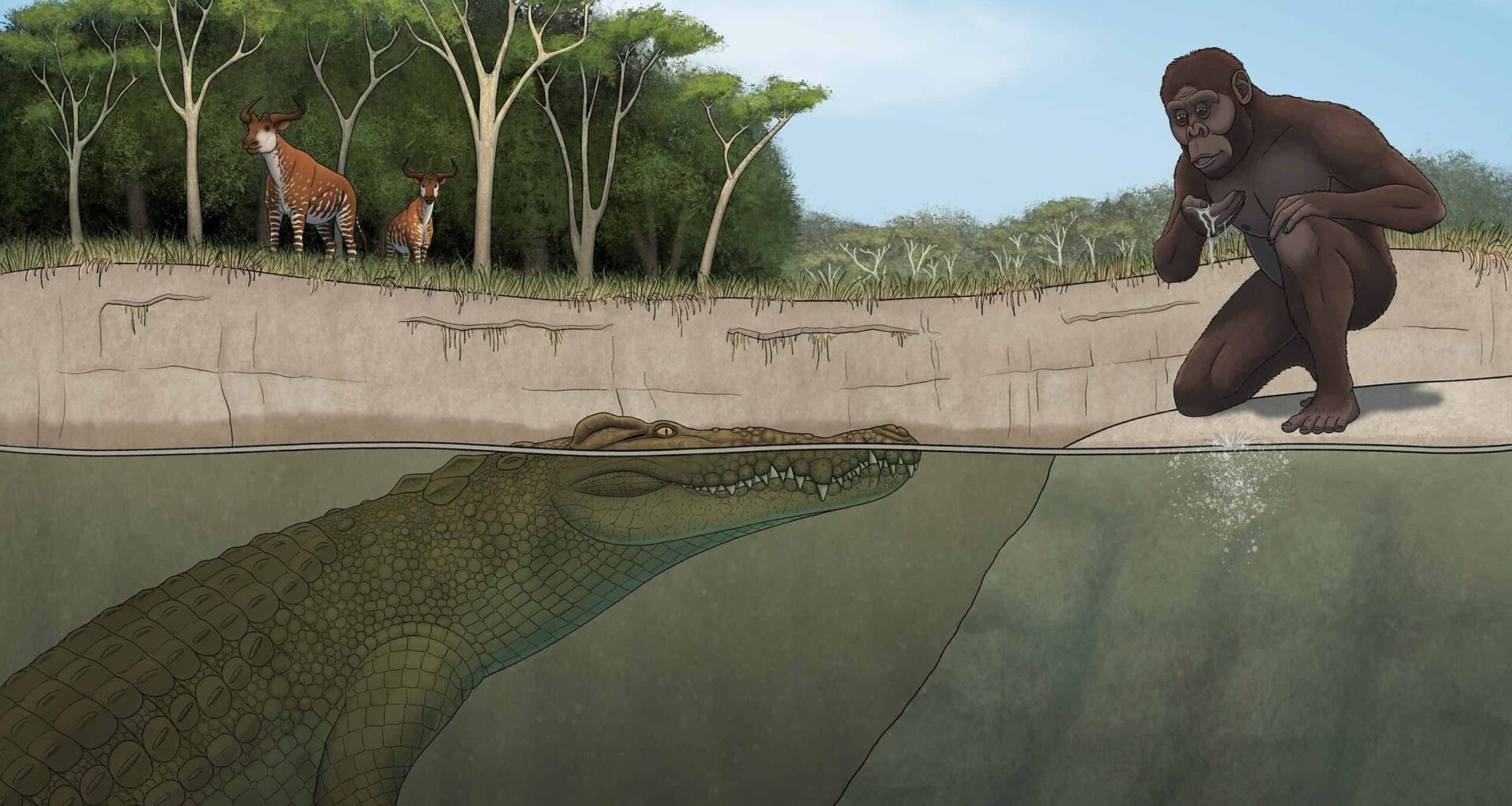
 Researchers led by the University of Iowa have described and named a new crocodile species that roamed a region in Africa more than 3 million years ago. Credit: Tyler Stone, University of Iowa.
Over three million years ago, the wetlands of ancient Ethiopia were dominated by an ambush predator that dwarfed early human ancestors and likely preyed on them. Researchers have officially identified this apex predator as a new species, Crocodylus lucivenator.
The name translates to “Lucy’s hunter.” It references the famous fossil skeleton of Australopithecus afarensis discovered in the same region in 1974. Lucy is one of the most significant links in the human evolutionary chain and a direct ancestor or close relative of the genus Homo.
These ancient reptiles lived between 3.4 and 3 million years ago. They grew between 12 and 15 feet (3.6 and 4.6 meters) long and weighed up to 1,300 pounds (590 kilograms). They shared the shrublands, wet grasslands, and gallery forests of the Afar region with early hominins.
“It was the largest predator in that ecosystem, more so than lions and hyenas, and the biggest threat to our ancestors who lived there during that time,” says Christopher Brochu, paleontology professor at the University of Iowa and lead author of the new study.
Although there is no direct evidence, Brochu and colleagues strongly believe that Crocodylus lucivenator preyed upon hominins like Lucy.
“It’s a near certainty this crocodile would have hunted Lucy’s species. Whether a particular crocodile tried to grab Lucy, we’ll never know, but it would have seen Lucy’s kind and thought, ‘Dinner,’” Brochu says.
Unraveling an Ancient Family Tree
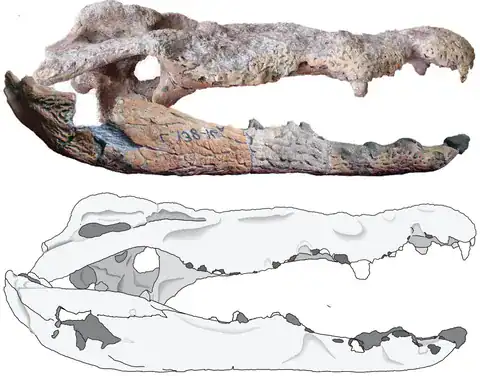 Skull of Crocodylus lucivenator. Credit: Cristopher Brochu.
Fragmented skulls, jaws, and teeth of the newly described croc had actually been collected many years ago from the Hadar fossil site. Brochu first examined the cataloged C. lucivenator specimens at a museum in Addis Ababa in 2016. He was struck by the unusual anatomy.
“I was just blown away because it had this really weird combination of character states,” Brochu recalls.
×
Thank you! One more thing…
Please check your inbox and confirm your subscription.
The most striking feature was a prominent bony hump in the middle of its snout. Modern Nile crocodiles lack this feature, but it appears on modern American crocodiles.
Researchers believe male crocodiles used this bump for sexual display. “You see this in some modern crocodiles,” Brochu says. “The male will lower his head down a little bit to a female to show it off”.
The species also possessed upturned bone margins at the back of its skull, creating horn-like projections.
By mapping these traits, the researchers determined that this wasn’t just a variant of an existing reptile. Instead, it belongs to a completely separate evolutionary branch called Paleoafrican crocodiles. This ancient lineage ruled Africa long before the modern Nile crocodiles we see today ever arrived on the scene.
Surviving Brutal Turf Wars
Life at the top of the food chain involved intense competition. The study team found clear evidence of violence on one specific fossilized crocodile lower jaw, known as A.L. 126-11.
The jawbone preserved deep furrows and a massive puncture wound. The J-shaped, hooked marks indicate the attacker used a violent, inertial biting strategy.
This matches the behavior of crocodiles performing death rolls to disarticulate prey or fight rivals. The crushing damage was too severe to belong to a mammalian predator like a lion or giant otter. Instead, it perfectly matched the bite of another massive Crocodylus lucivenator.
The surrounding bone had remodeled and become spongy. This proves the victim survived the brutal encounter with a competitor from the same species and healed over time.
“The fossil record preserves similar injuries in extinct groups as well, so this kind of face-biting behavior can be found throughout the crocodile family tree,” says Stephanie Drumheller, a paleontologist at the University of Tennessee and study co-author.
“We can’t know which combatant came out on top of that fight, but the healing tells us that, winner or loser, this animal survived the encounter,” Drumheller adds.
The Lone Crocodile of the Afar
 Reconstruction of the ancient hominid known as Lucy. Credit: Elisabeth Daynes.
Despite a changing environment, Crocodylus lucivenator maintained an exclusive grip on its territory.
“During the Pliocene, Hadar was composed of a variety of habitats alongside its lake and river systems over space and time, including open and closed woodlands, gallery forests, wet grasslands, and shrublands,” says Christopher Campisano, an associate professor at Arizona State University and study co-author.
Through all these climatic shifts, the newly discovered predator stood its ground. “Interestingly, this crocodile was one of only a few species that was able to persist throughout,” Campisano explains.
Crocodylus lucivenator was the only crocodylian species living in the Hadar Formation. However, fossil sites just to the south in the Turkana Basin suggest up to four different crocodylian species co-existing in the same waterways.
Researchers do not yet understand why the Turkana Basin supported such a diverse crocodylian ecosystem while the Afar region hosted only one.
For our ancient ancestors navigating the lakes and rivers of Hadar, one apex predator was likely enough. The presence of Crocodylus lucivenator meant early hominins had to stay constantly alert at the watering hole’s edge.
The findings appeared in the Journal of Systematic Palaeontology.