
image:
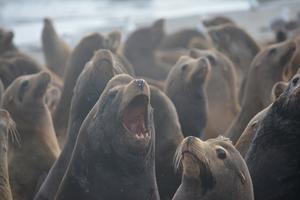
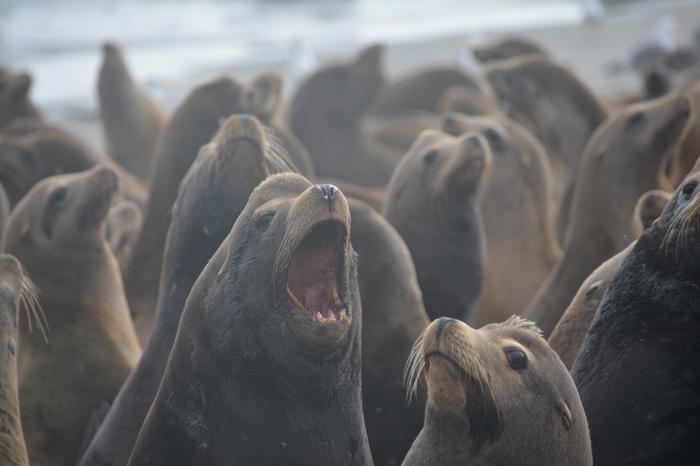
Adult California sea lions at Ano Nuevo Island, San Mateo, California. Credit: C. Reichmuth
Credit: C. Reichmuth
Neuroscientists uncovered new insights into a key evolutionary question: Why can humans talk when most animals can’t?
The journal Science published the research led by Emory University and the New College of Florida. The findings suggest that seals and sea lions may have vocal flexibility as a side effect of developing a brain “bypass” for voluntary breath control. This same bypass allowed them to adapt to aquatic life.
The comparative study examined the brains of coyotes along with those of sea lions, elephant seals and harbor seals — marine carnivores with varying degrees of vocal control that are evolutionary cousins to canines.
Seals are among the few animal species known to have the super vocal flexibility that allows them to mimic human voices. Sea lions have also demonstrated good vocal plasticity on a more limited scale. The neurobiology of these capabilities, however, was not known.
Senior author Gregory Berns, Emory professor of psychology, and first author Peter Cook, a former Emory postdoctoral fellow, used the technique of diffusion magnetic resonance imaging (MRI) on post-mortem animal brains, giving them a view of connective neural pathways across species.
All the brains used in the study came from wild animals that died naturally in rehabilitation facilities or had to be euthanized due to injuries.
The results showed that, in coyotes, the mid-brain — associated with automatic behaviors important to survival, such as breathing, swallowing and reactions to threats — controls the groups of cells in the brain stem that send signals to muscles used for vocalization.
The marine mammal brains, however, have a direct connection between the vocal motor cortex and the groups of cells controlling vocal muscles. That connection bypasses the mid-brain region.
The researchers hypothesize that most animals lack vocal flexibility due to their inability to “unlock” this automatic response mechanism from vocalization.
Seals and sea lions have loosened this automatic control through their development of exquisite breathing and swallowing capabilities allowing them to hunt and eat underwater. Sea lions, for example, can stay underwater for an average of 10 to 20 minutes while some seal species can dive without surfacing for up to two hours.
“We’ve discovered an ecological recipe for how a mammal might evolve a vocally flexible brain,” says Cook, who is now associate professor of marine mammal science at New College of Florida.
“By broadening the scope and using these neuroimaging techniques to compare more mammalian species wired to have vocal flexibility with those that are not, we might be able to build up an evolutionary tree for language,” adds Berns.
Mapping brain connectivity
MRI scans reveal information about the architecture of a brain — known as gray matter. Diffusion MRI provides information about how molecules move through biological tissues, mapping the connective pathways of a brain — known as white matter.
The technique of using diffusion MRI on a non-living brain was developed by co-author Karla Miller at the University of Oxford to study Alzheimer’s disease in human brains. “Because dead brains don’t move, and don’t mind holding still for hours on end, we can acquire extremely high-quality data,” Miller explains.
The technique has since been used in some primate and rodent studies.
Berns helped pioneer the use of diffusion MRI in a range of other animals, including brains preserved in museum collections. He led a 2017 study that successfully mapped the connectivity in the brains of two extinct thylacines, or Tasmanian tigers. The brains had been stored in formaldehyde for more than 100 years.
“I believe we hold the record for getting diffusion MRI data out of the oldest brain specimens,” Berns says.
Cook came to the Berns lab from the Institute of Marine Sciences at the University of California, Santa Cruz, where he studied the neurobiology and behavior of pinnipeds — carnivorous, fin-footed marine mammals that include seals, sea lions and walruses.
“Many people have an impression of seals and sea lions as just fat, furry slugs, laying on a beach and barking,” Cook says.
In reality, he adds, they are intelligent animals with brains close in size to those of chimpanzees.
“I really enjoy teaching them hearing and memory tasks,” Cook says. “They have a tremendous drive to learn new things and are quick at picking up new behaviors.”
Both Berns and Cook were intrigued by the unique vocal capabilities of these marine mammals, which offer a rare opportunity to study vocal dexterity in a non-human animal.
Hoover, a harbor seal who could mimic his keeper’s Boston accent, is the most famous example of this plasticity. More recently, researchers at the University of St Andrews in Scotland trained gray seals to imitate human voices humming “Twinkle, Twinkle Little Star” and the theme to “Star Wars.”
The researchers decided to use diffusion MRI to gain a neurobiological window into how this vocal flexibility may have developed in pinnipeds.
They acquired brains from four California sea lions, four harbor seals and three northern elephant seals that died of natural causes or had to be euthanized at a California veterinary rehabilitation center. They compared those brains to the brains of four coyotes that had to be euthanized at a United States Department of Agriculture facility in Utah.
Brain data in hand, the researchers painstakingly mapped out specific circuits related to vocal control and vocal learning. They identified and carefully delineated the 15 relevant regions in each animal’s brain. That allowed them to make comparisons between individuals and species.
The most striking result showed that the pinnipeds have a neural pathway that links vocalization directly to neurons controlling the larynx — a bypass that allows them to consciously control the muscles used in vocalization.
The data also revealed distinctions in pathways connecting auditory and vocal brain systems. The elephant seals and harbor seals all showed robust auditory-vocal motor connections, but the coyotes did not.
An additional finding may help explain the ability of seals to mimic novel sounds. Parrots and humans have special connections between the thalamus — the brain’s sensorimotor waystation — and the vocal motor cortex. In the current study, the harbor seals showed much stronger connections between these regions than all the other species.
The researchers are building on these findings through a similar brain study in whales, dolphins and porpoises, another group of marine mammals with impressive vocal abilities.
“All animals can learn,” Cook says. “And almost all birds and mammals communicate with their voices. The paradox of why so few animals can learn to control their calls is an irresistible scientific mystery.”
Method of Research
Imaging analysis
Subject of Research
Animals
Article Title
Seal and Sea Lion Brains Have Evolved to Support Volitional Control of Vocal Behavior and Learning
Article Publication Date
12-Mar-2026