
Astronomy images are among the most powerful tools for engaging the public with science. From the iconic views of distant galaxies to dramatic nebulae captured by space telescopes, astronomical imagery helps people explore the universe and understand our place within it.
However, despite the enormous scientific and educational value of these images, there has historically been no standardized way to describe, organize, and distribute them across the global astronomy outreach community.
The Astronomy Visualization Metadata (AVM) standard addresses this challenge by providing a structured set of metadata that can be embedded directly within astronomical image files. This metadata preserves the scientific and descriptive context of the imagery and allows images from many observatories and missions to be discovered, searched, and integrated into educational and visualization applications.
The AVM standard is endorsed by the International Virtual Observatory Alliance (IVOA) and is used by observatories, planetariums, museums, and software developers around the world.
Astronomy is an inherently visual science. Images of planets, nebulae, and galaxies capture the imagination and provide a gateway to learning about the universe.
Yet access to these resources can be surprisingly difficult.
Astronomical images are distributed across hundreds of observatory websites and archives, each with its own organizational structure and description format. Developers, educators, journalists, and planetarium presenters often must manually search multiple sites to locate suitable imagery. Important contextual information—such as the telescope used, the wavelengths observed, or the coordinates on the sky—is frequently lost when images are copied and reposted across the web.
The result is a fragmented system where valuable educational resources are difficult to locate and use.
AVM solves this problem by creating a standardized metadata framework that allows astronomical images to be indexed, searched, and retrieved in a consistent way.
The Astronomy Visualization Metadata standard defines a set of metadata tags that describe astronomical images and their scientific context.
These tags include information such as:
The astronomical object depicted
Sky coordinates and field of view
Wavelength or spectral band
Observatory or telescope used
Observation date
Image creators and credits
Descriptive captions and subject taxonomy
This metadata can be embedded directly within image files using XMP (Extensible Metadata Platform), a standard widely used in digital photography and publishing.
By embedding this information directly within the image file, the scientific and descriptive context of the image travels with the image itself wherever it is used.
The broader vision of AVM is to enable a global network of astronomical image resources.
Rather than storing images in a single location, AVM provides a system for indexing metadata from images that remain on the servers of the institutions that created them.
A centralized metadata database can then:
index images from participating observatories
organize their metadata
enable powerful searches
return links to the original image files
This approach functions similarly to a search engine: the system indexes metadata and image locations, while the actual images remain hosted by the institutions that produced them.
This architecture allows observatories, missions, and research organizations to maintain control of their imagery while making it accessible through a shared discovery framework.
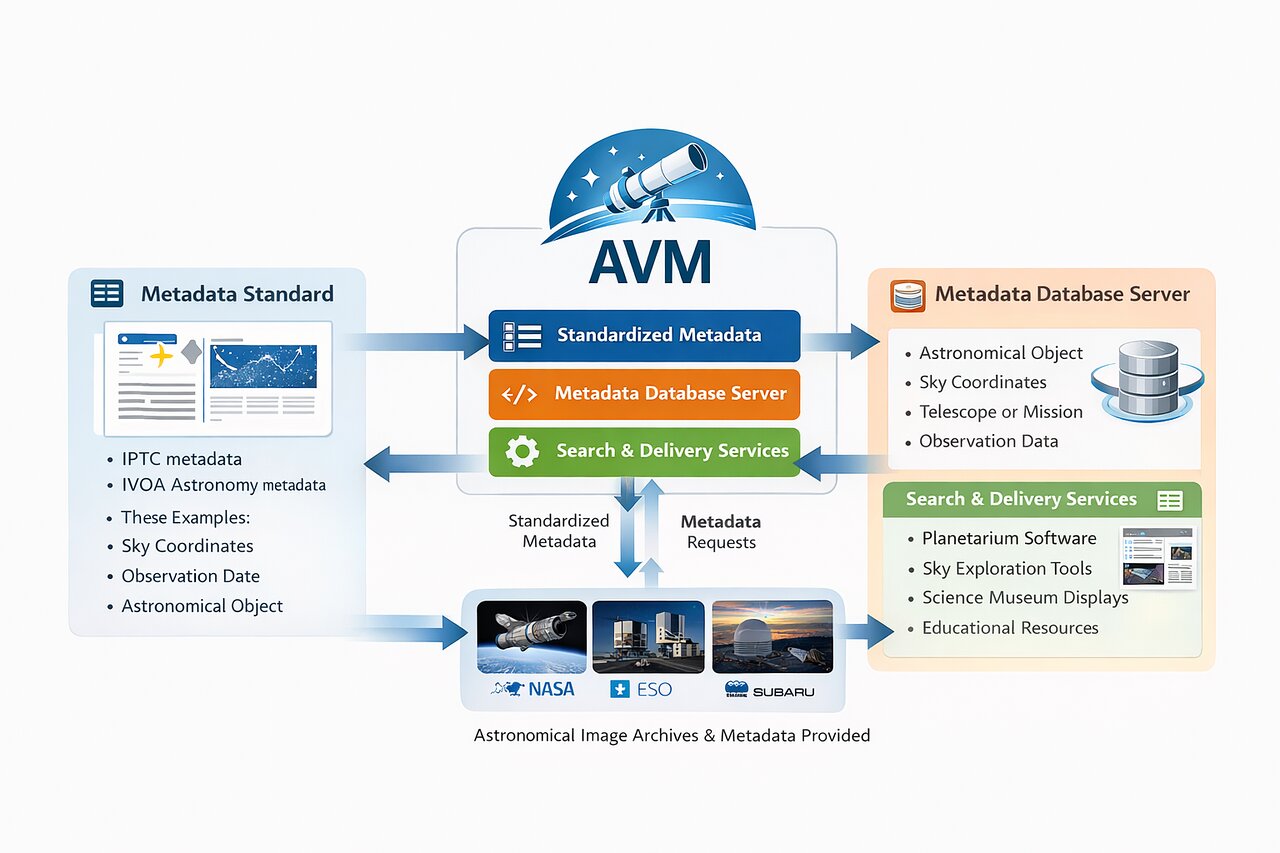
The AVM system consists of three primary components.
1. Metadata Standard
A well-defined schema describing the scientific, descriptive, and technical properties of astronomy imagery.
The schema draws on two major metadata frameworks:
IPTC metadata, widely used in the publishing and photography industries
IVOA metadata standards, used for astronomical datasets
AVM extends these systems to support the needs of astronomy education and outreach imagery.
2. Metadata Database Server
A database system collects and organizes metadata from participating institutions.
This database enables powerful queries based on:
astronomical object
sky coordinates
wavelength or spectral band
telescope or mission
caption keywords
observation date
The database stores metadata and image locations, not the image files themselves.
3. Search and Delivery Services
Applications and users can query the AVM system using web services.
Search queries can include:
all images of a specific object
images covering a particular region of the sky
imagery from specific observatories
images in particular wavelengths
The AVM service returns metadata and URLs pointing to the original image sources.
Applications can then retrieve the images directly from the originating observatory servers.
Because AVM provides a standardized way to discover and access imagery, it enables a wide range of applications.
Planetarium Visualization
Modern digital planetariums can query AVM databases in real time to retrieve images of astronomical objects during live presentations. Presenters can quickly locate high-resolution images and display them within the context of the night sky.
Planetarium systems such as the Digital Universe platform developed by the American Museum of Natural History can integrate AVM resources to enrich their visualizations.
Online Sky Exploration Tools
El software de astronomía interactiva como WorldWide Telescope y otras herramientas de navegación celeste pueden utilizar metadatos AVM para recuperar imágenes dinámicamente a medida que los usuarios exploran el cielo.
Las imágenes que incluyen información completa del Sistema de coordenadas mundial (WCS) se pueden ubicar con precisión en sus posiciones reales en el cielo, lo que permite a los usuarios hacer zoom sin problemas desde todo el cielo hasta objetos astronómicos detallados.
Software de planetario de escritorio
Muchas aplicaciones de planetario de escritorio dependen de actualizaciones en línea para mejorar sus bibliotecas de contenido. AVM permite que estas aplicaciones recuperen automáticamente las imágenes astronómicas recién publicadas y las integren en sus entornos de visualización.
Museos y centros de ciencias
Las exhibiciones interactivas de los museos pueden utilizar sistemas impulsados por AVM para mostrar colecciones de imágenes seleccionadas, lo que permitirá a los visitantes explorar imágenes astronómicas a través de pantallas dinámicas e interfaces interactivas.
La astronomía suele describirse como la ciencia más visual. Las imágenes de telescopios y naves espaciales ofrecen algunas de las perspectivas más reconocibles e inspiradoras de la ciencia.
Estas imágenes hacen más que ilustrar descubrimientos: ayudan a las personas a comprender preguntas fundamentales sobre el universo:
Cómo se forman las estrellas y los planetas
Cómo evolucionan las galaxias
Si podría existir vida en otras partes del universo
Cómo empezó el universo y cómo evolucionará
Al hacer que las imágenes astronómicas sean más fáciles de encontrar, compartir e integrar en experiencias educativas, AVM ayuda a expandir el alcance de la comunicación astronómica en todo el mundo.
Obtenga más información sobre el estándar y las herramientas AVM: