
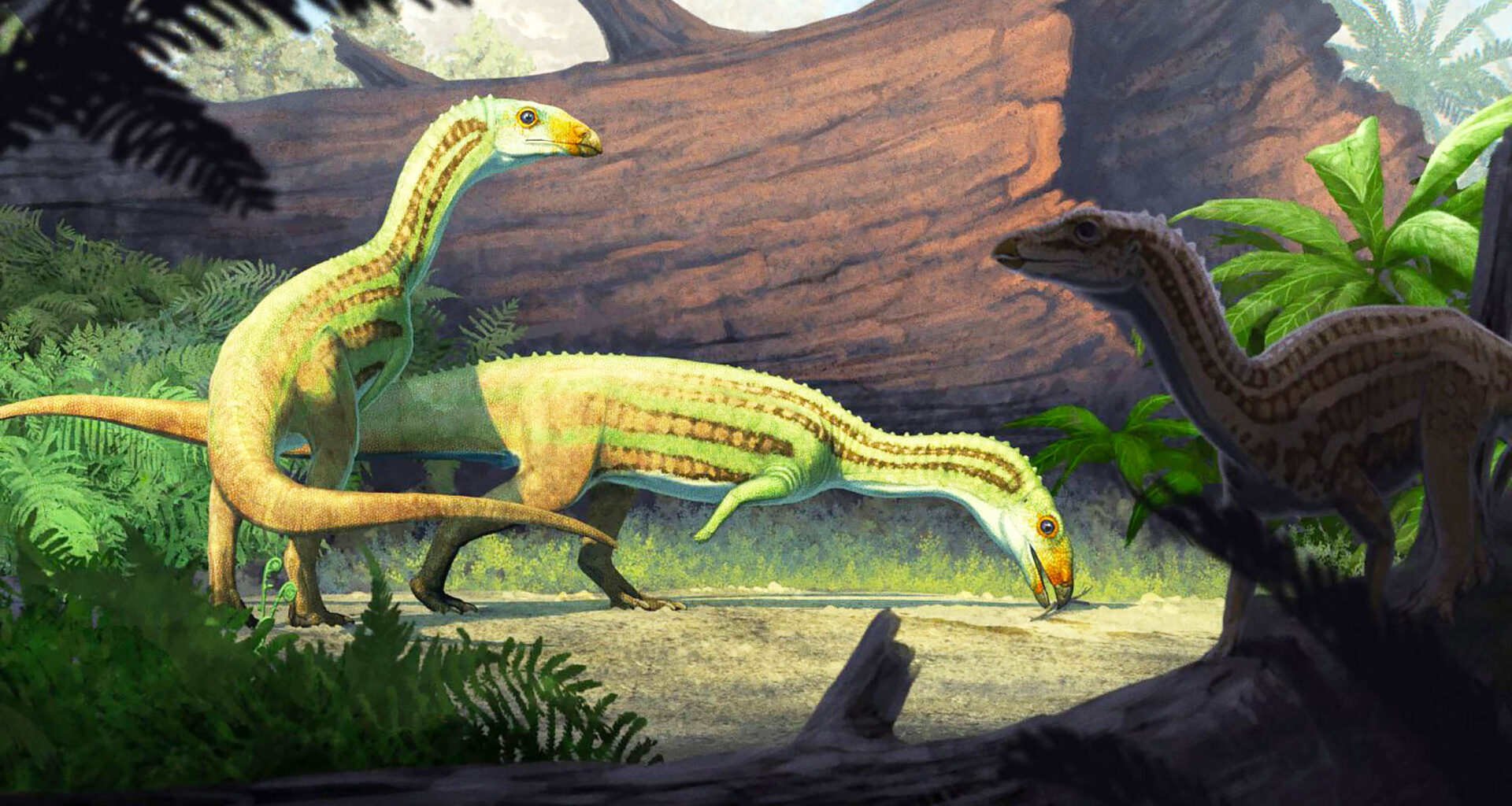
Reptiles lived on land long before modern crocodiles appeared. Some of their early relatives looked very different from anything alive today.
During the Triassic period, crocodile relatives came in many forms. Some walked low to the ground on four legs, while others developed features that made them look a lot like the early dinosaurs living at the same time.

Researchers have now found one of the strangest examples. The animal was small and built a little differently from most of its relatives. Fossils suggest it may have started life on four legs and later walked on two as it grew.
Meet Sonselasuchus cedrus
The animal is called Sonselasuchus cedrus. It lived roughly between 225 and 201 million years ago during the Late Triassic period.
At that time, North America was part of a much larger supercontinent and forests stretched across wide regions filled with reptiles, amphibians, and early dinosaurs.
Sonselasuchus belonged to a group called shuvosaurids. Many animals in this group had bodies that resembled ornithomimid dinosaurs, the fast-running, bird-like dinosaurs that appeared later. The resemblance is striking, even though these reptiles were not dinosaurs at all.
The work was led by Elliott Armour Smith from the University of Washington Department of Biology, along with Professor Christian Sidor of the Burke Museum.
Growing up on four legs
The fossil bones tell an unusual story about how this reptile developed. By carefully studying the proportions of the limbs, researchers noticed something odd. The front and back legs did not seem to grow at the same pace.
“By analyzing the proportions of the limb skeletons of different animals, they determined its bipedal stance (standing on two feet) may have been the result of a differential growth pattern,” said Smith.
Young animals likely had front and back limbs that were more similar in size. As they matured, the back legs became longer and stronger.
“We think that Sonselasuchus had more proportional forelimbs and hindlimbs when young, and that its hindlimbs grew longer and more robust through adulthood,” he said.
“Essentially, we think these creatures started out their lives on four legs. They then started walking on two legs as they grew.”
Sonselasuchus cedrus fossils
The discovery comes from a rich fossil site in Arizona’s Petrified Forest National Park. In 2014, researchers uncovered a dense deposit of bones belonging to Sonselasuchus. The dig site has kept scientists busy for years.
Professor Sidor was part of the team that first uncovered the fossils. In total, about 950 bones from this reptile have been collected there.
The location itself is remarkable. Over a decade of excavation and preparation has revealed more than 3,000 fossil bones from the same area, offering a detailed glimpse into an ecosystem that existed over 200 million years ago.
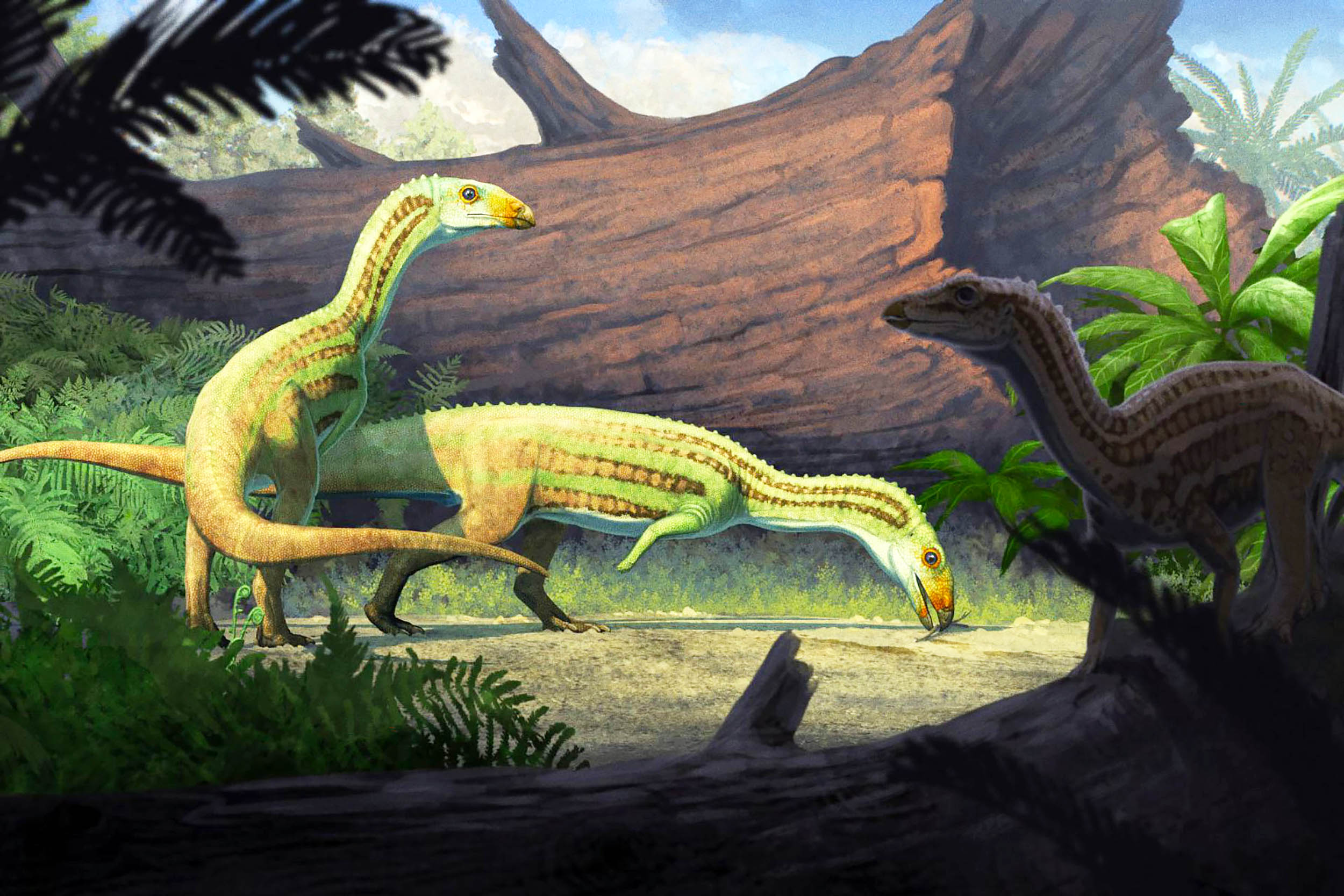 Artist’s reconstruction of Sonselasuchus cedrus in its environment in what is now Petrified Forest National Park, 215 million years ago. Credit: Gabriel Ugueto. Click image to enlarge.What the animal looked like
The fossils also give a fairly clear idea of how Sonselasuchus appeared. It stood about 25 inches tall and likely moved quickly through forested environments.
It had a toothless beak and a large eye socket. Its bones were hollow, a feature often linked with lighter body weight.
These traits might remind many people of certain dinosaurs, but this reptile came from a different branch of the archosaur family tree.
“Although similar to ornithomimid dinosaurs, these features would have evolved separately,” said Smith. “This similarity was probably due to the fact that croc-line and bird-line archosaurs evolved in the same ecosystems and converged upon similar ecological roles.”
Features like bipedalism, a toothless beak, hollow bones, and a large orbit are characteristic of ornithomimid theropod dinosaurs.
However, shuvosaurids like Sonselasuchus cedrus show that these features evolved on the croc-line as well.
Fossil site that keeps producing
The fossil bed continues to provide scientists with new material. Alongside the remains of Sonselasuchus, researchers have found bones from many other animals that once shared the same environment.
“Since starting fieldwork at Petrified Forest in 2014, we have collected over 3,000 fossils from the Sonselasuchus bonebed, and it doesn’t seem to show any signs of petering out,” said Sidor.
“In addition to Sonselasuchus, the bonebed has yielded fossils of fish, amphibians, as well as dinosaurs and other reptiles.”
“Over 30 University of Washington students and volunteers have been involved over the years. It’s exciting to see that the site continues to produce new and interesting fossils.”
Lessons from Sonselasuchus cedrus
The name of the reptile reflects both the place it was discovered and the environment where it lived.
Sonselasuchus refers to the Sonsela Member of the Upper Triassic Chinle Formation, the layer of rock where the fossils were found. That formation has already produced many important discoveries.
The second part of the name, cedrus, refers to cedar trees. These evergreen conifers were common in the forests that covered the region during the Late Triassic.
Sonselasuchus likely moved through those wooded landscapes alongside many other early reptiles.
Each fossil from that adds another piece to the puzzle of how crocodile relatives evolved long before modern crocodiles appeared.
The full study was published in the journal Journal of Vertebrate Paleontology.
—–
Like what you read? Subscribe to our newsletter for engaging articles, exclusive content, and the latest updates.
Check us out on EarthSnap, a free app brought to you by Eric Ralls and Earth.com.
—–