
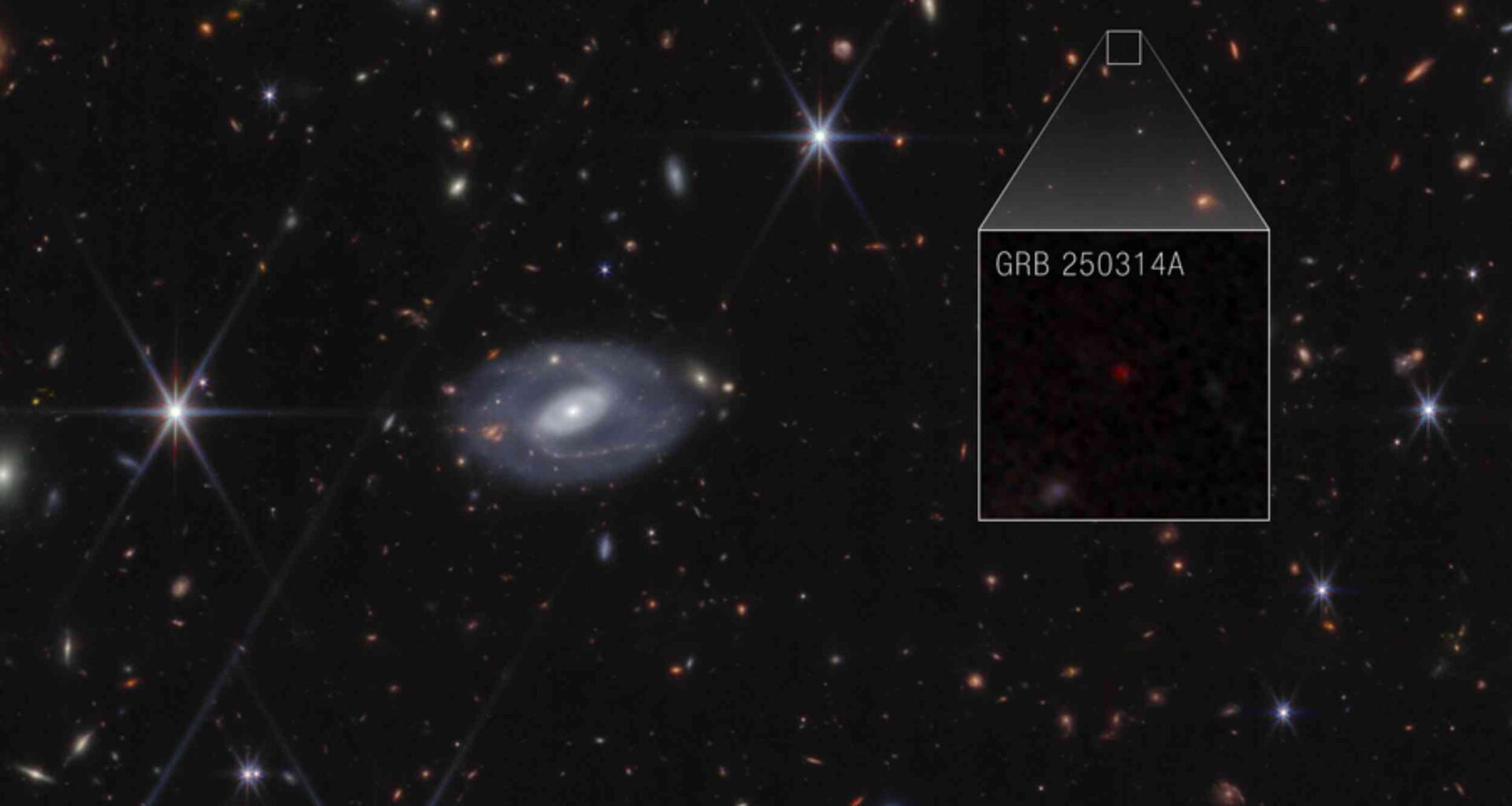
Astronomers have confirmed a supernova from a star that exploded 13 billion years ago, making it the earliest stellar explosion ever directly observed.
The finding places a single dying star into view from a time when the Universe was only about 730 million years old.
Tracking the ancient burst

A brief burst of high-energy light first marked the location of the ancient explosion, sending astronomers toward a distant galaxy where the event occurred.
By analyzing the light from that burst, Andrew Levan at Radboud University showed that the fading signal included the unmistakable glow of a supernova.
The event unfolded across months rather than weeks because the expanding Universe stretched the original flash across time and wavelength.
That unusual timing forced astronomers to isolate the explosion carefully before they could confirm what kind of star had died.
Timing Webb observations
Because the Universe has stretched this light for billions of years, the event unfolded far more slowly than a nearby blast.
Astronomers call the opening flash a gamma-ray burst – a brief blast of extremely energetic light – and this one lasted about ten seconds.
That fading glow could have confused the picture if the James Webb Space Telescope (JWST) had looked too soon after the burst.
Waiting until July gave the fading burst time to dim and the rising supernova time to stand out.
What Webb found
When Webb finally looked, the source did not behave like one ordinary object across its different infrared views.
Blue light stayed weak, but redder bands climbed sharply – the pattern expected when a hidden supernova starts to dominate.
In the main study the host galaxy looked faint and blue, while the brighter red light matched the exploding star.
That mix gave astronomers their strongest clue that they were seeing both a galaxy and one dying star.
Against an old benchmark
To judge the blast, researchers compared it with SN 1998bw, the nearby explosion long used as a benchmark.
That older event helped establish that some long bursts come from massive stars collapsing and exploding, not from crashes between dead stars.
The March burst landed surprisingly close to that template, with a brightness the team estimated at about 70% of it.
That resemblance makes the blast easier to classify, but it also raises a harder question about early stars.
Rethinking early supernovas
Early stars formed in harsher conditions, with fewer heavy elements and less time for galaxies to become chemically rich.
Many astronomers expected those differences to change how such stars died, perhaps producing brighter or bluer explosions.
Instead, the March event looked stubbornly familiar, which challenged simple ideas that the first stellar deaths should appear very different from modern supernovae.
One observation cannot settle that argument, but it narrows the room for wildly different kinds of explosions.
A young galaxy
Webb also caught the faint home galaxy, turning the discovery from a lone flash into a fuller scene.
Its light appears compact and blue, which fits many small galaxies already known from the Universe’s first billion years.
The observation shows that the star did not explode in empty space, but inside a young system still building itself.
Seeing both the galaxy and the explosion helps tie one stellar death to the larger story of early galaxy growth.
Other ideas tested
Not every red smudge near a burst has to be a supernova, so the team tested other explanations.
One option held that lingering glow from the burst still dominated the scene, even months after the original flash.
Another idea suggested that the galaxy itself might be unusually old, compact, and red – a possibility the authors judged possible but awkward.
Because both alternatives demanded too many extra assumptions, the supernova explanation remained the cleanest reading of the evidence.
Limits of the data
One missing piece still matters: astronomers have only one Webb snapshot, not a second image after the supernova fades.
A later visit would reveal how much light belonged to the galaxy alone, sharpening the case considerably.
The authors proposed another look a year or so later, when the burst should have faded enough to isolate the galaxy.
That follow-up would turn a strong case into a cleaner measurement of both the star and its galaxy.
The early Universe
Even with that limit, the Webb observation reaches beyond one burst and a single star in the early Universe.
“This particular event is very rare and very exciting. This observation also demonstrates that we can use Webb to find individual stars when the Universe was only 5% of its current age,” Levan said.
If similar events keep turning up, astronomers may finally test whether the earliest massive stars truly lived and died differently.
What comes next
The signal now looks less like a lonely burst and more like a clear record of a single ancient star dying.
Another Webb visit should tell astronomers how much of the remaining light belongs to the galaxy, and how much belonged to the blast.
The study is published in Astronomy & Astrophysics.
—–
Like what you read? Subscribe to our newsletter for engaging articles, exclusive content, and the latest updates.
Check us out on EarthSnap, a free app brought to you by Eric Ralls and Earth.com.
—–