
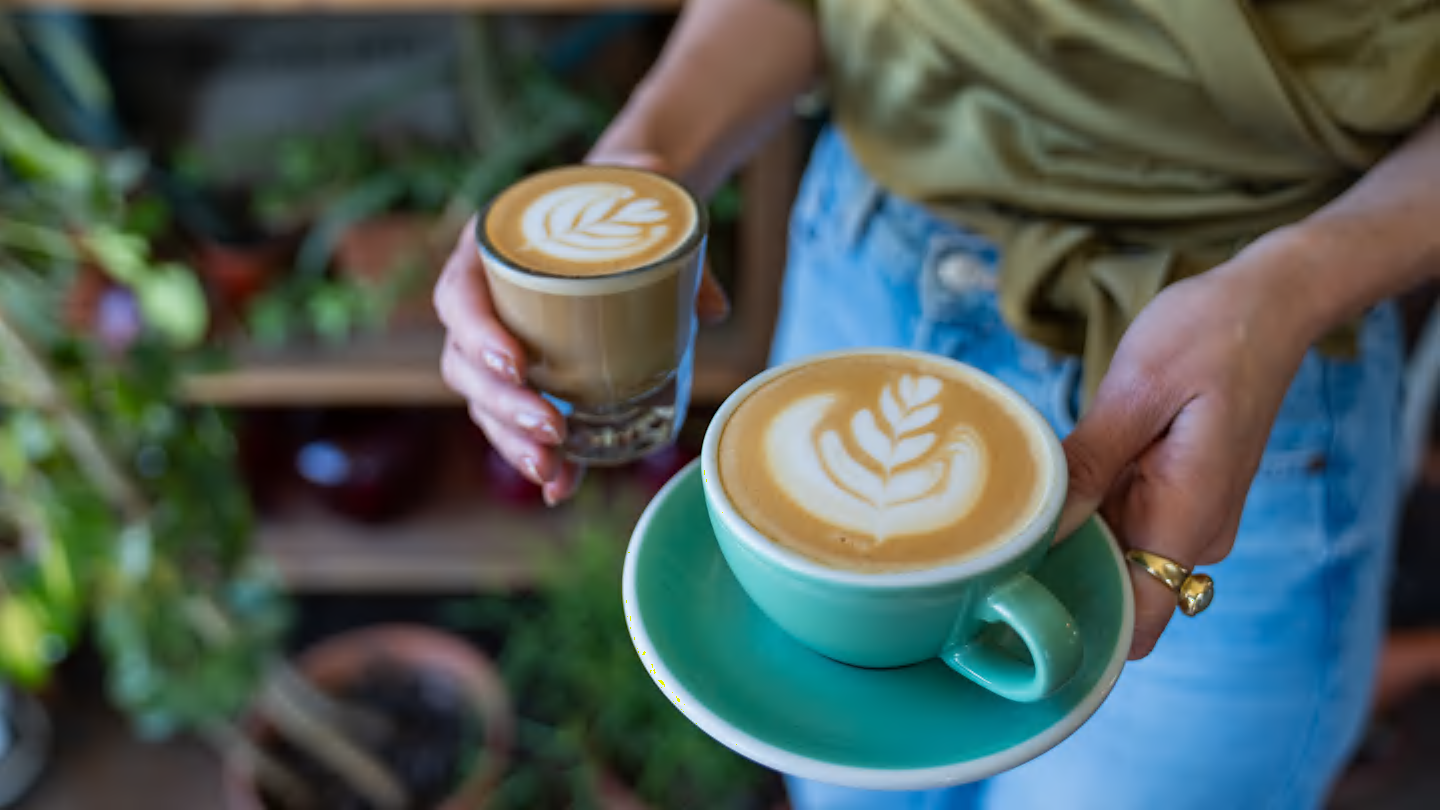
Many people spend most of their time at home and at work. Yet did you know there’s actually a name for locations other than these two places—like cafes, bars, parks, and library-type settings where people go to hang out free from the constraints of their houses and their offices?
These are so-called third places. According to some experts, these places might be essential for individual well-being—and even for the well-being of democracy.
The term third place was coined by sociologist Ray Oldenburg in 1989. He first used it in his book The Great Good Place to describe a location where people gather and socialize with both friends and strangers and truly engage with their communities. These places, he theorized, can help people feel connected to others who live near them, and can be vital for the health and well-being of communities on the whole.
Shopping malls, markets, and concerts don’t exactly fit this bill, Oldenburg noted, as the centerpiece of any proper third place should be conversation. Third places should allow neighbors to meet each other and should provide places where newcomers can be integrated into communities, he wrote in a 1996 essay. They should also provide opportunities for people of different generations to meet, for community members to support one another and share resources, and for political debate to occur. Ideally, they should be long-term establishments located within walking distance of people’s homes. Finally, he emphasized, they should foster entertainment and friendship—not stress and more expenses.
The History of Third Places
Third places of sorts have always existed in human civilizations, ever since we stopped being hunter-gatherers and started settling down and staying put. Older iterations of contemporary third places date back to the agoras of ancient Greek city-states of the sixth century BCE, where people would gather to debate, socialize, and access amenities like temples and administrative buildings. These spaces were essential to the development of Greek society and democracy.
Today, the quintessential third place, of course, is the cafe—one of the few places where people can meet to simply be together and talk in a safe, comfortable social setting. One early predecessor to the modern cafe is the tea houses of the Tang Dynasty (618-907 AD) in China; these places were fixtures in communities of this era, acting as spaces where meetings, celebrations, and gatherings were held regularly.
The very first coffeehouses arose in the Middle East, and cafes started to thrive in England in the 17th century, when people would often engage in political debates long into the night inside them. The cheap price of admission to these spaces—usually nothing more than a cup of coffee—allowed large cross-sections of people to gather and simply talk, debate, and meet each other without the threat of intoxication that always loomed in taverns. At this time, coffeehouses were sometimes referred to as “penny universities,” as cups of coffee typically only cost a penny.
Naturally, not every cafe in existence today is an ideal third place. Some are too small, expensive, or otherwise inhospitable to really serve this function. Yet if you’ve ever stumbled upon the perfect cafe—the kind of place you return to again and again to work, rest, meet up with friends, and simply soak in the ambiance—you probably can imagine what Oldenburg was envisioning when he created the term.
Some other popular third places—such as libraries, bowling alleys, and hair salons—became widespread in the West around the 1930s, when an economic boom and a surge in the popularity of cars gave people the means to spend more time and money in these sorts of spaces.
The Future of Third Places
According to Oldenburg and more recent scholars, third places have also been undergoing a steady decline since the late 20th century. In a 1996 essay, Oldenburg described how technology and the structure of modern cities and suburbs have made it possible for people to go years without ever meeting their neighbors.
Today, that phenomenon has become even more extreme thanks to the rise of apps that allow people to order coffee straight to their doors and economic conditions that have made it more and more difficult for third places to stay open and for people to enjoy them.
Studies have shown that third places are essential for the well-being and health of neighborhoods, and their widespread closure can have significant risks. According to an article published in PubMed Central in 2020, by losing third places, “residents are losing access to key services, goods, amenities, and recreational leisure facilities; and spaces to socialize, connect, play, and care for one another. The loss of protective factors and resilience mechanisms, including buffers against stress, loneliness, inactivity, and alienation may be particularly harmful to groups who rely on third places including older adults, children, the chronically ill, and socioeconomically marginalized.”
On the other hand, the authors continue, “focusing on third places can advance multiple domains of health geography and public health, including upstream socio-geographic conditions that impose downstream barriers to health, neighborhood-level protective factors and sources of resiliency, and the importance of place and context.”
In short, that beloved local cafe might be doing a lot more than just serving great coffee. “What suburbia cries for,” Oldenburg wrote in 1996, “are the means for people to gather easily, inexpensively, regularly, and pleasurably—a ‘place on the corner,’ real life alternatives to television, easy escapes from the cabin fever of marriage and family life that do not necessitate getting into an automobile.”
More Like This: