
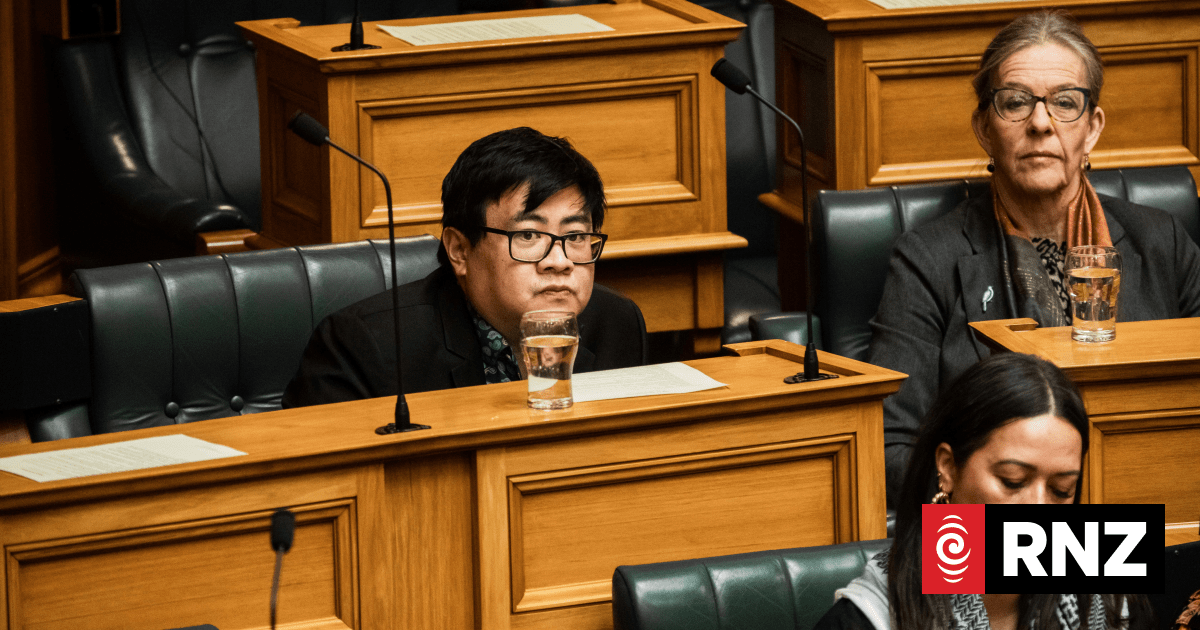
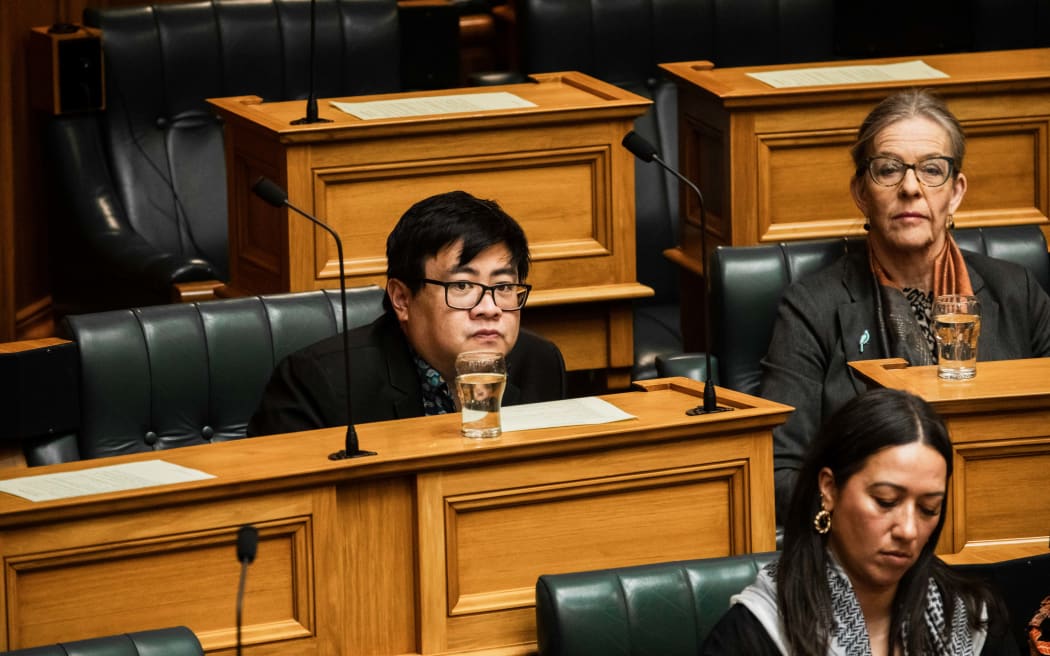
The Green Party’s public services spokesperson Francisco Hernandez (L).
Photo: RNZ / Samuel Rillstone
Officials advised the government that its new ‘mega-ministry’ risks losing environmental functions and perspectives, following the disestablishment of the Ministry for the Environment.
The Green Party believed it would weaken environmental advice and expertise, but the Minister for the Environment insists no statutory obligations would change, as they would be transferred over to the new ministry.
The government is establishing the Ministry of Cities, Environment, Regions and Transport (MCERT) as one “coherent” new agency to handle its reform agenda across housing, transport, urban development, and the environment.
The ministry would bring together the ministries of Housing and Urban Development, Environment, and Transport, and take local government responsibilities from the Department of Internal Affairs.
The first phase of the MCERT establishment was to disestablish the Ministry for the Environment (MfE), which had to be done through legislation as it was the sole ministry forming MCERT that was established by statute (the others could be disestablished through an Order in Council).
The government has maintained there would be no substantive changes to the statutory functions under the Environment Act, and no reduction in environmental protections in the new ministry.
“In terms of the statutory obligations, yes they transfer straight through,” environment minister Penny Simmonds told RNZ.
The functions of MfE would transfer to the Secretary for the Environment, who would take on the role of chief executive at MCERT.
Simmonds said that was also a requirement of the legislation, as the chief executive still needed to meet the statutory obligations.
At the first reading of the legislation to disestablish MfE in February, minister Tama Potaka, standing in for Simmonds, said the new ministry would “support faster decisions and better outcomes across housing, transport, local government, and environmental systems”.
Potaka said functions of “climate, natural hazards, natural and physical resources, wider ecosystems, and the economic, social, and cultural factors that matter to current generations as well as future generations” were not changing, and would remain an important part of the new ministry.
During the debate, the Green Party accused the government of “burying” MfE within the new ministry.

Environment minister Penny Simmonds.
Photo: RNZ / Mark Papalii
Officials express support but warn of trade-offs
Documents obtained by the Greens under the Official Information Act, and seen by RNZ, show Public Service Commission officials expressed support for the merger, saying over time it would perform “stronger monitoring functions”.
But they also warned of potential trade-offs.
A briefing in May 2025 warned that the machinery of government changes should not be taken lightly.
“Given the proposed agency would be development oriented, there is a particular risk of environmental functions and perspectives being lost.”
While the costs of the change could be partly mitigated by “careful planning, scoping and phased implementation over time,” the commission said it would “unlikely ever be cost neutral”.
The report said consolidation should improve efficiencies in the longer-term, but warned of shorter to medium-term costs like a “diversion from core priorities, such as delivery of your current reform agenda, as organisational resources and attention are reallocated to implementing change”.
The Green Party’s public services spokesperson Francisco Hernandez said he was concerned with the advice around a potential loss in environmental functions and perspectives.
He did not believe the government’s claims that the new ministry would value environmental protection.
“We think that’s very concerning, given this government’s wider track record around climate and the environment, whether it’s around things like the fast-track legislation, whether it’s opening up oil drilling, or whether it’s weakening our climate targets,” he said.
The advice said it was not uncommon for agencies to oppose each other, with Cabinet often required to “reconcile differences that cannot be resolved through the policy process”.
Officials said several measures indicated that the current planning and infrastructure measures were underperforming.
“In comparison to other developed countries, we get less bang for buck for our infrastructure investment, our houses are more unaffordable, and we derive less agglomeration benefits from our cities.”
Chief executive vacancies at the Ministry of Transport and the Ministry of Housing and Urban Development presented an opportunity to consolidate them with MfE, which already had “strong functional alignment” with the other agencies.
The Public Service Commission identified several potential issues with the consolidated entity, including “currently unquantified implementation costs”, as well as disruption to existing work programmes, “continued disconnection” with other parts of the system “critical for encouraging economic growth and productivity”, and a limited ability to “improve alignment with local government”.
Greens concerned with potential job losses
The report also said there would be financial costs, including potentially new accommodation, IT and HR systems, and staff transfers.
Simmonds said the government did not know what workforce from MfE would be going across at this stage.
“But all the statutory safeguards are there. It’s just that it’s not under that particular piece of legislation, but all the requirements will be there of what we need to meet.”
Hernandez was concerned around potential job losses.
“We’ve repeatedly asked around with the government to guarantee there’d be no job losses. We know that the union has done that as well, and they’ve declined to do so,” he said.
“So that’s another hugely concerning thing, which is that the environmental advice and environmental expertise, which we know there’s already been huge losses of in the science sector, will be further degraded by the changes being proposed in this new mega-ministry.”
Because the new ministry had to be operational from 1 July, the government needed to move at-pace to disestablish MfE by 30 June.
Officials advised this meant “the Select Committee stage would need to be truncated”.
Submissions closed on Wednesday, and the Environment Committee has to report back to the House by 24 April.
That led to a lengthy, and ultimately unsuccessful, attempt from opposition MPs in the House following the first reading to extend the date the committee has to report back by.
Sign up for Ngā Pitopito Kōrero, a daily newsletter curated by our editors and delivered straight to your inbox every weekday.