
“If the situation were to worsen, the Government has a range of tools it can use to manage supply pressures and keep essential services running,” a spokesperson said.
“These steps would only be taken if genuinely needed, and they would be scaled to match the severity and duration of the disruption.
“To be clear, we are not experiencing the types of sustained supply disruption that the National Fuel Plan enables as emergency measures.”
MBIE has convened the Fuel Sector Co-ordinating Entity (Fuel SCE), which “increases lines of communications with the fuel industry and oversight of fuel imports”. It last met yesterday.
Finance Minister Nicola Willis is among those keeping an eye on fuel supplies. Photo / Mark Mitchell
Ministers have also stressed there is no need to panic. Although there are reports of high demand, the latest update from MBIE shows more than 50 days of fuel stock either onshore or on its way to New Zealand.
There is a question, however, over the medium-term. Finance Minister Nicola Willis said this morning that disruptions to shipments could lead to “problems weeks or months down the track”.
While we may have fuel on a ship coming to New Zealand, what happens if, in the coming weeks, another nation puts in place export controls?
If there were signs our access to fuel could be at risk, New Zealand would have time to react. Our fuel supply wouldn’t immediately drop to zero. In the first instance, the Government would expect importers here to look for alternative sources.
In terms of government action, Resources Minister Shane Jones has said ministers are getting advice on all potential options should stock fall low.
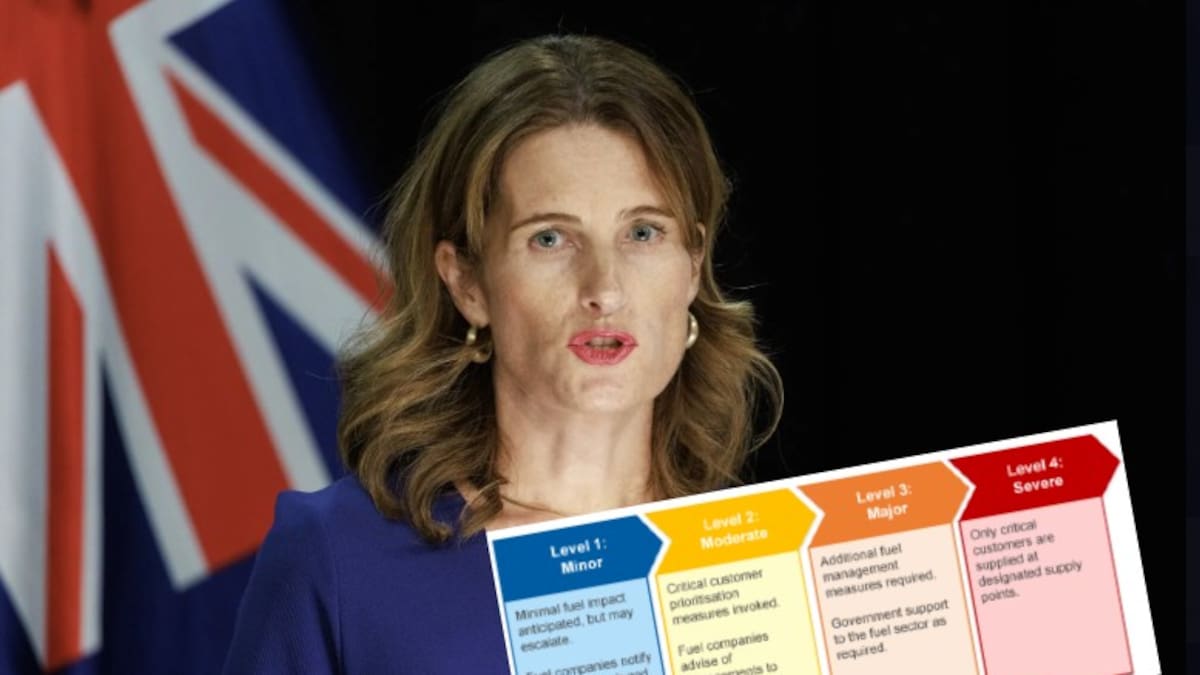
The fuel emergency level system
At the centre of the response would be the National Fuel Plan, which was published in 2024. It contains a section on how to respond to a fuel supply disruption or emergency.
This is a relatively generic plan and not specifically designed just for a situation where supply from overseas has been compromised. There are “many events” that could disrupt fuel supply, ranging from earthquakes to pipes being sabotaged to a damaged road network limiting truck movement.
The level system is found in the National Fuel Plan. Image / Civil Defence
Level 1
The first stage in what is described as the “Escalation Levels for Fuel Response” is where there is a “minor” impact on the fuel sector, but this “may escalate”. This is where New Zealand is currently.
The Fuel SCE – which is made up of officials as well as representatives of key fuel companies – is monitoring the situation and “planning for potential escalation” at this level. The fuel companies are doing their own planning for potential disruption.
Other officials from emergency management groups are looped in on what is going on.
Level 2
Level 2 is where there is a “moderate” impact on the fuel sector, and “critical customer prioritisation measures” are invoked.
If New Zealand were to move to this level, customers would still be able to get fuel, but there is a “risk of shortages to critical fuel customers”. The Fuel SCE would be monitoring demand levels, resupply options and co-ordinating Government support.
The critical fuel customer prioritisation measures invoked at this stage could include having designated fuel retail outlets just for these customers, designated lanes at stations, or mini-tankers on-site. A decision could be made to direct fuel companies to prioritise these customers.
What are critical fuel customers? They would be specifically named organisations viewed as “critical to response activities and have a reliance on fuel resupply to carry out response activities”. These would include emergency services, as well as the likes of the Ministry of Health, Corrections, and Defence.
The plan says security arrangements may need to be organised at the outlets to “maintain a safe working environment for site personnel”. Police may need to be involved “with providing community support and reassurance, maintaining law and order and providing crime prevention advice at fuel retail outlets if required”.
Resources Minister Shane Jones says officials are considering options. Photo / Mark Mitchell
Level 3
Next is level 3, reflecting a “major impact” on the country’s fuel sector, where “additional fuel management measures” are required.
“Serious impact on fuel distribution with severe resource and capacity constraints and multi-region and/or major impacts to critical customers,” is how the plan describes this level.
The Government has powers, including under the Petroleum Demand Restraint Act 1981, to impose mandatory fuel demand constraints.
These could include:
Opening hour restrictions for fuel retail outletsSetting a maximum purchase limit, either in terms of price or volume of fuelRestricting sales into containers to limit hoardingMore critical customer prioritisation
The legislation does contain provisions to restrict, regulate or prohibit the use of cars. However, the Finance Minister has said this is not something currently needed.
Level 4
The fourth and final level is where there is a “severe” impact.
“Actions as above, plus fuel companies to supply only critical fuel customers and these customers to be serviced by any supplier,” the plan says.
Beyond this escalation level system, the National Fuel Plan also contains a host of other options to help ensure supply to critical customers. This includes increasing the capacity carried by road tankers or allowing more truck movements (for example, in bus lanes).
There is a lot New Zealanders could do voluntarily as well. If the country were at risk of running low on fuel, it’s likely the Government and the fuel sector would encourage Kiwis to conserve fuel.
“This can be achieved through reducing speed on open roads, carpooling, working from home, checking tyre pressure and reducing unnecessary trips or using other transport modes,” the plan says.
“This is only considered a practicable option when managing a long-term supply disruption where immediate stocks are not at threat (panic buying will be a likely result otherwise).”
Jamie Ensor is the NZ Herald’s chief political reporter, based in the press gallery at Parliament. He was previously a TV reporter and digital producer in the Newshub press gallery office. He was a finalist in 2025 for Political Journalist of the Year at the Voyager Media Awards.