
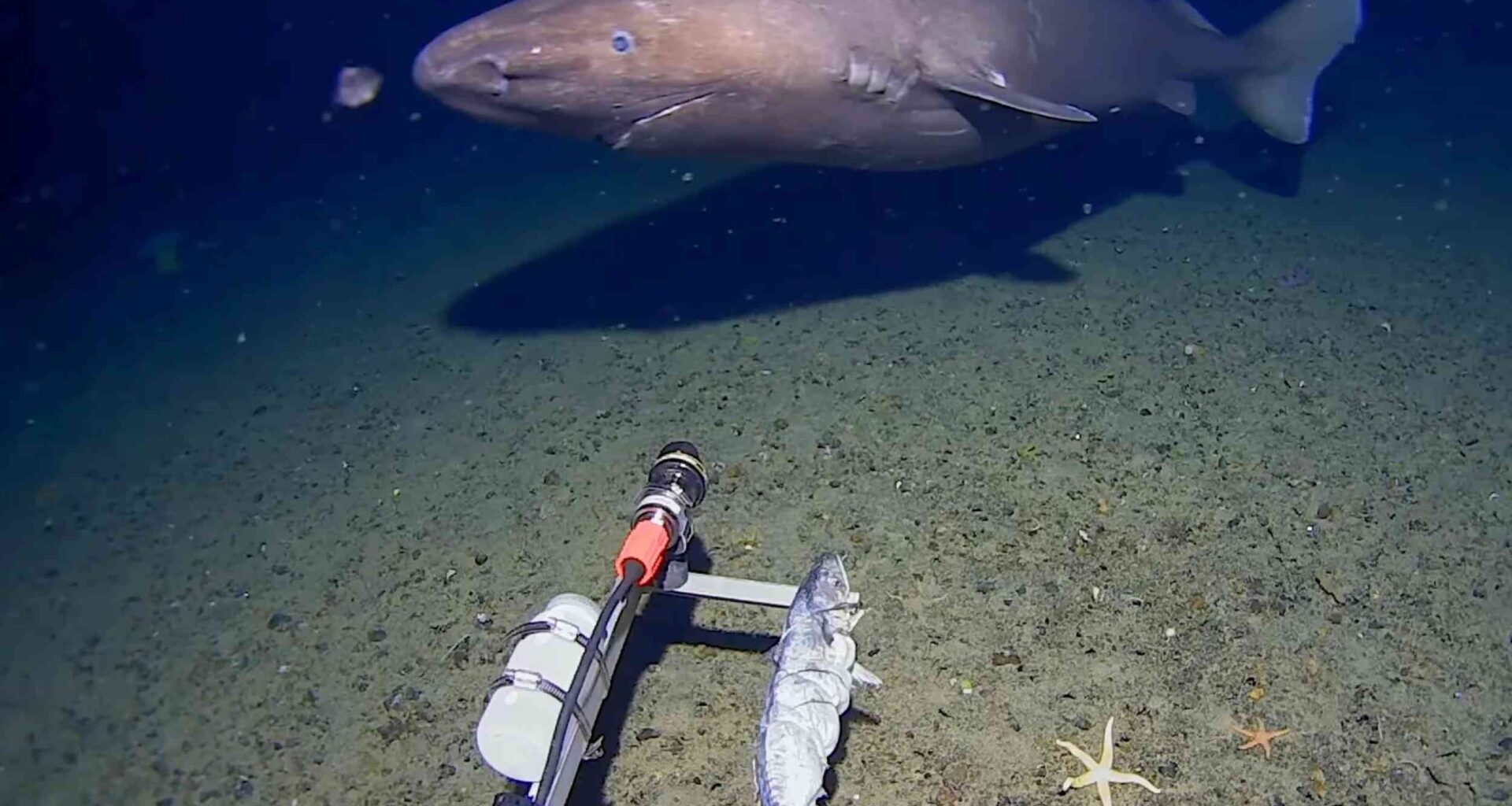
A large sleeper shark has become the first shark ever filmed inside Antarctic waters. It was captured gliding past at a depth of 1,608 feet (490 meters) through near-freezing darkness.
That single appearance inside the Southern Ocean overturns a long-standing assumption that sharks do not inhabit Antarctica at all.
Where the shark appeared

Far below the ice near the Antarctic Peninsula, a deep-sea camera recorded the barrel-shaped shark crossing the seabed in the South Shetland Trench.
Reviewing the footage from that expedition, Professor Alan Jamieson and colleagues at the Minderoo-UWA Deep-Sea Research Centre, University of Western Australia, documented the first confirmed shark presence within Antarctic waters.
The shark passed slowly through the camera’s light at a depth of 1,608 feet (490 meters), moving in water that was only slightly above freezing temperature.
Because no earlier record places a shark this far south, the sighting forces scientists to reconsider whether these animals have quietly occupied Antarctic depths all along.
Hidden life in Antarctic trenches
Catching the animal on camera depended on a narrow search in a place that resists nearly every routine observation.
During a 64-day cruise, the UWA team logged 840 hours of seafloor video from 63 lander drops across the trench.
Jamieson said that for most of the year no one is observing the deep Antarctic seafloor, leaving long stretches when unexpected animals could easily pass unnoticed.
That blind stretch makes the sighting feel less like a sudden arrival than a reminder of how little surveillance takes place there.
Why sleeper sharks survive here
Sleeper sharks are built for patience, not quick bursts through bright water near the surface. They occupy deep, dark water, grow slowly and can take decades to reach maturity.
Their large bodies and slow pace fit a life where food is scattered and long waits are normal. Scarcity, not impossibility, may explain why the Antarctic seemed empty of sharks for so very long.
The water around the shark measured about 34.3°F (1.3°C), cold enough to narrow life sharply without freezing the sea solid.
Salt lowers seawater’s freezing point, and that leaves a little operating room for animals that are already adapted to deep cold.
Sleeper sharks make use of that margin by moving slowly and spending energy carefully when food is patchy. Those traits fit a place where meals can be rare and the margin for waste stays thin.
Why depth mattered
Depth may have mattered as much as latitude in this strange encounter under the Antarctic ice.
Researchers said the shark held near 1,640 feet (500 meters) because a warmer band of water sits there, with colder layers above and below.
That water is stratified – stacked in layers that resist mixing – which can create a narrow corridor where a shark spends less energy.
The animal’s path therefore may have been less random than it first seemed, and more like a precise use of local physics.
Identifying the Antarctic shark
Most clues point toward the southern sleeper shark, Somniosus antarcticus. This is a bulky, deep-water species that is known from the Southern Hemisphere.
Records place it mainly along continental margins and island slopes, often between roughly 1,600 and 3,800 feet (488 and 1,158 meters).
That profile fits the filmed animal’s heavy body, small fins, and unhurried movement over the bottom.
Even so, shape alone cannot settle every close relative, which is where genetics enters the story.
Shark identity debated
Modern genetics has complicated the neat label attached to these sharks in southern waters today.
A 2023 study found no molecular evidence separating southern sleeper sharks from Pacific sleeper sharks in sampled populations.
Those samples came mostly from the South Pacific, leaving scientists short of South Atlantic and Indian Ocean material.
That is why careful researchers describe the Antarctic visitor as likely a southern sleeper rather than stamping the case as closed.
What climate may mean
Climate change hangs over any Antarctic surprise, but the evidence here does not yet point one clear argument.
A warmer ocean can rearrange layers and move heat deeper, which may open or widen the depths that some cold-water species use.
At the same time, one shark on one camera could simply mean these animals were always there and almost nobody looked.
The sighting therefore raises a climate question without answering it, and that distinction still matters.
Next steps for researchers
New water samples will probably carry the next evidence, not another lucky silhouette on camera.
The expedition collected 202 environmental DNA samples with genetic traces that organisms leave behind. Analysis of these samples may reveal the identity of the shark from its genetic traces.
If those samples match sleeper sharks, researchers can begin asking whether the filmed animal was a stray or part of a thin population.
More landers at the same depth would sharpen that answer faster than a single dramatic encounter ever could.
Rethinking sharks in Antarctic seas
The footage turns Antarctica from a presumed shark-free zone into a place with at least one deep-sea exception.
What follows now is slow science by necessity: more watching, more sampling, and more patience in a region that rarely offers easy answers.
Details reported by ABC News.
—–
Like what you read? Subscribe to our newsletter for engaging articles, exclusive content, and the latest updates.
Check us out on EarthSnap, a free app brought to you by Eric Ralls and Earth.com.
—–