
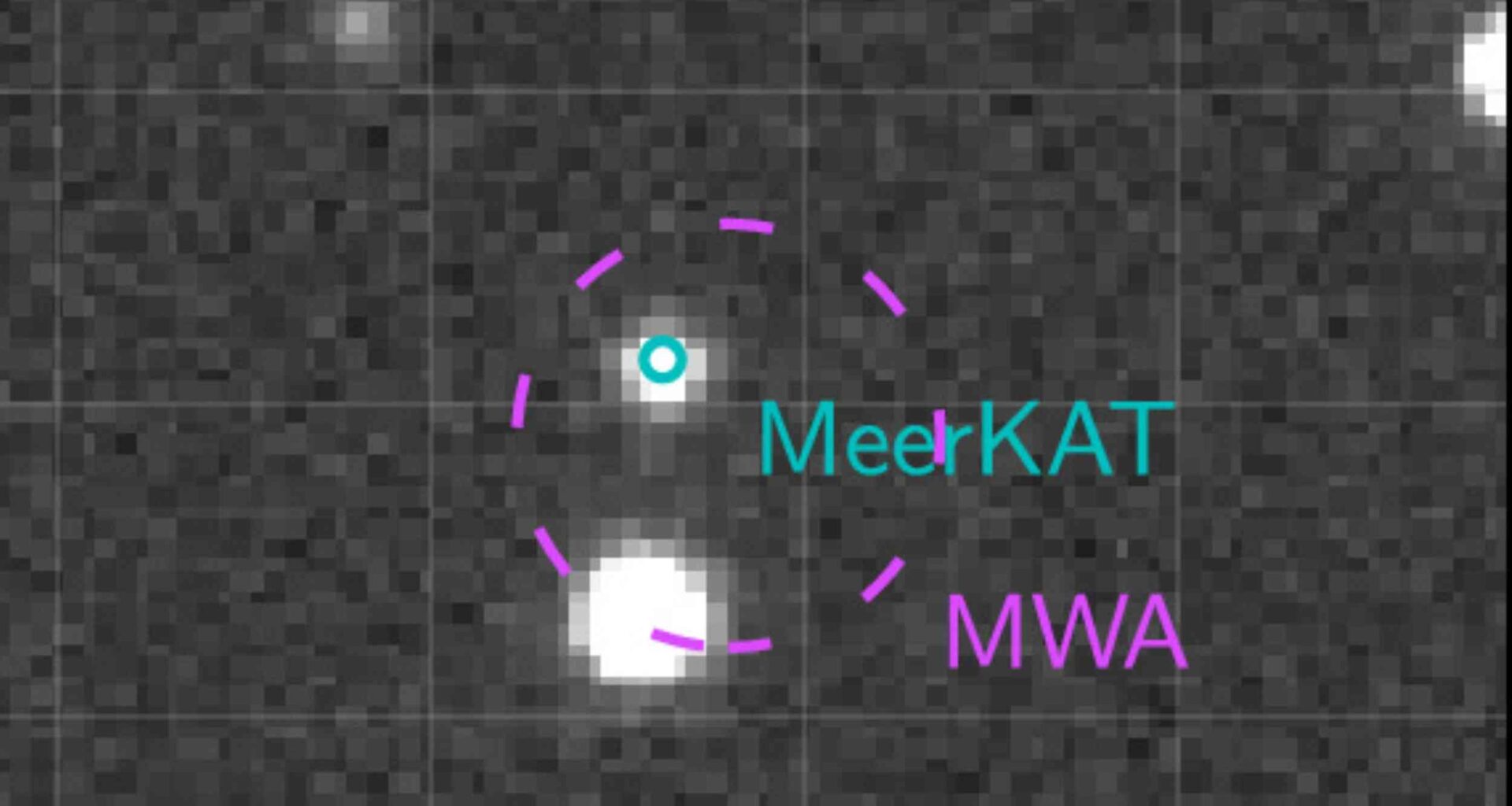
A buried radio pulse has become the clearest case yet that one of astronomy’s strangest repeating signals comes from a likely two-star system, two stars bound together by gravity and orbiting each other, near the Milky Way’s edge.
That finding pulls a long-running mystery out of the galaxy’s most crowded regions and into a place where astronomers can finally test what is making these bursts.
Where the pulse appeared

In archival observations from 2013 onward, the same source kept reappearing briefly before fading back into the background.
At the International Centre for Radio Astronomy Research (ICRAR) Natasha Hurley-Walker tied the pulses to a single visible star system.
That difference matters because earlier examples sat in packed star fields where overlapping light hid the exact object producing each burst.
With a cleaner target now in hand, the argument moves from guessing about the source to testing how two stars could make it.
A class emerges
Astronomers place the source in the class of long-period radio transients, objects that send repeating radio flashes minutes or hours apart.
Most known examples were first spotted toward crowded inner regions of the galaxy, which kept their actual homes unclear.
This one breaks that pattern, because its position near the galaxy’s edge leaves fewer stars competing for the same patch of sky.
That does not solve the mystery outright, but it gives astronomers a far clearer place to test competing ideas.
A third-year undergraduate made the crucial difference by building search code to comb old data from the Murchison Widefield Array.
The powerful radio telescope in Western Australia scans the sky for low-frequency cosmic signals.
That system sifted thousands of observations and separated real flashes from the far larger pile of false alarms and image artifacts.
Once the hidden pulse appeared, the team could track earlier bursts across more than a decade of stored data.
Such history matters because a source active for years suggests archives may hold many more signals nobody has recognized yet.
Finding the red dwarf
Follow-up work with telescopes in South Africa and Chile pinned the source to a dim red dwarf about 5,000 light-years away.
That star turned out to be an M dwarf, a small cool star type that makes up 70% of Milky Way stars.
“An M dwarf alone couldn’t generate the amount of energy we’re seeing,” said Hurley-Walker.
So the case moved toward an unseen companion and prepared the ground for a white dwarf explanation.
A binary system
The best fit is a white dwarf, the dense core left after a star dies, orbiting the red dwarf in the same system.
Strong magnetic fields could accelerate particles between the pair, producing brief radio flashes when the geometry lines up with Earth.
“Together, they power radio emission,” Hurley-Walker said, describing the combined effect of the two stars.
For now, the team still needs sharper ultraviolet evidence, so the companion remains a strong case rather than a final verdict.
Rejecting the neutron star
A highly magnetic neutron star remains possible only briefly before the evidence pushes against it.
Because the system sits well above the galaxy’s crowded middle, a young magnetar, a neutron star with extreme magnetism, looks unlikely here.
The radio brightness also seems too high for an old neutron star slowly losing rotation to power the bursts.
That leaves the white dwarf idea looking less unusual than the alternative, even if both remain imperfect fits.
Inside each radio burst
Each burst lasts only 30 to 60 seconds, yet inside that brief window the signal breaks into finer structure.
MeerKAT data showed rapid changes within the pulse, a clue that strong ordered magnetic fields were shaping the emission.
The timing may also wobble across roughly six years, although the paper treats that longer cycle as tentative.
Those details matter because they point away from a simple flare and toward a process governed by repeating internal physics.
The archive advantage
The telescope that caught the signal has been operating since 2013, and its archive offers about 50 petabytes of storage.
That scale lets astronomers compare years of observations, checking whether a strange source flickered once, for months, or for years.
In this case, old files turned a one-off oddity into a long-running pattern with enough history to study seriously.
For radio astronomy, the payoff may come first not from a new telescope but from better searches of old data.
A growing pattern
Another recent system showed a red dwarf and white dwarf producing periodic radio pulses on a two-hour cycle.
That parallel strengthens the idea that at least some of these bursts come from interacting binaries rather than lone stellar remnants.
The source still may not behave exactly like that earlier case, especially because its pulse period stretches even longer.
Even so, the match hints that astronomers are no longer chasing one cosmic oddball, but a family of related systems.
What the signal changes
A signal found in forgotten files now links precise radio flashes, a visible red dwarf, and a white dwarf companion into one story.
Sharper ultraviolet observations and continued timing will decide whether this record-setting source becomes the template for many others hiding in archives.
The study is published in The Astrophysical Journal Letters.
—–
Like what you read? Subscribe to our newsletter for engaging articles, exclusive content, and the latest updates.
Check us out on EarthSnap, a free app brought to you by Eric Ralls and Earth.com.
—–